


US President Donald Trump and Iranian President Masud Pezeshkian have signed a memorandum of understanding aimed at ending the conflict that has roiled the Middle East since late February.
The agreement was signed by Trump on June 17 at the Palace of Versailles following the Group of Seven 7 (G7) summit. A video shared by the White House and French President Emmanuel Macron on X shows Trump signing the document.
"This was not easy," Trump said as he signed the agreement, while host French President Emmanuel Macron and other guests applauded.
"This agreement paves the way for lasting peace and allows the reopening of the Strait of Hormuz," Macron said on X.
Iran's state news agency, IRNA, released photos on June 18 showing Iranian President Masud Pezeshkian also signing the agreement.
In the photos, the Iranian president holds the pages of the agreement up to the cameras, with both his signature and that of the US president visible. Iranian Foreign Ministry spokesman Esmaeil Baqaei later confirmed that the document had "been finalized with the signatures of the presidents."
Pakistan Prime Minister Shehbaz Sharif, whose government mediated the negotiations, said the agreement takes effect immediately.
As an initial confidence-building measure, Iran will reopen the Strait of Hormuz while Washington lifts its naval blockade.
Under the agreement, Iran is also required to facilitate safe commercial shipping through the strategic waterway free of charge for 60 days while a longer-term maritime framework is negotiated with Oman and Arab Gulf states.
The United States will begin ending its naval blockade immediately and remove it completely within 30 days.
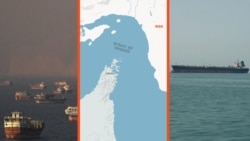

US officials said the arrangement was already having an impact. "For the first time in the 100 days of this conflict, Iran did not fire at any vessels," one official said late on June 17.
The memorandum also provides for the immediate waiving of US oil sanctions on Iran, offering substantial relief to the country's economy.
In addition, Washington has pledged to facilitate the release of a $300 billion reconstruction fund backed by regional nations once a broader final agreement on Iran's nuclear program is reached.
The agreement also envisages the eventual lifting of all US primary and secondary sanctions on Iran and the staged release of frozen Iranian assets, although officials said such measures would be contingent on Iranian compliance. "What they conceded is that they wouldn't get any money unless they performed," an official said.
Nuclear Stockpile
Central to the arrangement is Tehran's commitment to dilute its stockpile of enriched uranium during a two-month negotiating period.
According to US officials, the material could be reduced through "down-blending on site under the supervision of the IAEA", the United Nations nuclear watchdog.
Iran has also reaffirmed that it "shall not procure or develop nuclear weapons." US officials said international inspectors and US technical teams would play a key role in verification. "We're not in the trusting business," a senior official said.
The interim deal is intended to create space for negotiations on a more comprehensive framework governing Iran's nuclear activities, which Washington has long suspected could be linked to weapons development.
Attention is now turning to technical talks in Switzerland this weekend, where negotiators will attempt to convert the memorandum into a detailed implementation plan.
"The meeting this weekend in Switzerland will be quite critical," the senior US official said, adding that any failure by either side to meet expectations should become apparent "within days or weeks, not months".
While the agreement was welcomed by many as a step toward regional stability, it has drawn criticism from some US lawmakers.
Republican Senator Bill Cassidy argued that Iran's nuclear ambitions had not been adequately constrained and warned that Tehran had learned strategic leverage could be gained through threats to maritime trade routes.
Iranian officials, meanwhile, portrayed the accord as evidence that US military pressure had failed.
Hezbollah leader Naim Qassem hailed the agreement as a "great victory" for Iran and thanked Tehran for ensuring that Lebanon was included within the scope of the truce.
Fighting on the Lebanese front has eased since the announcement, although sporadic violence has continued, including Israeli strikes in southern Lebanon and reported rocket and drone attacks.
Financial markets responded positively to the prospect of a lasting settlement.
Oil prices continued to drop sharply a sharp decline on June 18, having already fallen significantly as expectations of a deal gathered pace.