



News
- By RFE/RL
U.S. Lawmakers Say Plenty Of Bipartisan Support For Ukraine In Congress
Two members of the U.S. House of Representatives say bipartisan support for Ukraine remains strong in Congress, which last week passed another massive aid package for the country -- $40 billion worth of weapons and other aid to help the country in its fight against Russia.
Representative Michael McCaul (Republican-Texas) said members were aware of the horrific circumstances caused by the war and when they visit countries such as Romania, Poland, and Moldova, which have taken in millions of people who have fled the war, they always return "in a very bipartisan manner."
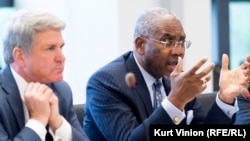
McCaul, top Republican on the House Foreign Affairs Committee, and Representative Gregory Meeks (Democrat-New York), the committee's chairman, spoke in an interview on May 25 at RFE/RL's headquarters in Prague.
The visit followed passage of the $40 billion bill to send military, economic, and food aid to Ukraine that President Joe Biden signed into law last week. It came two months after the passage of a $13.6 billion aid bill for Ukraine and passed the House overwhelmingly by a vote of 368-57.
But all no votes came from Republicans, fueling warnings about isolationist tendencies in the current election year.
McCaul denied that the vote revealed any fractures in the bipartisanship that Congress has shown for Ukraine. Some members had concerns about the size of the package, whose original price tag was $33 billion, he said. Others objected to the short amount of time they had to read it before voting.
"I think most of the no's on that bill were based on process and not substance," McCaul said. "So there's still very, very strong bipartisan support for Ukraine against the horrors of what Mr. Putin is doing."
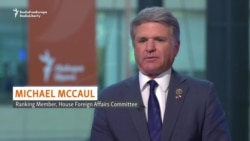
McCaul said the people of Ukraine can rely on the U.S. Congress and even after the midterm elections in November there will still be enough votes among Democrats and Republicans to reach a majority.
"I think Ukraine's earned that," he said, adding that by many accounts Ukraine is "actually winning this war against what we though was a major world power."
Meeks said the $40 billion aid bill was passed to ensure that Ukrainian President Volodymyr Zelenskiy and the people of Ukraine have the military protection they need to save their country.
He said the United States was now working "in a in a fashion that is unprecedented" to move weapons as quickly as possible and coordinating closely with allies to ship the equipment that the Ukrainians have requested. He noted that the package included between $4 billion and $5 billion for humanitarian concerns.

Both lawmakers expressed concern about Ukrainian ports being blockaded by Russian forces.
Meeks said the situation was discussed during the congressmen's visit to Moldova, which is concerned about the situation along with other countries of the world.
“We're talking about the possibility of starvation in various other parts of the world, particularly on the continent of Africa and other underdeveloped areas,” Meeks said. “We're talking about the inclusion of inflation all over the world, the cost of food and bread.”
He said that’s why it’s important to give Ukraine what it needs to help it open those ports as the United States approaches problems caused by the war not thinking solely about itself but “the entirety of an interconnected world.”

More News
Kazakhstan Confirms Two Citizens Killed In Russia In What FSB Calls Antiterror Operation
ASTANA -- Kazakhstan on March 9 confirmed that two of its citizens were shot dead in Russia in what the Kremlin said was an antiterrorism operation that prevented an attack against a synagogue in the Moscow area.
“The media published reports about the killing of two Kazakh citizens by Russian law-enforcement agencies during an attempt to organize a terrorist attack in the Russian Federation,” the Kazakh Committee of National Security (KNB) said in a statement.
“We can confirm the Kazakh citizenship and the deaths in Russia,” it added.
The independent Astra news outlet reported that two men, aged 32 and 35, entered Russia on February 28 and allegedly intended to commit a terrorist act.
Astra identified them as adherents of the Wilayat Khorasan group, a branch of the Islamic State (IS) extremist group, which is recognized by Kazakhstan as a terrorist organization.
Russian state-run news agency TASS quoted the Federal Security Service (FSB) on March 7 as saying it had shot dead two suspects of the Wilayat Khorasan terrorist group “whose members were planning to commit a terrorist act against one of the Jewish religious institutions in Moscow."
"During an operation to detain them, the terrorists put up armed resistance to Russian FSB staff and as a result were neutralized by return fire," the FSB said.
The FSB said the Wilayat Khorasan group is an offshoot of Islamic State from that is mostly active in Afghanistan.
The FSB, which did not identify the nationality of the suspects, said the shootings took place in the viillage Koryakovo in the Kaluga region, about 120 kilometers southwest of Moscow.
Russian media identified the two suspects as Kazakh nationals and said they had arrived in Russia in February.
The KNB said it was working “closely” with the FSB to investigation the matter.
The incident came as the U.S. Embassy, along with those of other nations, on March 7 advised citizens to avoid large groupings in Moscow, warning that "extremists" were planning an operation within the next 48 hours and ahead of Russia's March 15-17 presidential election.
Armenia Considering EU Membership, Foreign Minister Says
Armenian Foreign Minister Ararat Mirzoyan said his nation is considering applying for EU membership, a further sign of Yerevan's attempts to distance itself from traditional ally Russia. "Many new opportunities are largely being discussed in Armenia nowadays, and it will not be a secret if I say [there is] an idea that includes membership in the European Union," Mirzoyan told Turkey's TRT World television on the sidelines of the March 1-3 Antalya Diplomatic Forum. "The people of Armenia do have European aspirations…we are passing through a process…and no one can be sure or predict the end of this process," he said. To read the original story by RFE/RL’s Armenian Service, click here.
Western Defense Chiefs To Hold New Ukraine Meeting In Germany
The 20th meeting of the Ukraine Defense Contact Group (UDCG) is set for March 19 at the U.S. Ramstein Air Base in Germany, the U.S. Air Force said on March 9. "U.S. Secretary of Defense Lloyd Austin...again invited defense ministers and senior military officials around the world to discuss the crisis in Ukraine and the various security challenges facing U.S. allies and partners," it said. The UDCG consists of the 32 NATO member nations, now inducing Sweden. The previous meeting took place online on February 14 and discussed the strengthening air defenses, artillery systems, and drones, Ukrainian Defense Minister Rustem Umerov reported. To read the original story by RFE/RL’s Ukrainian Service, click here.
- By dpa
German, Polish, And Czech Farmers Protest Ukrainian Imports, EU Agriculture Policy
Farmers from Germany, Poland, and the Czech Republic demonstrated on March 9 at the intersection of their countries against EU agricultural policy and imports of cheap produce from Ukraine. Around 400 farmers with 150 tractors took part in the joint action in the Polish village of Bogatynia at the shared border crossing, the initiative Land Creates Connection reported. The farmers called for a revision of the common EU agricultural policy. They also demanded that imports such as Ukrainian grain should not be allowed to enter the EU uncontrolled, saying these imports would destroy the markets in all three countries.
Asif Zardari Voted Pakistan's President For Second Time
Asif Zardari, the widower of Pakistan's slain first female leader Benazir Bhutto, was voted in as president following a heated election marred by claims of rigging. Election officials said on March 9 that Zardari, who served as president from 2008 to 2013, won by a vote of 411-181 in ballots cast by the national legislature and four provincial assemblies. Zardari beat out Mahmood Achakzai, who had the support of the party of former Prime Minister Imran Khan. Zardari had the backing of the country’s ruling bloc, which includes at least five major political parties and the party of three-time Prime Minister Nawaz Sharif. Shebaz Sharif, Nawaz's younger brother, won backing as prime minister in the National Assembly earlier this week. To read the original story by Radio Mashaal, click here.
- By AP
Polish Foreign Minister Says NATO Troops In Ukraine 'Not Unthinkable'
Poland's foreign minister said the presence of NATO forces in Ukraine is "not unthinkable" and that he appreciated the French president for not ruling out that idea. Radek Sikorski made the observation on March 8, during a discussion in the Polish parliament. The Foreign Ministry later tweeted the comments in English. Last month French President Emmanuel Macron said the possibility of Western troops being sent to Ukraine could not be ruled out. French officials later sought to clarify Macron’s remarks and tamp down the backlash, while insisting on the need to send a clear signal to Russia that it cannot win its war in Ukraine. The Kremlin has warned that if NATO sends combat troops, a direct conflict between the alliance and Russia would be inevitable.
Iran Rejects Critical UN Report On Death Of Mahsa Amini, Crackdown On Protests
Iran condemned a United Nations report on the September 2022 death of a 22-year-old woman in police custody and the protests that later erupted, denouncing what it called Western countries' "Iranophobia." The March 9 Foreign Ministry statement followed a UN mission report that found the Iranian government was responsible for the physical violence that led to the death of Mahsa Amini, and for the brutal crackdown on street protests. Amini was arrested in Tehran by the so-called morality police, accused of improperly wearing a head scarf. Within hours of her detention, she was hospitalized in a coma and died days later. Spokesman Nasser Kanani asserted the UN report contained "baseless claims" and "false and biased information, without a legal basis." To read the original story by RFE/RL's Radio Farda, click here.
- By AP
Trump Meets With Hungary's Orban, Continuing His Embrace Of Autocrats
Donald Trump met with Hungarian Prime Minister Viktor Orban, as the likely Republican presidential nominee continued his embrace of autocratic leaders who are part of a global pushback against democratic traditions. The Trump campaign said late on March 8 that the two men discussed “a wide range of issues affecting Hungary and the United States, including the paramount importance of strong and secure borders to protect the sovereignty of each nation.” Orban has become an icon to some conservative populists for championing what he calls "illiberal democracy." He's cracked down on Hungary’s press and judiciary and rejiggered the political system to keep his party in power.
- By RFE/RL
U.S. State Department Approves Sale Of Light Tactical Vehicles To North Macedonia
The U.S. State Department has approved a possible sale of joint light tactical vehicles and related support logistics to NATO ally North Macedonia for an estimated cost of $111 million. The Defense Security Cooperation Agency on March 8 delivered the required certification of the proposed sale to Congress, which is expected to approve the transaction. The U.S. statement said the proposed sale will enhance North Macedonia’s “capacity to meet current and future threats by providing a tactical vehicle capability to deter adversaries and participate in NATO operations.”
- By RFE/RL
Russian Military Says Dozens Of Ukrainian Drones Launched Over Russian Territory
Russia’s military said Ukraine launched dozens of drones over western and southern Russia overnight, causing minimal damage and casualties.
The Defense Ministry on March 9 claimed that 47 drones in all were intercepted or downed over the Rostov, Kursk, Belgorod, and Volgograd regions. Local officials said an emergency worker was slightly wounded, possibly by falling debris.
Live Briefing: Russia's Invasion Of Ukraine
RFE/RL's Live Briefing gives you all of the latest developments on Russia's full-scale invasion, Kyiv's counteroffensive, Western military aid, global reaction, and the plight of civilians. For all of RFE/RL's coverage of the war in Ukraine, click here.
One drone attack was reported at a facility in Taganrog, where A-50 command surveillance planes are maintained.
Two A-50 planes have been allegedly downed by Ukrainian forces in recent months. The planes help provide airborne guidance for Russian jets and ships, firing missiles at targets in Ukraine.
Ukraine made no comment on the drone flights but did report downing a dozen Russian drones over central Ukrainian regions. No casualties were reported.
Russia also claimed on March 9 that it had shot down a Ukrainian fighter jet over the eastern Donetsk region. Ukraine also had no comment on the claim about the MiG-29 jet.
Russian forces are making slow, steady gains in several places in Ukraine. Last month, Ukrainian troops withdrew from the industrial city of Avdiyivka after months of armored and infantry assaults. Since then, Russian units have pushed gradually west.
In the town of Chasiv Yar, west of the city of Bakhmut, which was captured by Russian troops last year, a Ukrainian man was killed overnight by Russian shelling, local authorities said.
Vadym Filashkin, the regional military administrator, said at least two apartment buildings were damaged in the shelling and at least one other person was wounded.
In the Nikopol district of the Dnipropetrovsk region, a 16-year-old boy was killed as a result of Russian shelling, regional military administrator Serhiy Lysak said.
Elsewhere, Poland's foreign minister said the presence of NATO forces in Ukraine “is not unthinkable” and that he appreciated the French president for not ruling out that idea.
Radek Sikorski made the observation March 8 during a discussion in the Polish parliament. The Foreign Ministry later tweeted the comments in English.
Last month French President Emmanuel Macron said the possibility of Western troops being sent to Ukraine could not be ruled out.
French officials later sought to clarify Macron’s remarks and tamp down the backlash, while insisting on the need to send a clear signal to Russia that it cannot win its war in Ukraine.
The Kremlin has warned that if NATO sends combat troops, a direct conflict between the alliance and Russia would be inevitable.
With reporting by RFE/RL's Ukrainian Service and AP
- By Reuters
U.S. Issues Sanctions On Russian, Central African Republic Entities Over Wagner Ties
The United States has sanctioned two entities in Russia and the Central African Republic for what the Treasury Department on March 8 said were efforts to advance Moscow's "malign activities" in the African nation in part by enabling the Wagner mercenary group. The Russian and CAR entities targeted sought to benefit financially "from illicit natural resource extraction and provided material and financial support to the Wagner Group and other organizations" tied to Wagner's former owner Yevgeny Prigozhin, who died in a 2023 plane explosion in Russia, the U.S. Treasury Department said.
Ukraine Says It Will Soon Receive 4.5 Billion Euro Tranche From EU
Ukraine will receive 4.5 billion euros ($4.9 billion) from the European Union through its four-year Ukraine Facility program in the next few days, with an additional 1.5 billion euros ($1.6 billion) to come over the next two months, Prime Minister Denys Shmyhal said on March 8. The comments came during a visit to Kyiv by European Commission Executive Vice President Valdis Dombrovskis. Shmyhal said Ukraine anticipates receiving 16 billion euros ($17.5 billion) in economic aid for the budget from the EU this year. The bloc on February 28 approved a four-year, 50 billion euro ($54.7 billion) financing program for Ukraine. To read the original story by RFE/RL’s Ukrainian Service, click here.
- By RFE/RL
Iranian Government 'Bears Responsibility' For Amini's Death, Brutal Crackdown, UN Mission Says
The Iranian government "bears responsibility" for the physical violence that led to the death of Mahsa Amini, the 22-year-old Iranian-Kurdish woman who died in police custody in 2022, and for the brutal crackdown on largely peaceful street protests that followed, a report by a United Nations fact-finding mission says.
The report, issued on March 8 by the Independent International Fact-Finding Mission on the Islamic Republic of Iran, said the mission “has established the existence of evidence of trauma to Ms. Amini’s body, inflicted while in the custody of the morality police."
It said the mission found the "physical violence in custody led to Ms. Amini’s unlawful death.... On that basis, the state bears responsibility for her unlawful death.”
Amini was arrested in Tehran on September 13, 2022, while visiting the Iranian capital with her family. She was detained by Iran's so-called "morality police" for allegedly improperly wearing her hijab, or hair-covering head scarf. Within hours of her detention, she was hospitalized in a coma and died on September 16.
Her family has denied that Amini suffered from a preexisting health condition that may have contributed to her death, as claimed by the Iranian authorities, and her father has cited eyewitnesses as saying she was beaten while en route to a detention facility.
The fact-finding report said the action “emphasizes the arbitrary character of Ms. Amini’s arrest and detention, which were based on laws and policies governing the mandatory hijab, which fundamentally discriminate against women and girls and are not permissible under international human rights law."
"Those laws and policies violate the rights to freedom of expression, freedom of religion or belief, and the autonomy of women and girls. Ms. Amini’s arrest and detention, preceding her death in custody, constituted a violation of her right to liberty of person,” it said.
The New York-based Center for Human Rights in Iran hailed the findings and said they represented clear signs of "crimes against humanity."
“The Islamic republic’s violent repression of peaceful dissent and severe discrimination against women and girls in Iran has been confirmed as constituting nothing short of crimes against humanity,” said Hadi Ghaemi, executive director of the center.
“The government’s brutal crackdown on the Women, Life, Freedom protests has seen a litany of atrocities that include extrajudicial killings, torture, and rape. These violations disproportionately affect the most vulnerable in society, women, children, and minority groups,” he added.
The report also said the Iranian government failed to “comply with its duty” to investigate the woman’s death promptly.
“Most notably, judicial harassment and intimidation were aimed at her family in order to silence them and preempt them from seeking legal redress. Some family members faced arbitrary arrest, while the family’s lawyer, Saleh Nikbaht, and three journalists, Niloofar Hamedi, Elahe Mohammadi, and Nazila Maroufian, who reported on Ms. Amini’s death were arrested, prosecuted, and sentenced to imprisonment,” it added.
Amini's death sparked mass protests, beginning in her home town of Saghez, then spreading around the country, and ultimately posed one of the biggest threats to Iran's clerical establishment since the foundation of the Islamic republic in 1979. At least 500 people were reported killed in the government’s crackdown on demonstrators.
The UN report said "violations and crimes" under international law committed in the context of the Women, Life, Freedom protests include "extrajudicial and unlawful killings and murder, unnecessary and disproportionate use of force, arbitrary deprivation of liberty, torture, rape, enforced disappearances, and gender persecution.
“The violent repression of peaceful protests and pervasive institutional discrimination against women and girls has led to serious human rights violations by the government of Iran, many amounting to crimes against humanity," the report said.
The UN mission acknowledged that some state security forces were killed and injured during the demonstrations, but said it found that the majority of protests were peaceful.
The mission stems from the UN Human Rights Council's mandate to the Independent International Fact-Finding Mission on the Islamic Republic of Iran on November 24, 2022, to investigate alleged human rights violations in Iran related to the protests that followed Amini's death.
Serbia To Allow Russian Citizen To Remain Despite Earlier 'Unacceptable Risk' Ruling
BELGRADE -- Serbia's Interior Ministry has accepted an appeal by Russian citizen Yelena Koposova, saying she does not have to leave the country after she was earlier declared to be an "unacceptable security risk” and told to leave.
Koposova told RFE/RL on March 8 that an initial decision requiring her to leave Serbia has been revoked after authorities decided the original assessment was incorrect because the details of her professional and family life in Serbia were not included.
"I can breathe and live again. We didn't know this month what would happen the next day and whether we have a home and the right to live somewhere forever," she told RFE/RL's Balkan Service.
The ordeal started on February 2 when Koposova received a police notice rejecting her request for permanent residency and ordering her to leave Serbia within 30 days.
Koposova previously told RFE/RL that she didn’t know the reason for the decision, but she said she assumed it was related to one of the founders of the Russian Democratic Society, Peter Nikitin, who initiated a public anti-war letter that she signed along with 25 other Russian citizens.
She said she generally is not politically active but that she "couldn't help but sign" her name to the text calling for an end to Russian aggression.
Koposova said she has applied for a new temporary residence permit, which she was told would be granted on an urgent basis and that a decision will be made shortly for her husband and children regarding their request for permanent residency.
After living in Serbia for four years, she applied for permanent residency in September 2023. Until then, she and her husband and two young children had temporary residence permits.
The Russian Democratic Society -- a group of Russian expatriates who are critical of President Vladimir Putin and oppose his invasion of Ukraine -- stated that the annulment of Koposova's expulsion decision was a great victory for all who supported her.
According to Serbia’s Law on Foreigners, "an unacceptable security risk exists if a foreigner advocates, incites, aids, prepares, or undertakes activities that jeopardize the constitutional order and security of the Republic of Serbia, regional and global security of significance for the Republic of Serbia, and the legal order."
The police and BIA security agency have not responded to RFE/RL inquiries on the matter since the summer of 2023.
Serbia is a historic ally of Russia, and Serbian President Aleksandar Vucic has not joined the EU's sanctions regime against Moscow for its invasion of Ukraine.
St. Petersburg Police Detain Friend Of Woman Missing Since Being Forced Back To Chechnya
Police in Russia's second-largest city, St. Petersburg, on March 8 detained a friend of Seda Suleimanova, whose whereabouts have been unknown she was detained in August and sent her to her native Chechnya, where rights defenders believe she may have become the victim of an honor killing.
Lena Patyayeva was detained after she walked across the city telling people she passed about Suleimanova's ordeal while she distributed leaflets outlining her friend's situation.
She also staged a single-person picket in front the building of the St. Petersburg Prosecutor's Office with a picture of Suleimanova and the words "Where is Seda?" painted on her coat.
It is not the first time Patyayeva has been detained over her public efforts to find Suleimanova. On February 1, after she staged a similar picket at the same site, she was detained and charged with violating regulations for public gatherings.
Suleimanova's story attracted the attention of international human rights organizations after police in St. Petersburg detained her along with her partner, Stanislav Kudryavtsev, at their apartment and took them to a police station. There she was informed that she was suspected of stealing jewelry in Chechnya, a charge she rejected.
Suleimanova was then transferred to Chechnya, and attempts by Kudryavtsev, who converted to Islam to be able to visit Chechnya and marry Suleimanova, to locate her failed.
In September, Chechen authorities issued a video showing Suleimanova in Chechnya. She did not speak in the video. No information about her whereabouts was made public.
Suleimanova had turned to the SK SOS human rights group in October 2022 for help in leaving Chechnya, saying that her relatives may kill her for being "insufficiently religious."
Human right defenders say relatives in the North Caucasus often file complaints accusing fugitive women of crimes, usually theft, to legalize their detention and return. Once back, the women face violent abuse.
Domestic violence has been a problem in Russia's North Caucasus region for decades. Victims who manage to flee often say that they may face punishment, including honor killings, if they are forced to return.
Usually, local authorities take the side of those accused of being the abusers.
With reporting by SOTA
Afghan Women, Lives Upended, Demand Taliban End Bans And Restrictions
Afghan women on International Women's Day demanded the country's hard-line Islamist Taliban rulers end bans and restrictions that have turned their lives upside down since the militants seized power in August 2021 as international troops withdrew.
Despite a Taliban-mandated ban on protests, Afghan women held small demonstrations on March 8 to demand their rights and for authorities to release imprisoned Afghan women activists.
They also called on the government to reopen schools and universities to females after cutting off their education after grade seven.
"The international community should defend the rights of Afghan women and help them gain the right to work, education, and equality," an exiled women's rights activist who requested anonymity told RFE/RL's Radio Azadi.
The Taliban seized power promising more moderate policies than when it ruled the country some two decades earlier. But its leaders have since doubled down on the recreation of a totalitarian clerical regime, especially with regard to women, who have effectively been denied any public role in society.
Afghan women have been banned from working in many sectors of the economy. Women-owned businesses face myriad restrictions. Women are also banned from recreation and leisure activities such as visiting public parks and public baths.
Women also are dealing with severe restrictions on mobility and how they can appear in public. In most instances, they are required to be accompanied by a male chaperone. A Taliban decree requires women to wear the niqab, the head-to-toe veil in which only their eyes are visible.
"The Taliban's restrictions have upended our lives," a university student in Kabul who requested anonymity told Radio Azadi. "My hopes of serving my community and our country have been dashed."
In the capital, Kabul, right campaigner Kavia Siddiqi said the Taliban-led government has systematically deprived Afghan women of rights and freedoms.
"Afghan women live in a prison because they are deprived of all their rights," she said.
The Taliban has treated the anger surrounding its decisions with the same type of oppression. Its government has detained and tortured hundreds of women activists, some of whom remain in custody.
"The fight for women's rights in Afghanistan is a global fight and a battle for women's rights everywhere," said Alison Davidian, special representative for UN Women in Afghanistan.
Richard Bennett, the UN special rapporteur on human rights in Afghanistan, told Radio Azadi that Taliban discrimination against Afghan women could amount to "gender apartheid" if codified in international law.
He said that under the concept of "gender persecution," the treatment of women in Afghanistan could be prosecuted as crimes against humanity under the 1998 Rome Statue of the International Criminal Court.
"It is already possible to criminally prosecute for the crime of gender persecution," he said.
Tsikhanouskaya Calls On UN Chief To Intervene On Behalf Of Political Prisoners In Belarus
Exiled Belarusian opposition leader Svyatlana Tsikhanouskaya called on UN chief Antonio Guterres to intervene on behalf of political prisoners in her home country – including in the case of her imprisoned husband, Syarhey Tsikhanouski. Speaking in Vilnius, where she is living, Tsikhanouskaya said that while “people in prisons are our heroes, they're also fighting their own battle.” Over the past four years, she said, “we’ve tried many measures to release political prisoners.... We appealed to the Red Cross, the pope, and to politicians and diplomats. But we still don't know what the [Belarusian] regime wants.” Tsikhanouskaya said she's had no information about her husband for one year. To read the original story by RFE/RL’s Belarus Service, click here.
Activists, Domestic Violence Victims March In Bishkek Demanding Women's Rights Be Defended
BISHKEK -- Feminist activists and domestic violence survivors marched in the Kyrgyz capital, Bishkek, on March 8 to mark International Women's Day and to demand that women's rights be defended and respected.
The demonstrators gathered near the monument of Urkia Salieva, a figure of female emancipation in the Central Asian nation, and marched to Gorky Park with posters bearing slogans such as "Real Men Are Not Scared Of Equality," "An Educated Girl Finds Her Place," "Defend Our Mothers And Sisters," and "I Want To Live In A Safe Country."
Asel Nogoibaeva, whose ex-husband, Azamat Estebesov, raped and severely beat her -- cutting off her nose and ears -- told the marchers they can't stop fighting for their rights.
“You all know the horror I went through.... But I am not alone. My case is just one of hundreds of thousands of situations women face daily in Kyrgyzstan. There will be no results unless all types of violence are criminalized. The torture will go on," Nogoibaeva, whose husband was handed a 20-year prison term in January, said.
"It will never do to forgive those who beat and torture their spouses. Never believe their promises that they will change. They will attack again. I see police here. Dear police officers, in many cases, you are the only hope for domestic violence victims. Do not hesitate to intervene and stop attackers. Judges, look into the domestic violence cases the same way you look into other heavy crimes!" she continued.
Police officers present at the gathering and march did not interfere.
An activist from neighboring Kazakhstan, who introduced herself as Aida, said she came to Bishkek from Kazakhstan's largest city, Almaty, because this year the city administration did not allow activists to hold a rally for women's rights there.
"In 2023, in Kazakhstan, some 100,000 domestic violence cases were officially registered. We have been demanding the Kazakh government toughen punishment for such crimes. Rallies like this one are important for all countries," Aida stated.
Kyrgyzstan's Interior Ministry said earlier that 13,104 cases of domestic violence had been registered in the country last year, which was 32 percent higher than in 2022.
The country has witnessed several high-profile cases of deadly bride-snatching and domestic violence in recent years.
Prison Term Of Tajik Businessman Extended After Additional Charge Of Smuggling
Tajik media reports quoted the Supreme Court's press service on March 7 as saying that the prison term handed to businessman Abdukhalil Kholiqzoda last month over his autobiography has been extended from 6 1/2 years to nine years.
Kholiqzoda was initially sentenced on February 22 after the court found him guilty of inciting hatred. The additional sentence was handed to him on February 28 on a charge of smuggling. It remains unclear what the latter charge stems from.
The court also ordered Kholiqzoda to pay 76,800 somonis ($7,000).
Kholiqzoda was tried along with two other public figures -- Abduqodir Rustam and Suhrob Rajabzoda -- over writing, editing, and publishing the book Stories Of My Life that highlighted some of the challenges faced by those living in the tightly controlled former Soviet republic, which authorities ordered cleared from bookstores.
Rustam was sentenced to 4 1/2 years and Suhrob Rajabzoda received one year in prison after the court convicted them of inciting hatred.
There was no official announcement of the verdicts and sentences as the trial was held behind closed doors within a detention center in Dushanbe.
The men were arrested in August last year and went on trial on January 19.
The charges against the trio stemmed from their roles in publishing the book that, among other things, focused on everyday developments in modern Tajikistan, including corruption, migration, and cultural challenges in the Central Asian nation.
Kholiqzoda wrote the book, while Rustam edited the text and Rajabzoda's Er-Graf publishing house published it.
Self-exiled Tajik intellectuals and opposition figures condemned the arrests and the sentencing of the three men, calling the case against them a crackdown on freedom of expression.
Meanwhile, amid a lack of transparency in the country, speculation has risen that the case might be connected to a power struggle among Tajik power holders.
President Emomali Rahmon, who has run Tajikistan for almost 30 years, has been criticized by international human rights groups over his administration's policies toward independent media, religious freedoms, civil society, and political pluralism.
In recent years, several Tajik journalists, rights activists, and opposition politicians have been handed lengthy prison terms on charges seen by rights groups as trumped up and politically motivated.
With reporting by Asia-Plus
Kazakh Activists Accused Of Plotting To Overthrow Government Jailed
An Almaty court on March 7 sentenced six Kazakh activists to prison terms of between five and six years, while one activist received a suspended sentence of three years and four months, on a charge of plotting to overthrow the government. The activists were detained in November 2022 on the eve of a snap presidential election after the self-exiled leader of the Democratic Choice of Kazakhstan movement (DVK), Mukhtar Ablyazov called on Kazakh citizens to stage anti-government protests across the country. Dozens of activists have been prosecuted for their links to DVK in recent years. Kazakhstan labeled the DVK extremist and banned it in 2018. To read the original story by RFE/RL's Kazakh Service, click here.
In Pakistan, Women March For More Rights
In Pakistan, hundreds of women rallied across the country on March 8 to mark International Women's Day. Known as the Aurat March (Women's March in Urdu), the annual protest is held in the capital, Islamabad, and cities such as Karachi, Lahore, Multan, Peshawar, and Quetta.
During the march, women usually highlight issues such as street harassment, bonded labor, and the lack of proper representation in parliament.
In last month's elections, only 12 women were directly voted into parliament out of 266 seats.
Organizers said that this year's march was dedicated to Baluch female human rights activist Mahrang Baloch, who has been protesting unlawful enforced disappearances and extrajudicial killing by the authorities in Balochistan Province.
To read the original story by RFE/RL's Radio Mashaal, click here.
Ukrainian Journalists' Union Calls For Release Of RFE/RL's Yesypenko On Third Anniversary Of Incarceration
The National Union of Journalists of Ukraine (NSZhU) issued a statement on March 8 marking the third anniversary of the incarceration by Russian occupiers of RFE/RL journalist Vladyslav Yesypenko in Ukraine's Crimea region.
Yesypenko, a dual Russian-Ukrainian citizen who contributed to Crimea.Realities, a regional news outlet of RFE/RL's Ukrainian Service, was arrested on March 10, 2021 and sentenced to six years in prison in February 2022 by a Russian-appointed court in Crimea on espionage charges that he, his employer, and rights organizations reject as politically motivated.
The NSZhU expressed solidarity with "Yesypenko and other journalists illegally detained by the occupiers [Russia]," and demanded "their immediate release."
The group also quoted Yesypenko's wife, Kateryna, as saying that her husband "was detained for his journalistic activities."
"From the very moment of his arrest, numerous violations of law by the officers of [Russia's Federal Security Service] have taken place," Kateryna Yesypenko said.
During his trial in 2022, Yesypenko rejected the charges and said the Russian authorities "want to discredit the work of freelance journalists who really want to show the things that really happen in Crimea."
In November 2022, Yesypenko became a laureate of Ukraine's Ihor Lubenko National Prize for Defense of Freedom Of Expression.
In May 2022, Yesypenko was awarded the United States' PEN/Barbey Freedom to Write Award, which is given to political prisoners.
Before his arrest, Yesypenko had worked in Crimea for five years reporting on the social and environmental situation in the region.
Press-freedom advocates, including the Committee to Protect Journalists and Reporters Without Borders, along with Ukrainian Foreign Minister Dmytro Kuleba and the U.S. State Department, are among those who have called for Yesypenko's immediate release in the absence of any evidence of wrongdoing.
Moscow illegally annexed Crimea in early 2014 and weeks later threw its support behind separatists in Ukraine's east.
On February 24, 2022, Moscow launched an unprovoked invasion of Ukraine.
Yesypenko is one of four RFE/RL journalists -- Alsu Kurmasheva, Andrey Kuznechyk, and Ihar Losik are the other three -- currently imprisoned on charges related to their work. Rights groups and RFE/RL have called repeatedly for the release of all four, saying they have been wrongly detained.
Losik is a blogger and contributor for RFE/RL’s Belarus Service who was convicted in December 2021 on several charges including the “organization and preparation of actions that grossly violate public order” and sentenced to 15 years in prison.
Kuznechyk, a web editor for RFE/RL’s Belarus Service, was sentenced in June 2022 to six years in prison following a trial that lasted no more than a few hours. He was convicted of “creating or participating in an extremist organization.”
Kurmasheva, a Prague, Czech Republic-based journalist with RFE/RL who holds dual U.S. and Russian citizenship, has been held in Russian custody since October 18 on a charge of violating the so-called "foreign agent" law.
- By RFE/RL
Hungary's Orban, 'Banking' On Trump's Return To Power, Heads To Mar-A-Lago
Prime Minister Viktor Orban will meet with Donald Trump at the former U.S. president's luxury Florida resort on March 8 after the Hungarian leader endorsed the bid of his "good friend" in the November presidential election.
Orban, arguably Trump's biggest booster in Europe, has openly spoken of wanting the presumptive Republican presidential nominee back in the White House, saying it's "the only sane approach for Hungary," a position that comes in stark contrast to many of Europe's leaders, who fear a Trump return will damage relations and diminish security across the continent.
"For Hungary, the preference for Trump is not about personal likings or political affiliations but about which U.S. leader's foreign policy would bolster Hungarian security," government spokesman Zoltan Kovacs said in a post on X, formerly Twitter, on March 4.
Orban stops at Trump's Mar-a-Lago resort after attending a panel at the conservative Heritage Foundation in Washington a day earlier, where he spoke about Hungary's conservative family and economic policies, the war in Ukraine, relations between the United States and Hungary, Trump, and his personal political beliefs.
The Hungarian prime minister's schedule has not been published, and it is not known if he will meet with any other U.S. officials during his visit to the country.
Washington has been critical of Orban because of his government's erosion of democratic principles and its continued close ties to Russia since the Kremlin launched the full-scale invasion of Ukraine in February 2022.
Orban, who has been shunned by many Western leaders, has refused to send weapons to Ukraine while pushing for an immediate cease-fire and peace talks. He says Trump and his good relations with Russian President Vladimir Putin make him the better candidate to quickly end the war.
"The only chance of the world for a relatively fast peace deal is political change in the United States, and this is linked to who is the president," Orban said earlier this week.
"It is not gambling at all, but the only sane approach for Hungary is to bank on the return of President Donald Trump," he added.
Orban, who has been in power since 2010, has called Biden's White House an adversary, according to the pro-government Magyar Nemzet daily newspaper.
Trump has reciprocated with his admiration of Orban, whom he has called a "strong leader," even though in October he referred to Orban as "the leader of Turkey."
With reporting by AFP and Reuters
Activists Demand International Boycott Of Iran To 'Delegitimize The Regime'
Dozens of Iranian activists at home and abroad have called on the international community to boycott the Islamic republic for committing "gender apartheid."
In a statement marking International Women's Day on March 8, more than 40 activists and groups hailed the growing defiance against the mandatory head covering in Iran as an "achievement" of the Women, Life, Freedom movement, which was born out of the deadly 2022 unrest that rocked the country.
More than 500 protesters were killed in the protests that broke out following the death of Mahsa Amini, a 22-year-old Iranian-Kurdish woman who died in police custody after being detained for allegedly flouting the country's hijab law. Iran's brutal crackdown on the protests has been widely condemned by rights groups.
"This woman-killing regime has no legitimacy in Iran, and we ask the international community to also delegitimize the regime," the statement from the activists says.
In a separate statement, jailed Nobel laureate Narges Mohammadi urged international rights groups to help the women of Iran and Afghanistan by pushing for “the criminalization of gender apartheid” committed by the Islamic republic and the Taliban-led government in Kabul through “systemic and targeted” discrimination against women.
Mohammadi, who won the 2023 Nobel Peace Prize, has been convicted five times since 2021 on various security-related charges and has been sentenced to more than 12 years in prison.
On March 4, London-based activist Fariba Baluch, who has been advocating for the rights of women and the Baluch ethnic minority in Iran, was awarded the U.S. State Department’s International Women of Courage Award.
"This award is not mine, but for all the nameless, courageous girls and women in Iran who are fighting for their basic demands," she told RFE/RL’s Radio Farda.
The United Nations' Independent International Fact-Finding Mission asserted in a report on March 8 that Iran's repression of the 2022 protests and "pervasive institutional discrimination against women" had led to serious human rights violations, "many amounting to crimes against humanity."
The fact-finding mission concluded that unless the Iranian establishment implements fundamental changes, member states of the UN Human Rights Council "should explore avenues for accountability at international level and in their domestic systems."
The Islamic republic has long been dismissive of concerns by Western states and rights groups about women's rights in Iran.
"The issue of women is a point of strength in Islam," Supreme Leader Ayatollah Ali Khamenei said in an address to a group of women in December 2023. "It should not be thought that we are supposed to be held accountable on the issue of women."
Balkars In Russia's North Caucasus Mark 80th Anniversary Of Deportation To Central Asia
Balkars in Russia's North Caucasus region of Kabardino-Balkaria are marking the 80th anniversary of their mass deportation to Central Asia by Josef Stalin's government. The head of Kabardino-Balkaria, Kazbek Kokov, issued a statement expressing compassion for the relatives of the victims "of arbitrariness and lawlessness." About 38,000 Balkars were deported on March 8, 1944, to Kazakhstan and Kyrgyzstan by the Soviet regime, which accused them of collaborating with Nazi Germany. Those who survived were able to return to the North Caucasus in 1957. To read the original story by RFE/RL's Idel.Realities, click here.
RFE/RL has been declared an "undesirable organization" by the Russian government.
If you are in Russia and hold a Russian passport or are a stateless person residing permanently in Russia, please note that you could face fines or imprisonment for sharing, liking, commenting on, or saving our content, or for contacting us.
To find out more, click here.
Editors' Picks
Top Trending
Explosions Heard In City Of Kerch In Occupied Crimea; Bridge Connecting Peninsula To Russia Closed, Says Report
2Armenia Officially Asks Moscow To Remove Russian Border Troops From Yerevan Airport
3Moscow Warns U.S. Embassy, Designates 3 NGOs As 'Undesirable'
4Russian Patrol Vessel 'Sunk' Off The Coast Of Occupied Crimea, Ukraine Military Claims
5Small, Nimble, Ukrainian Unit Harasses Advancing Russian Forces Near Bakhmut
6'I Realize I May Never Come Back': Moldovan Mercenaries Join Russian Units In Ukraine
7Wider Europe Briefing: What Sweden Joining NATO Means For The Alliance
8Live Briefing: Russia Invades Ukraine
9Jingalov Hats: The Flatbread Creating A Lifeline For Armenia's Karabakh Refugees
10Taliban Returns Its 'Eye For An Eye' Justice To Afghanistan
Subscribe