




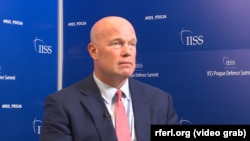
US Ambassador to NATO Matthew Whitaker has warned that global demand for missiles for Patriot air defense systems is “outpacing supply” and that Washington and its allies would have to “dig deep” to support Ukraine.
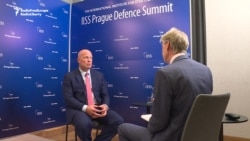
Speaking in an interview with RFE/RL on September 18, Whitaker said an increasingly dangerous international environment was leading to a shortage of Patriot interceptor missiles and that manufacturing capacity was not keeping up.
“The Ukrainians obviously are working very hard, in addition to everything we're doing on the Patriot front, to create some sovereign capabilities, some native interceptors,” Whitaker said. “There's some opportunity there.”
But currently, he added, “the demand is outpacing supply, and we're going to have to really dig deep, both as the United States, but more importantly, as allies, and find a way that Ukraine can defend itself into the winter.”

Whitaker’s comments follow remarks recently by Ukrainian President Volodymyr Zelenskyy saying that Ukraine needed some 300 PAC-3 Patriot interceptors to get though the winter. The country has been reeling from intense Russian aerial bombardment in recent months and weeks, and Zelenskyy has repeatedly pleaded for more air defense from Western allies.
The US conflict with Iran has depleted its Patriot stocks, which have been used to protect US forces and their Gulf allies from Iranian ballistic missile strikes. They are the only weapon effective against Russian ballistic and hypersonic missiles.
Asked how many PAC-3 Patriot interceptor missiles Ukraine could expect to receive this year, Whitaker said he was “probably the wrong person to ask” but that he was “working with all of our allies to find available Patriot missiles that can be contributed or sold to the Ukrainians.”
No Quick Fix
US President Donald Trump has said that Ukraine could produce Patriots under license, but Whitaker noted that this would not be a quick fix.
“We are working through all of the complicated details on export licenses, on the companies that control the IP (intellectual property rights), and on what that would actually look like to do it. I mean, it's still not going to solve this winter's problem. It will solve the long-term problem,” he said.

Whitaker was speaking at the Prague Defense Summit, a three-day gathering of senior politicians, military officials, and defense industry executives organized by the International Institute for Strategic Studies (IISS) in the Czech capital.
Other delegates at the conference also reflected on the global shortage of Patriots.
Swedish Defense Minister Pal Jonson told RFE/RL that his country did not have any missiles to spare but was negotiating with “other countries outside the Euro-Atlantic area who could provide also, for example, PAC-3s as well.”
He declined to name the nations, but countries such as Japan, South Korea, and Taiwan are known to have stocks. Jonson also noted “ongoing dialogues” between Sweden’s Saab and US manufacturer Lockheed Martin on joint production of PAC-3s.
Poland recently announced a new aid package that would include Patriots for Ukraine. But the details remain murky.
“Timescale? Very soon. The numbers are classified. There will be not so huge a number, but as much as we can, we will provide,” said Lieutenant General Krzysztof Krol, a top adviser to the chief of Poland’s general staff.
“And we know that taking into account Poland, that is a frontline nation, other nations will follow us as well,” he added.
When Krol spoke to RFE/RL on September 17, air raid sirens were sounding in eastern Poland and military aircraft scrambled after Russian drone strikes in western Ukraine drew close to the Polish border.
In Warsaw, Polish Prime Minister Donald Tusk said that Russia was planning drone and rocket attacks on European countries that support Ukraine. It was one of increasingly urgent warnings about Russian aggression amid intensifying reports of hybrid warfare such as cyberattacks and sabotage in Europe.
“Poland is, of course, in charge for more than 90 percent of all supplies for Ukraine, [for the] military waging war. So, everything that we do in Poland is also under threat of Russian special services,” said Krol, who advocated a tougher NATO response.
“Russia will test our readiness, our preparedness, our capabilities,” he said. “If Russia breaks international law, I don’t see a problem if NATO will react more aggressively. It shouldn't be a big deal.”
Hybrid Threat
Whitaker also addressed the hybrid threat.
“The first shot of a future conflict is not going to be soldiers crossing an international border. It is going to be a hybrid attack, it's going to be an attack on critical infrastructure,” he said.

So far, he added, NATO's response was sufficiently robust because Russian actions were below the threshold for activating Article 5 of the alliance's treaty, under which an attack on one is considered an attack on all.
"I would imagine if we are anywhere near Article 5 that it is a catastrophic hybrid activity, that it would be essentially an act of war. And we're just, we're not there right now," he said.
Whitaker would not be drawn on whether he had also seen intelligence of the kind of Russian attack plans mentioned by Tusk the previous day.
“I can't talk about US or allied intelligence, but we need to be more vigilant, and we need to be more prepared,” he said, praising Poland for investing in its armed forces. "They are clear-eyed and serious about the challenges and the threats that they face on the eastern flank.”

