




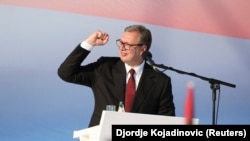
BELGRADE -- Aleksandar Vucic says he will resign as Serbia’s president even though he has almost a year left in his mandate. But few expect this means the man who has dominated Serbian politics for the past 14 years will step aside.
Last week Vucic told a gathering of thousands of his supporters at a rally in central Belgrade that he would remain Serbia's president for "only a few more weeks."
The 56-year-old politician served as deputy prime minister from 2012 to 2014, prime minister from 2014 to 2017, and since then as president. But he has already been elected president twice and is constitutionally barred from seeking a third presidential term.



Analysts say that by stepping down now, Vucic, who has said early general elections will be held in the Balkan nation in the next three to four months --they aren’t scheduled until December 2027 -- would open the door to returning as the head of government if his dominant Serbian Progressive Party (SNS) party wins the vote.
"His possible move to the position of prime minister would simply place him, constitutionally, where he already is -- the country's key political figure who makes all the important decisions," Dusan Spasojevic, a professor at the Faculty of Political Sciences at the University of Belgrade, told RFE/RL’s Balkan Service.
RFE/RL sought comment from both the Office of the President and the SNS party concerning Vucic’s announcement, but neither responded.
Street Protests
The political maneuvering comes at a time of turmoil for Vucic, who has faced more than a year of street protests, first sparked by the collapse of a train station roof in November 2024 that left 16 people dead.
Accusations that corruption played a role in the deadly event fanned the unrest from students holding demonstrations into a broader general public protest against Vucic and his stranglehold on the country, which has led to criticism of democratic backsliding in Serbia.
Vucic and his pro-government media accused the students and their professors of working with unidentified Western security services against the state to remove him from power together. He has never provided any evidence to back up his claims.
"Anyone who thinks he is thereby bowing to pressure from the streets and stepping down simply does not know Aleksandar Vucic very well," says Markus Kaiser, project director for the Western Balkans at the Friedrich Naumann Foundation for Freedom.
This is not the first time Vucic has announced that he might step down.
He has previously floated the idea of leaving office during both minor and major political crises.
But Kaiser, who calls Vucic’s resignation a "charade," notes that it may not be so easy for Vucic to maintain power as he faces a true threat for the first time.
"Whilst in the past, he has used elections to re-legitimize himself and the SNS, this time, the party is not certain that it can actually win the largely unfree parliamentary elections, despite its influence," he added.
If Vucic were to resign, a presidential election must be called within 30 days. Coupling it with a general election could give him and the SNS party a surprise edge over his opponents.
Indeed, at the political rally on June 27 where he announced his intention to step down as president, Vucic sounded like a politician already on the campaign trail with promises of better living standards, increases in salaries and pensions, and comments on Serbia’s foreign policy direction.


October Election?
Vucic could become prime minister even without calling early elections. Under Serbia’s parliamentary system, the head of the government is chosen by parliament upon the proposal of a candidate by the president.
SNS currently holds 136 seats in the 250-member legislature.
If Vucic resigns, the parliamentary speaker -- currently former Prime Minister Ana Brnavic -- would automatically become acting president, a position she could hold for a maximum of three months. A presidential election must be held within three months of a president’s resignation.
“Hypothetically, if, say, Vucic were to resign by the end of July, we would have a presidential election sometime in October," Spasojevic points out.
“[Vucic] can no longer run for president and must run for some other position, so possibly holding the presidential and parliamentary elections together would allow him to fully participate in the campaign," Spasojevic added.