



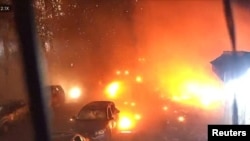
Ukrainian President Volodymyr Zelenskyy accused Russia of striking an energy plant after US leader Donald Trump's surprise announcement of an “energy cease-fire,” while Moscow remained silent on any suggestion of a truce.
“There was a statement from the president of the United States that an energy cease-fire has been secured. This is good news for everyone -- and it is important that it become reality,” Zelenskyy wrote on social media late on October 11.
However, he added, Russia launched an Iran-style shahed drone “at a power plant in Kyiv, and there were power outages in many areas. Later, there were strikes on energy facilities in the Kharkiv region. And this was AFTER the statement by the president of the United States about an energy cease-fire.”

It could not immediately be independently verified if the Russian energy strikes came after Trump’s announcement, but Moscow has yet to comment on the US president’s declaration.
"Effective immediately, there is an ENERGY CEASEFIRE in the War between Russia and Ukraine," he wrote on October 11 on Truth Social. "Both parties have agreed. Do not break it!"
Writing on Facebook, Zelenskyy said after speaking by phone with the leaders of Canada, Finland, and NATO that “Ukraine supports the cease-fire, and it is important that Russia support it as well."
Zelenskyy earlier said he was waiting for details from Washington, saying the announcement had taken him by surprise. Two senior Ukrainian officials told RFE/RL that Trump's announcement was the first that Kyiv had heard of a possible new cease-fire.
“The question we have is if [Russian President Vladimir] Putin knows about this,” one official said.
Trump has in the past declared that the sides had agreed to cease attacks on energy sites -- most recently on September 14 -- only to see Putin continue the attacks, ending any hopes of a lasting truce.
Zelenskyy has earlier signaled a willingness to halt strikes on Russian oil refineries, provided Moscow stopped attacking Ukraine's energy infrastructure.
Easing Of Sanctions
The announcement of an energy truce came two days after Trump ordered a temporary easing of US sanctions on Russian diesel -- prompting anger from Kyiv, its European allies, and many US lawmakers who said the move would emboldened Putin to continue his war on Ukraine.
Trump also issued his harshest criticism of Zelenskyy since the two had improved ties following a highly contentious meeting at the White House in February 2025, saying Ukraine should replace him as president while offering words of praise for Putin.
However, European leaders reaffirmed their support for the Ukrainian president and his country's defensive efforts.
"This is not the time to ease pressure on Russia, and Europe won't," EU foreign policy chief Kaja Kallas wrote on X on October 10, condemning the diesel agreement and warning it would increase Moscow's war revenues.
She added that EU foreign ministers planned to approve new sanctions listings on October 12. Meanwhile, some of the bloc's biggest member states, including Germany, confirmed they would maintain their strict sanctions regime despite Washington's shift.
Canadian Prime Minister Mark Carney denounced the US-Russian deal, saying it undermined efforts for stability in Europe and ending the war in Ukraine.
"The prime minister was clear: This agreement is in direct opposition to the efforts of Ukraine, Canada, and our allies to create peace and stability in Europe," a statement attributed to Carney stated.
"It will provide additional revenue for Russia and help finance its illegal, unjustifiable war against Ukraine.”
Lawmakers Push Back
In Washington, Republican Representative Brian Fitzpatrick said he plans to force a House vote on legislation blocking Russian oil purchases in a rare party challenge to Trump, also a Republican.
Seven Republican and Democratic senators on October 11 called on Trump in a joint statement to "reverse course" on the diesel supply deal, saying it runs counter to US law barring imports of energy until Russia ends its aggression against Ukraine.
"Congress explicitly banned Russian energy imports in 2022 to prevent American dollars from financing Putin’s brutal war against Ukraine," the seven senators -- four Republicans and three Democrats -- said.
It was issued by Republicans Susan Collins of Maine, Lisa Murkowski of Alaska, Thom Tillis of North Carolina and John Curtis of Utah, along with Democrats Jeanne Shaheen of New Hampshire, Richard Blumenthal of Connecticut, and Ron Wyden of Oregon.
While Trump’s plan to ease restrictions on Russian energy exports received widespread condemnation from Ukraine’s backers, his call for an energy cease-fire was supported by Western allies.
UK Prime Minister Andy Burnham, who vocally slammed the move to ease sanctions on Russia, said he backed Trump‘s call for an energy cease-fire.
"Russia has intensified its strikes on Ukrainian energy infrastructure over the weekend," Burnham wrote on X. "This is an attack on Ukrainian civilians, plunging them into cold and darkness.
"The UK strongly supports President Trump's call today for a sustained energy cease-fire to start now," he added.
Burnham said he had held phone talks with Zelensky on October 10 and was told "Ukraine is ready if Russia stops its attacks.”
"This is the best route to get energy and fuel back into world markets."
Canada’s Carney, in a phone discussion with Trump, also said he supported the US president’s call for an energy cease-fire.
Carney said it was "imperative that all attacks on energy infrastructure and civilians cease immediately."