




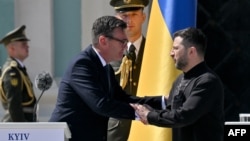
KYIV -- Ukrainian President Volodymyr Zelenskyy issued an appeal for greater international pressure on Russia to force it into talks to end the war against its neighbor, using an address on his nation's Independence Day to call on the United States, Europe, and China to each play their part.
"I believe that America will lose all its contradictions and phobias about Russia. The Russians must be brought to the negotiating table. There finally must be sanctions that will make them howl," Zelenskyy said on August 24, marking 35 years since Ukraine declared independence from Moscow amid the collapse of the Soviet Union.
"Europe must be Europe. United, ambitious, brave. China should no longer remain silent," he added. "China must prove its ambition to be one of the world’s leaders, not only economically and technologically, but also as a civilization -- making it clear that no dictators have the right to threaten the planet with their old warheads."
New Aid From Europe
Shortly before Zelenskyy spoke, European Commission President Ursula von der Leyen announced an additional $7 billion of military aid for Ukraine in an effort to help it fight off the full-scale invasion that Russian President Vladimir Putin' launched in February 2022.
"On Ukraine’s Independence Day, we show our unfaltering support," she wrote on social media, adding that the additional funding was for "air and missile defense systems, missiles, ammunition, and radars that Ukraine urgently needs."
Later in the day, at the start of a meeting of the Coalition of the Willing, a group of Ukraine backers that includes several European nations, Canada, and others, British Prime Minister Andy Burnham said supporters must do more to bolster Ukraine's flagging air defenses ahead of what is likely to be a brutal winter of Russian strikes.
"Putin is now hoping he can win through a campaign of terror using ballistic missiles against Ukrainian civilians.... This can never be the route to victory, and we need to be clear in sending that message," Burnham said.
"It means doing everything we can all do, and working with our allies as well, beyond this coalition, to dig into our own stocks of air defence...to protect Ukraine from the missiles that are falling now."
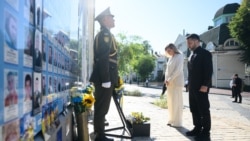
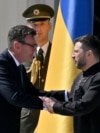

Addressing the meeting, Zelenskyy called on the coalition members to help close what he said was a 27-billion-euro ($31.5 billion) funding shortage for defense sector needs this year.
Burnham also called for additional sanctions on Russian oil and liquefied natural gas exports, a key source of revenue for Moscow.
While many leaders were joining the meeting virtually, Burnham was attending in person in Kyiv on his first foreign trip since taking office last month.
“"The sheer strength of the Ukrainian people is truly awesome," Burnham said in a separate speech in Kyiv.
Now halfway through its fifth year, Russia's full-scale invasion has caused major destruction to the Ukrainian economy, killed thousands of civilians, and forced millions of people to flee their homes.
Europe and the United States have provided tens of billions of dollars in economic and military aid since Russia's invasion, but supporters worry about possible assistance fatigue by Western partners.
In his Independence Day speech, Zelenskyy said that "Ukraine absolutely wants peace, but it is not ready to simply surrender," and asserted that Moscow would not stop if Ukraine handed it more territory in the east of the country.
Russia has said that for peace talks to be held, Ukraine must cede part of the Donetsk region that Russian forces have been unable to capture, among other conditions. Kyiv, the US, and others have called for talks with the front lines frozen in place.
Seeking US Aid
The US embassy in Kyiv issued a statement on August 24 saying Washington would boost "economic and security ties" with Ukraine.
US military supplies for Ukraine have almost entirely dried up since 2025, although Kyiv still benefits from vital US intelligence, surveillance, and reconnaissance (ISR) provision.
Recently, Ukraine's stock of US-made Patriot interceptor missiles have all but run out and plans to license them for production by Ukrainian manufacturers appear to have stalled.
With further assistance from the White House uncertain, Zelenskyy held talks with US Senators Richard Blumenthal (Democrat) and James Lankford (Republican) in Kyiv during a National Prayer Breakfast on August 23.
Zelenskyy thanked Washington for its “unwavering bipartisan and bicameral support” and said efforts were continuing in both chambers of Congress to increase pressure on Russia, including through the Lindsey Graham sanctions bill targeting Russia and Iran.
As Russia continued its missile and drone attacks across Ukraine, Zelenskyy said he briefed the senators on "Russia's ongoing terror with ballistic missiles," stressing the importance of giving Kyiv the capabilities to counter the attacks.

Meanwhile, the conflict has continued on August 24, with Russian e-commerce retailer Ozon saying its logistics hub in Krasnodar had been hit by Ukrainian drones and set ablaze. The company said there were no casualties.
On August 22, Kyiv's forces hit an Ozon warehouse in Samara, expanding its attacks on the sector after weeks of strikes on facilities belonging to Russian online giant Wildberries.
Burnham announced he would provide Ukraine with classified technical details for domestic production of Anglo-French Storm Shadow/SCALP cruise missiles to boost its medium-range strike capabilities.
Zelenskyy, in his address, stressed the importance of Ukraine's home-grown Flamingo missiles.
"Flamingos should not be a rare species, but birds arriving en masse. They must 'winter' in Russia," he said.

