



Moscow is making what an analyst called "completely unrealistic" demands about European security despite setbacks in its war on Ukraine, including the partial destruction of the only bridge linking Russia to occupied Crimea. In China, Putin gets a seat at the table with Xi and Trump, but what about substance?
Here are some of the key developments in Russia over the past week and some of the takeaways going forward.
Truth And Fiction
During the full-scale invasion of Ukraine, Russia has repeatedly warned Kyiv and the West that they must reckon with "new realities" or the "facts on the ground."
Regardless of the context of each particular case, these remarks are meant to suggest Russia is winning the war and will achieve its goals by force if it cannot do so through diplomacy, and that refusing to accept its demands now may only mean pressure to swallow even tougher conditions later.
Specifically, the refrain about "realities" is also a reference to something that is not a fact on the ground at all: Putin's claim, enshrined in Russian legislation in September 2022, that Ukraine's Donetsk, Luhansk, Zaporizhzhya, and Kherson regions are part of Russia now, including the areas that Kyiv controls.
Amid a revived US push for a deal to end the war, Russia's call for Ukraine to cede this territory -- particularly the strategic swath of the Donetsk region it has failed to capture in nearly five years of extremely costly fighting -- is one of its central demands. Another is a bar on Ukraine joining NATO, ever.
Considering the actual facts on the ground, these demands are seen by Ukraine and some of its backers in the West as nonstarters. Why, Ukrainian President Volodymyr Zelenskyy has asked, should Kyiv hand over territory its forces have fought and died to keep out of the Kremlin's hands?
Moscow's demands read like those of a country that has won a war or is about to do so. But Ukrainian battlefield gains, massive Russian casualties, and Kyiv's strikes on Russian energy, military, and logistical infrastructure tell a different story.
A Symbolic And Strategic Span
One of the latest chapters in that story is one of the most dramatic: a Ukrainian attack that sent part of the Crimea Bridge plunging into the Kerch Strait, destroying the only direct road link between Russia and the Ukrainian Black Sea peninsula it has occupied since 2014.
Aside from its strategic significance, the bridge has served as a symbol of Moscow's control over Crimea, a region Putin has sought to imbue with a mythical, quasi-religious meaning for Russia.
Putin drove a truck over the now-collapsed roadway of the bridge at an opening ceremony in 2018, four years after Russia sent forces to Crimea, seized key facilities, and staged a referendum considered illegitimate by most of the world.
All this makes for an incongruous backdrop for an additional Russian demand that came to the fore last week, when the United States held peace talks with Ukraine and Russia for the first time since February and added a new focus: the search for a new -- or at least adjusted -- European security architecture.
Ahead of the November 10-11 talks in Abu Dhabi and separate US huddles with Putin and Zelenskyy the following day, US President Donald Trump suggested the war would end soon with a "big, beautiful agreement" that is "going to involve more than Ukraine."
This must have been music to Moscow's ears: Since he came to power over a quarter-century ago, Putin -- a KGB officer who was posted in Dresden, near the western edge of the Soviet Empire, when it fell apart -- has been seeking greater sway for Russia in Europe.
In fact, hopes of reversing Moscow's retreat were clearly part of the reason he launched the full-scale invasion of Ukraine in February 2022. Two months before, Russia had set out a series of demands, couched as proposals in draft treaties with the United States and NATO, that would have rolled back some of the main outcomes of the Cold War.
Among other things, the treaties would have barred any expansion of NATO, not just Ukrainian membership, and obliged the alliance to pull military deployments back behind the borders of nations that were part of the alliance in 1997 -- before Poland, Hungary, the Czech Republic, or any former Soviet satellite joined.
Washington and NATO rejected some of the items and offered to discuss others. Russia said it was on offer only as a package deal, and the invasion began before dawn on February 24, 2022.
Five years later, despite its failure to achieve its goals in the war, from control over the Donetsk region to the subjugation of Ukraine, Russia is repeating the same demands.
'No Basis In Reality'
The "key provisions" of Moscow's vision of an effective security architecture are "the nonexpansion of the NATO bloc, nondeployment of weapons systems that pose a threat to us near Russia's borders, and a return of the alliance's force posture to the configuration that existed" in 1997, Putin's top foreign policy aide, Yury Ushakov said on November 12.
And Russia's demands won't end there, Ushakov warned, saying Moscow would "add some of our own fresh ideas" based on lessons drawn from "the current situation, in which the collective West has taken up arms against us."
On November 13, The New York Times reported that Russian officials had circulated a paper echoing Moscow's stance set out in December 2021 "sometimes word for word," including the call for a NATO troop pullback.
Putin vaguely hinted at a partial climbdown on November 19, saying that times change and "certain requirements from our side may no longer relevant," but he gave no detail and did not specify whether he was referring to demands on Ukraine or NATO.
Analysts familiar with Moscow's rhetoric were not exactly surprised the Kremlin is repeating such audacious demands despite its struggle to achieve its war aims, and delivered a clear verdict on their viability.
"Completely unrealistic" was how Russian political analyst Dmitry Oreshkin put it in comments to Current Time.
"No-one is going to be carving up Europe into spheres of influence," Ruth Deyermond, senior lecturer in the department of war studies at King's College London, wrote on BlueSky. In part, she wrote, that's because "European states have agency" and don't want it to happen.
"The Russian demands are a ludicrous fantasy," Mick Ryan, a retired Australian major general and a senior fellow at the Lowy Institute think tank, wrote on X. "They have no basis in reality."
So why is Moscow making them?
Samuel Charap, senior political scientist at the Rand Corporation, a US-based think tank, sees two possibilities.
One is that it's "business as usual for Russian diplomacy: starting out by making unreasonable demands, which makes coming down to Earth seem like a concession." The other is if "Russia is just playing for time but wants to keep everyone else busy with their outrage in the meantime."
"Either way, the best response is to counter," Charap wrote on X. "If they don't budge, we'll have certainty."
Deyermond suspects the Kremlin is seeking to capitalize on its relationship with the Trump administration before Democrats take control of both houses of US Congress in January following big Republican setbacks in the November 3 midterm elections.
Russia may see "a window of opportunity that is closing," she said on The Global Agora podcast on November 16, adding, "They're trying to press Europe hard now, while they can, in November and December, knowing things are going to look different in January."
'No Yalta 2.0'
One of the striking things about Russia's gambit is that it would deny agency to a slew of countries in Central and Eastern Europe: not just Ukraine -- which Putin has said shouldn't exist unless it's closely tied to Russia -- but also the Baltic states and former Warsaw Pact members that sought NATO and EU membership after the collapse of communism, in part to protect themselves against exactly what Russia is wreaking on Ukraine now.
For Putin, it's a dream that may go back as far as Dresden in the late 1980s: the desire to return to a time when Washington and Moscow were rival superpowers, dominating Europe and the smaller countries on either side of the Iron Curtain.
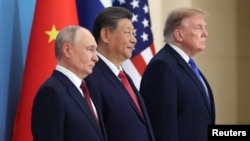
For a new dose of great power symbolism, Putin looked to an unprecedented meeting with Trump and Chinese President Xi Jinping on the sidelines of an APEC summit in Shenzhen, China, on November 19.
He seems to have gotten what he wanted: a seat at a big, round table with Xi and Trump and a chance to cast Russia, China, and the United States as indispensable providers of global "security and stability." He described Russia's war on Ukraine as a conflict that the three countries have a shared interest in "resolving," not as an invasion he could stop as easily as he started it.
The three presidents issued a joint "peace" declaration covering UN reform, energy exports, international courts, and nuclear arms control, according to a text issued by Russia and China. It did not mention the war in Ukraine.
Amid the symbolism of a summit Trump said was "making history," some of the optics weren't great for Putin: Xi greeted Trump on the tarmac when he arrived, a highly unusual move, while Putin was met by lower-level officials. And Putin's apparent attempt to stand beside Xi and Trump for an initial photo didn't work out, as the Chinese leader seemed to direct him to a spot further away.
As plans for the trilateral talks developed, comparisons were drawn with the Yalta meeting between Roosevelt, Stalin, and Churchill in February 1945, which helped seal the fate of smaller nations after the Allies defeated Nazi Germany three months later.
Putin's chief negotiator at the Ukraine peace talks suggested Yalta was something to emulate, while Kyiv and its European backers expressed concern that the United States, Russia, and China might seek to make decisions about their futures in their absence.
"The concern is natural but unnecessary," Richard Fontaine, CEO of the Center for a New American Security, wrote ahead of the meeting. "No Yalta 2.0 is in the offing. It's not only unlikely that the three leaders will divide the world, it's impossible."
For one thing, "Soviet domination of Central and Eastern Europe came from Moscow undermining the Yalta agreements more than embracing them," Fontaine wrote, adding, "Today is wildly different.
"Trump, Xi and Putin are not divvying up territory under their military occupation. And the countries affected would not simply accept domination by a great-power neighbor. Ukraine is example enough, but ask the rest of Europe -- or Japan, Australia, Taiwan."