



Even Russia’s friends, for the most part, showed little appetite for relaxing sanctions in “strategic” EU talks in Brussels on Monday (19 January).
Summing up the debate, EU foreign relations chief Federica Mogherini told press there was a “consensus” they should stay in place until Russia pulls back from east Ukraine.
...
“There is no normalisation. There is no back to business as usual”.
The Czech Republic, Germany’s foreign minister, and Hungary - which had criticised EU sanctions in recent months - sent out similar messages.
Germany’s Frank-Walter Steinmeier said: "Given the current situation in east Ukraine, nobody expressed the desire to loosen some of the Russia sanctions”.
Hungary’s Peter Szijjarto added that Russia has done nothing to comply with last year's so-called Minsk peace deal. “Without it, there can be no positive change”, he said.
Italy’s Paolo Gentiloni, who in December said the EU should “re-engage” with Russia, devoted his press comments to counter-terrorism.
Austria, Luxembourg, and Spain spoke more softly on Russia but stopped short of calling for a sanctions roll-back.
Austria said the EU should start thinking “how to put the relationship with Russia back on a solid footing in the long-term”.
Luxembourg noted the EU must show Moscow the sanctions are not meant to “destabilise” Russia, while Spain said the EU should separate its sanctions in two - on the annexation of Crimea (to stay in place) and on east Ukraine (to change in line with the situation).
This ends our live-blogging for January 19. Be sure to check back tomorrow for our continuing coverage.
Amnesty International says the rising violence hitting civilians hard:
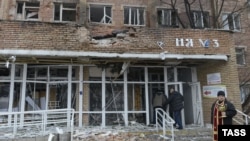
An escalation in hostilities in eastern Ukraine since yesterday has resulted in the deaths of numerous civilians, including children, with many more lives in grave danger, Amnesty International said as it renewed its calls on both sides to protect civilians amid the fighting.
"The use of heavily populated areas for launching attacks by pro-Russian separatists in Donetsk and Horlivka and the return of fire into these areas by pro-Kyiv forces is putting civilian lives in great danger," said Denis Krivosheev, Deputy Europe and Central Asia Programme Director at Amnesty International.
"Pro-Russian separatist forces must stop using densely populated areas for launching military operations and Kyiv-controlled forces must not launch indiscriminate attacks which put civilian lives at risk. These are violations of the laws of war for which civilians are paying with their lives."
On 18 January, Ukrainian armed forces received orders to open heavy fire on pro-Russian separatist positions in eastern Ukraine in a push to retake full control of the contested Donetsk airport and surrounding areas. This followed an earlier ultimatum issued to them by the pro-Russian forces to leave the airport and their subsequent full-scale offensive against the Ukrainian forces' positions there.
Videos posted on the internet by users in Donetsk show separatist forces launching volleys from Grad multiple launch rocket systems based inside residential areas in the city on the morning of 18 January.
Residents in pro-Russian separatist controlled Horlivka, 40 km north-east of Donetsk, told Amnesty International of similar cases of rockets being fired from the town centre. Shortly after one such instance on 18 January, artillery fire was returned by pro-Kyiv forces, killing at least two civilians.
According to a high-ranking local official, two brothers, aged seven and 16, were killed on 18 January after their house was hit directly in Vuhlehirsk, a town some 60 km north-east of Donetsk which is controlled by pro-Kyiv forces. A girl, aged eight, was wounded in the same attack and her leg was later amputated in the hospital.
Three people, including a father and his teenage son, died this morning (19 January) in Ukrainian-controlled Debaltseve, a key rail hub, after shelling by pro-Russian separatist forces. A total of 10 people were injured in the attack.