



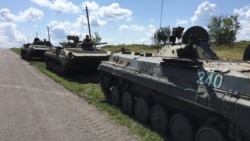
Here's more via Amnesty International's statement announcing the report:
An Amnesty International researcher on the ground in eastern Ukraine has gathered gruesome evidence of civilian deaths and casualties inflicted by both sides in the bloody conflict in the towns of Donestk and Debaltseve over the last few days.
The evidence was collected on the spot in the immediate aftermath of shelling and includes interviews with eyewitnesses and casualties in hospital.
The reported violations include an attack on a humanitarian aid line, a market place in Donestk and indiscriminate shelling of homes and streets in Debaltseve.
“This evidence reveals the horror of the bloodshed suffered by civilians, who are being killed and injured because both sides are firing unguided rockets and mortars in heavily populated areas. Such attacks are a violation of international humanitarian law and may amount to war crimes,” said John Dalhuisen, Europe and Central Asia Director at Amnesty International.
The recent serious upsurge in fighting in several areas of eastern Ukraine, including in rebel-held Donetsk and government-held Debaltseve, has inflicted a high cost on the civilian population. More than 25 civilians have been killed in eastern Ukraine since Thursday.
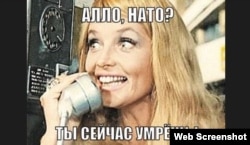
A headline for a popular current events program on Russia's Channel One claimed that Vladimir Putin could destroy NATO with a phone call. And Twitter users have been giggling ever since.
Tickling Twitter's Funnybone: Putin Can Destroy NATO With What?
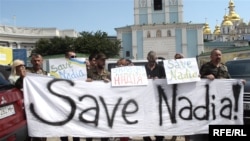
Savchenko's Lawyer Says Hunger-Striking Ukrainian Pilot 'Resolute'
And this tidbit:
About a quarter of Russians (26 percent) say that there is a "rather high probability" that Russia will launch military activity in the region. Another 10 percent is "convinced that a war between the countries is already under way."
From our newsroom:
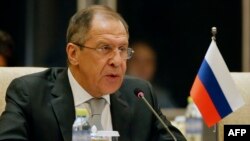
Russian Foreign Minister Sergei Lavrov claims recent remarks by President Barack Obama about an internationally-brokered deal to resolve last year's Ukrainian crisis proves Washington was involved in a "coup" against Ukraine's Moscow-backed president.
In a CNN interview broadcast on February 1, Obama said he believes Russia's interference in Ukraine has occurred in part because President Vladimir Putin was "caught off balance" by embattled Ukrainian President Viktor Yanukovych "fleeing after we had brokered a deal to transition power in Ukraine."
Obama was clearly referring to a deal signed by Yanukovych and opposition leaders on February 21, 2014, that called for the creation of a national unity government and for a presidential election by December.
Yanukovych, who had triggered mass protests in Kyiv by refusing to sign an EU association agreement in November 2013, abandoned power and fled to Russia shortly after signing the deal with the opposition.
Speaking in Beijing on February 2, Lavrov said Obama's remarks were "proof that from the very beginning, the United States was involved in the anti-government coup that Obama neutrally described as a 'power transition'."
Lavrov did not explain how Obama's remarks proved his claims.
With reporting by Interfax and sputniknews.com

More extensive quotes from the meeting in Budapest between German Chancellor Angela Merkel and Hungarian Prime Minister Viktor Orban:
Merkel:
"We agreed that in the conflict between Ukraine and Russia, we must insist that another cease-fire is reached as soon as possible and that the Minsk agreement is a good starting point for achieving a stable position, again in which Ukraine's territorial integrity is safeguarded. Germany will continue to work towards this together with all other European countries."
"At the same time I and others have said that, in view of the trade relationships between Ukraine and Europe, and between Ukraine and Russia on the other side, we should also continue to look in the long term at working on an economic relationship between the Eurasian Union and the European Union and moving towards a common economic area."
"Germany will not support Ukraine with weapons. I am firmly convinced that this conflict cannot be solved militarily and therefore we insist that on the one hand, we will impose sanctions if necessary -- we have done that jointly in Europe -- and on the other hand, we will use all diplomatic means to resolve this conflict through talks, or at least alleviate it."
Orban:
"We think that not all democracies are necessarily democratic and if someone wants to say that a democracy is necessarily liberal, then that person demands privileges for one system of notions which we cannot give."
Two notable editorial pieces from The New York Times today.
The first is from the paper's Editorial Board under the headline Mr. Putin Resumes His War In Ukraine. Here's an excerpt:
Tempting as it is to focus on punishing Mr. Putin, the greater objective must be to end the fighting so that Ukraine can finally undertake the arduous task of reforming and reviving its economy. Toward that end, the West must make clear to Mr. Putin that if a federation is his goal, the United States and its allies will actively use their good offices with Kiev to seek a workable arrangement.
But if the evidence continues to accumulate that Mr. Putin and the rebels are carving out a permanent rebel-held enclave in eastern Ukraine, à la Transdniestria, Abkhazia or South Ossetia, he must know that the United States and Europe will be compelled to increase the cost.
The other, Putin's Evolution, is a contribution from Vedomosti opinion-page editor and Wilson Center fellow Maksim Trudolyubov. He puts his finger on the dilemma facing Putin critics at home and abroad:
Today Russia continues turning inward. For Mr. Putin, competing with the rest of the world means playing by Western rules; if you don’t, the West freezes your assets and hits you with sanctions. He is fighting back by instilling his country with a war mentality. Russia’s plunging economy is presented as the price of pursuing a noble cause: standing up to America, fighting “fascism” in Ukraine and winning recognition for Russia as a global power.
Why my countrymen seem so receptive to this warmongering is an open question. Mr. Putin has certainly succeeded in clouding Russian perceptions and distorting Russian thinking. No one knows how long this strategy will succeed, but of one thing there is no doubt: For many Russians, Mr. Putin has turned himself into a kind of noble cause.
He concludes by wondering "when the Russian people will snap out of their lethargy and realize that the state and the person leading it are not the same thing."