

In today's Daily Vertical, RFE/RL's Brian Whitmore says he believes Russian President Vladimir Putin wants another Yalta-type postwar conference, but first he needs a war.


EU considers expanding Ukraine sanctions list:
The European Union is reportedly discussing a proposal to expand a list of people and entities subjected to visa bans and asset freezes over Russia's involvement in the war in eastern Ukraine.
Diplomats in Brussels told RFE/RL that EU ambassadors were likely to agree later on February 4 to add about 25 individuals and entities.
They said senior Russian officials were not likely to be included on the expanded list.
The proposal is expected to be formally approved by EU foreign ministers on February 9.
The decision to add more names and entities to the sanctiosn list was made at an EU foreign ministers meeting on January 29.
At the same meeting, the ministers agreed to extend until September an initial blacklist that targets Russians and pro-Russia separatist leaders in Ukraine due to the ongoing conflict in eastern Ukraine.
Without the extension, the initial sanctions list would have expired in March.
France not planning to deliver lethal weapons to Ukraine:
Defense Minister Jean-Yves Le Drian says that at least for now, France will not deliver weapons to Ukraine to fight pro-Russian separatists.
Le Drian, speaking at a news conference in Paris with Canadian counterpart Robert Nicholson on February 4, said: "We think that we need to find a political solution to this crisis."
He added, "We have no intention of supplying lethal weapons to Ukraine at this time."
On Feburary 3, German Chancellor Angela Merkel also said her government did not back arming Ukraine with "deadly, lethal weapons" to fight the separatists.
The French and German statements came amid U.S. media reports that Washington was considering supplying lethal defensive arms to Kyiv.
Ukrainian President Petro Poroshenko said on February 3 he did not have the "slightest doubt that the decision to supply Ukraine with weapons will be made by the United States as well as by other partners of ours." (AFP, Reuters, AP)
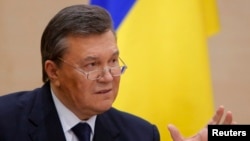
Details via the newsroom on the Verkhovna Rada's mostly symbolic takedown of former President Yanukovych:
Ukraine's parliament has adopted legislation stripping Viktor Yanukovych of his presidential title.
The decision by the Verkhovna Rada was backed by 281 lawmakers on February 4. It needed 226 votes to pass.
The move deprives Yanukovych of all the benefits enjoyed by former heads of state.
Yanukovych, who triggered mass protests in Kyiv by refusing to sign a deal tightening ties with the EU in November 2013, fled Kyiv on February 21, 2014, and later arrived in Russia.
Lawmakers said Yanukovych must be stripped of his title because he relieved himself of duties as president "in an unconstitutional way" that threatened the country's territorial integrity and sovereignty and led to "mass violations of the rights and freedoms of citizens."
On February 22, 2014, parliament voted to formally remove Yanukovych from his post on the grounds that he was unable to fulfill his duties.
Two days later it issued a warrant for his arrest, accusing him of "mass killing of civilians." (TASS, UNIAN, Kyiv Post)
European Commission Vice President and Commissioner for Energy Union Maros Sefcovic speaking today at the EU Commission daily briefing on Russia's decision to scrap the South Stream project and instead build pipelines to Turkey:
"When I was Moscow, when we discussed this issue I think the arguments I heard most often was that the primary reasoning for this decision was to bypass or avoid Ukraine.
"The reasoning for that was that Ukraine was the reason for different kind of stoppages of gas supply in previous times and that huge investments were needed for the renovation of the gas transportation system and gas storage in Ukraine and these were the reasons which were presented to me.
"Of course I didn't agree [with them] because I was informing the Russian counterpart that Ukraine was fully aware of the need for energy reform. Ukrainian representatives were fully aware of the need to restructure, modernize Naftohaz which is the major Ukrainian energy gas company and I was also arguing by the fact that through this route historically it was more than 100 billion cubic meters [of gas] which was shipped from Russia to Central and Western Europe and it just simply would not viable that like this you can change everything.
"I was arguing also with the fact that the European Union and the international financial institutions are going to help Ukraine to modernize the energy system, to renovate the gas transmission systems so really such a radical change would definitely not be economical."