



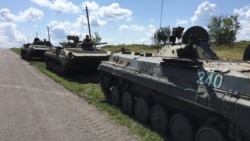
Good morning. We'll start the live blog today with the latest update from RFE/RL's news desk on efforts to come up with a new peace plan for eastern Ukraine:
German Chancellor Angela Merkel and French President Francois Hollande are due to present a new Ukraine peace plan to Russian President Vladimir Putin in Moscow on February 6.
Moscow said it hoped talks with Merkel and Hollande would be "constructive."
The two discussed their ideas with Ukrainian President Petro Poroshenko in Kyiv on February 5.
No details of the plan have emerged, but Poroshenko said the plan gives "hope for a cease-fire" in eastern Ukraine, where fighting between pro-Russian separatists and Ukrainian forces has killed more than 5,350 people since April, 2014.
Ukrainian Prime Minister Arseniy Yatsenyuk said Kyiv would not consider any peace plan that casts doubt on the nation's territorial integrity, sovereignty, or independence.
Yatsenyuk was speaking after talks with U.S. Secretary of State John Kerry, who arrived in the Ukrainian capital on February 5 to express U.S. support for Kyiv.
After talks with Poroshenko, Kerry said Washington supported diplomacy, but would "not close our eyes" to Russian tanks and troops crossing the border.
U.S. President Barack Obama will decide soon whether to provide Ukraine with lethal weapons to fight the separatists, Kerry said.
Moscow said it would consider any U.S. arms sent to Kyiv to be a security threat.
In Washington, Republican Senator John McCain said U.S. lawmakers would write legislation requiring the United States to send arms to Ukraine if Obama did not do so.
In Moscow, Putin adviser Yuri Ushakov said Russia was "ready for a constructive conversation" aimed at stabilizing the situation, establishing a dialogue between the Ukrainian government and the rebels, and rebuilding economic ties between eastern Ukraine and Kyiv.
He said the Kremlin expects that Merkel and Hollande had taken Putin's own peace proposals into account.
Kerry said the French and German foreign ministers had informed Washington about the Russian proposal, but he didn't have all the details.
Kerry brought $16.4 million in new humanitarian aid to Ukraine as the Obama administration weighed sending arms to help Kyiv's military battle the heavily armed separatists.
Germany and other European nations remain fiercely opposed to sending arms to Ukraine.
Federica Mogherini, the EU's foreign policy chief, backed the French-German peace effort, saying "there is no military solution to the crisis in Ukraine."
The top NATO commander, U.S. Air Force General Philip Breedlove, said on February 5 that Russia continues to supply the separatists with heavy, state-of-the-art weapons, air defenses, and fighters.
Russia denies playing any role in the conflict.
Breedlove also cautioned that any move to give Ukraine lethal defensive weapons "could trigger a more strident reaction from Russia."
On the ground in eastern Ukraine, fighting has centered on Debaltseve, a village astride a key link between Donetsk and Luhansk, the rebels' two main strongholds.
On February 5, the rebels appeared to have captured Vuhlehirsk, a nearby small town where government troops had also been holding out.
The army said it was still contesting the town, but Reuters journalists saw no sign of areas under army control.
Ukraine's economy, meanwhile, has been devastated by the crisis in the east.
Its currency, the hryvnya, slid 46 percent on February 5 against the U.S. dollar, prompting the government to raise a key interest rate by 5.5 percentage points to 19.5 percent.
The move eased some pressure on the currency.
According to Poroshenko, Ukraine is spending up to $8 million a day fighting the rebels.
(With reporting by AP and Reuters)
Barring any major developments, that ends the live blogging for today.
These countries will host the new NATO bases.
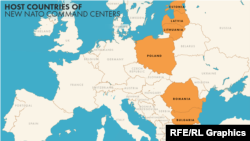
And here's the latest on NATO's plans to set up six bases in eastern Europe:
NATO chief Jens Stoltenberg said February 5 that the alliance has agreed to immediately set up six bases in eastern Europe and establish a spearhead force of 5,000 troops in response to Russian aggression in Ukraine.
Stoltenberg, speaking at a news conference in Brussels after a meeting of NATO defense ministers, said France, Germany, Italy, Spain, Poland and Britain agreed to take the lead in forming the spearhead force.
The force would be available to deploy within two to seven days in a crisis, Stoltenberg said.
"We have decided on the immediate establishment of the first six multinational command and control units in Bulgaria, Estonia, Latvia, Lithuania, Poland and Romania," he said.
The spearhead force will be backed up by two more brigades in order to keep reinforcements coming in a crisis.
In total, the NATO response force will be increased to 30,000 troops from the current number of 13,000.
Here's our latest wrap on all of today's diplomacy:
U.S. Secretary of State John Kerry says President Barack Obama will decide “soon” whether to provide lethal weapons to Ukraine to help it fight a Russian-backed military offensive by pro-Russian separatists in eastern Ukraine.
Kerry made the remark after talks in Kyiv on February 5 with Ukrainian Prime Minister Arseniy Yatsenyuk.
Earlier in the day, after meeting Ukrainian President Petro Poroshenko, Kerry placed the onus on Moscow to end the war that has killed more than 5,350 people since April.
Kerry said Washington wants a peaceful solution but "cannot close our eyes to Russian tanks crossing the border" into Ukraine.
He said: "Russia's continued aggression in the east" is the gravest threat facing Ukraine today.
Kerry demanded the immediate implementation of a September cease-fire deal and the withdrawal of all Russian troops and weaponry from Ukrainian territory.
He also said Moscow must "respect the international border" between Russia and Ukraine.
He said those actions are the only way to stop the conflict and end Russia's "international isolation" -- referring to sanctions and other measures imposed by Western governments in response to Moscow's illegal annexation of Crimea in March and its support for separatists who have seized parts of eastern Ukraine.
Yatsenyuk mocked President Vladimir Putin for denying his troops fighting in eastern Ukraine, saying Russia is “the only country denying Russian military boots are on the ground” there.
Yatsenyuk said Putin can “use my glasses if he needs” them.
Meanwhile, the leaders of France and Germany were meeting with Poroshenko in Kyiv on February 5 to discuss what French President Francois Hollande has called a "new proposal" for peace amid a bloody escalation of fighting.
After Kyiv, Hollande and German Chancellor Angela Merkel plan to go to on to Moscow for talks with Putin on February 6.
Kerry said Putin should recognize "that there is a diplomatic solution that is staring everybody in the face.”
He said that the United States is not playing a "zero-sum game" aimed at weakening Russia, as Putin has alleged, and added that the tense confrontation between East and West over Ukraine is "about the rule of law" and "fundamental respect for the integrity, the sovereignty of Ukraine."
Poroshenko said Ukraine is facing a "growing escalation of violence by terrorists directly supported by Moscow" and thanked the United States for its support.
In Brussels, NATO defense ministers discussed plans to bolster defenses on the alliance's eastern flank in what Secretary-General Jens Stoltenberg said was a response to "aggressive actions" by Russia.
Diplomats speaking on condition of anonymity said that EU ambassadors, also meeting in Brussels, decided to impose visa bans and assets freezes on an additional nine entities and 19 individuals -- including Russian officials and separatists -- over Moscow's intervention in Ukraine.
They said the sanctions would be approved by EU foreign ministers on February 9, and that those affected did not include top Russian officials.
In Moscow, Kremlin spokesman Dmitry Peskov confirmed that Putin would meet with the French and German leaders on February 6 and said they would discuss "the fastest possible end to the civil war in southeastern Ukraine."
Foreign policy aide Yury Ushakov said Putin was ready to hold constructive talks with Merkel and Hollande and that Russia regrets Kerry was not planning to join the talks.
Ushakov said Russia hopes Germany and France will take measures proposed by Putin into account, apparently referring to a proposal he made last month.
U.S. officials have dismissed those proposals, saying they seek to legitimize rebel territorial gains and are little more than a blueprint for military occupation.
Separatists hold much of the eastern Ukrainian provinces of Donetsk and Luhansk, which border Russia, and have been trying to seize more territory in recent weeks with what the United States has called a "Russian-backed offensive."