



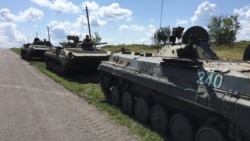
More on the truce around the eastern town of Debaltseve:
Ukrainian government officials and pro-Russian separatists have reportedly agreed a brief humanitarian truce around the east town of Debaltseve.
The temporary truce was declared as German Chancellor Angela Merkel and French President Francois Hollande pressed forward with a new peace plan to end the Ukraine crisis.
Ukraine Interior Ministry official Vyacheslav Abroskin told AFP news agency that the cease-fire was agreed to allow besieged civilians to be evacuated.
Rebels said the truce would last from 10 a.m. to 5 p.m. local time on February 6, and that buses carrying civilians had already left Debaltseve.
Earlier, the Reuters news agency reported that dozens of empty buses escorted by monitors from the Organization for Security and Cooperation in Europe (OSCE) were heading toward the town.
Witnesses said there was no firing between government forces and separatists as the convoys moved toward Debaltseve.
Debaltseve is within a narrow strip of land in the region of Donestk that is under Ukrainian government control in the midst of territory controlled by separatists.
It has been the scene of heavy fighting for several weeks, with separatists pushing forward with an offensive they say is aimed at controlling the entire Donetsk region.
It's the Munich security today. And Ukraine is top of the agenda.
The conflict in Ukraine is expected to dominate an annual security conference that opens in Munich on February 6.
Dozens of world leaders and ministers will gather in the German city for the three-day event.
German Defense Minister Ursula von der Leyen and NATO Secretary General Jens Stoltenberg will address the conference on February 6.
The top NATO commander, U.S. General Philip Breedlove, will then take part in a discussion on hybrid warfare, a term that characterizes the conflict in Ukraine, where government forces have been battling pro-Russian separatists since April 2014.
On February 7, German Chancellor Angela Merkel will address the conference, followed by Russian Foreign Minister Sergei Lavrov, U.S. Vice President Joe Biden, and Ukrainian President Petro Poroshenko.
This just in from our news desk:
Ukrainian government officials and pro-Russian separatists have reportedly agreed a brief humanitarian truce around the east town of Debaltseve.
Ukraine Interior Ministry official Vyacheslav Abroskin told AFP news agency that the cease-fire was agreed to allow besieged civilians to be evacuated.
Rebels said the truce would last from 10 a.m. to 5 p.m. local time on February 6, and that buses carrying civilians had already left Debaltseve.
Earlier, the Reuters news agency reported that dozens of empty buses escorted by monitors from the Organization for Security and Cooperation in Europe (OSCE) were heading toward the town.
Witnesses said there was no firing between government forces and separatists as the convoys moved toward Debaltseve.
Debaltseve is within a narrow strip of land in the region of Donestk that is under Ukrainian government control in the midst of territory controlled by separatists.
It has been the scene of heavy fighting for several weeks, with separatists pushing forward with an offensive they say is aimed at controlling the entire Donetsk region.
(AFP, Reuters, Interfax)
Good morning. We'll start the live blog today with the latest update from RFE/RL's news desk on efforts to come up with a new peace plan for eastern Ukraine:
German Chancellor Angela Merkel and French President Francois Hollande are due to present a new Ukraine peace plan to Russian President Vladimir Putin in Moscow on February 6.
Moscow said it hoped talks with Merkel and Hollande would be "constructive."
The two discussed their ideas with Ukrainian President Petro Poroshenko in Kyiv on February 5.
No details of the plan have emerged, but Poroshenko said the plan gives "hope for a cease-fire" in eastern Ukraine, where fighting between pro-Russian separatists and Ukrainian forces has killed more than 5,350 people since April, 2014.
Ukrainian Prime Minister Arseniy Yatsenyuk said Kyiv would not consider any peace plan that casts doubt on the nation's territorial integrity, sovereignty, or independence.
Yatsenyuk was speaking after talks with U.S. Secretary of State John Kerry, who arrived in the Ukrainian capital on February 5 to express U.S. support for Kyiv.
After talks with Poroshenko, Kerry said Washington supported diplomacy, but would "not close our eyes" to Russian tanks and troops crossing the border.
U.S. President Barack Obama will decide soon whether to provide Ukraine with lethal weapons to fight the separatists, Kerry said.
Moscow said it would consider any U.S. arms sent to Kyiv to be a security threat.
In Washington, Republican Senator John McCain said U.S. lawmakers would write legislation requiring the United States to send arms to Ukraine if Obama did not do so.
In Moscow, Putin adviser Yuri Ushakov said Russia was "ready for a constructive conversation" aimed at stabilizing the situation, establishing a dialogue between the Ukrainian government and the rebels, and rebuilding economic ties between eastern Ukraine and Kyiv.
He said the Kremlin expects that Merkel and Hollande had taken Putin's own peace proposals into account.
Kerry said the French and German foreign ministers had informed Washington about the Russian proposal, but he didn't have all the details.
Kerry brought $16.4 million in new humanitarian aid to Ukraine as the Obama administration weighed sending arms to help Kyiv's military battle the heavily armed separatists.
Germany and other European nations remain fiercely opposed to sending arms to Ukraine.
Federica Mogherini, the EU's foreign policy chief, backed the French-German peace effort, saying "there is no military solution to the crisis in Ukraine."
The top NATO commander, U.S. Air Force General Philip Breedlove, said on February 5 that Russia continues to supply the separatists with heavy, state-of-the-art weapons, air defenses, and fighters.
Russia denies playing any role in the conflict.
Breedlove also cautioned that any move to give Ukraine lethal defensive weapons "could trigger a more strident reaction from Russia."
On the ground in eastern Ukraine, fighting has centered on Debaltseve, a village astride a key link between Donetsk and Luhansk, the rebels' two main strongholds.
On February 5, the rebels appeared to have captured Vuhlehirsk, a nearby small town where government troops had also been holding out.
The army said it was still contesting the town, but Reuters journalists saw no sign of areas under army control.
Ukraine's economy, meanwhile, has been devastated by the crisis in the east.
Its currency, the hryvnya, slid 46 percent on February 5 against the U.S. dollar, prompting the government to raise a key interest rate by 5.5 percentage points to 19.5 percent.
The move eased some pressure on the currency.
According to Poroshenko, Ukraine is spending up to $8 million a day fighting the rebels.
(With reporting by AP and Reuters)