



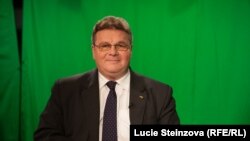
Lithuanian Foreign Minister Linas Linkevicius speaking to journalists as he arrived this morning for an EU Foreign Affairs Council -- foreign ministers -- meeting in Brussels.
On the planned French-German-Russian-Ukrainian summit in Minsk on February 11:
"We all expect that there will be some agreement [in Minsk], we all expect that there will be a diplomatic solution. No one wants war, but we can only judge by the developments on the ground. We cannot trust a single word from the Russian leadership currently -- it is worthless, unless proved on the ground."
On a U.S. initiative to provide Ukrainian armed forces with weapons:
"It is a decision for the U.S. [to make]. [There] is some logic behind [it], I personally understand it because Ukraine is withstanding external aggression. The other side is not considering -- they have already made up their minds -- already delivering weapons, sophisticated and heavy weapons. It is cynical, but it is going on exactly during the time of negotiations sometimes. We really should help Ukraine not only financially, economically, politically, but also militarily; not sending soldiers -- that is not [being] discussed -- but at least to support their armed forces with defensive weapons."
From our newsroom:
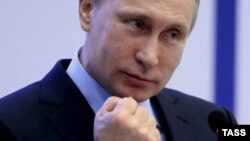
Russian President Vladimir Putin has called on Ukraine's government to cease military operations in eastern Ukraine and stop exerting economic pressure on separatist-held regions, warning that Kyiv was on a "dead-end track, fraught with a big catastrophe."
Putin made the remarks in an interview with the Egyptian state-owned newspaper Al-Ahram ahead of his arrival in Cairo on February 9 for a two-day visit.
According to a transcript released by the Kremlin, Putin said: "The most important condition for the stabilization of the situation is immediate cease-fire and ending" of what he called a "punitive operation in the southeast of Ukraine."
The conflict between Ukrainian government forces and Russian-backed separatists has killed more than 5,350 people since April.
Washington says Ukraine's separatist leaders answer directly to Putin, and that Russia supports the rebels with trained troops and heavy weaponry.
Despite mounting evidence, Putin continues to deny the allegations.
Based on reporting by Reuters and AFP
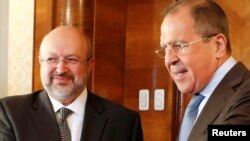
OSCE Secretary-General Lamberto Zannier says in an interview (published in Ukrainian) with our Ukrainian Service that "we desperately need a political breakthrough." He also says the "new security mechanisms" that arose following the Cold War "all seems to have stopped working."
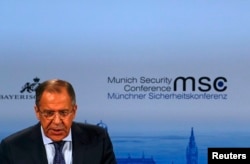
Also re-upping this, for those who've been away from the news this weekend, because it says volumes about the current state of international relations with respect to Russia's crumbling credibility on the Ukraine issue:
Russia's Lavrov Met With Hoots, Indignation At Testy Munich Talk
The latest (extended) wrap-up from our newsroom:
German Chancellor Angela Merkel is in Washington, where she is due to hold talks on February 9 with U.S. President Barack Obama on the conflict in Ukraine.
Merkel's visit comes after the German government said the leaders of Germany, France, Ukraine, and Russia plan to hold a summit on the Ukrainian crisis in Minsk on February 11.
In Washington, Merkel is expected to once again voice Germany's opposition to calls for the United States to begin arming the Ukrainian military, which is fighting pro-Russian separatists in the east.
Merkel told a security conference in Munich at the weekend, "I am convinced that this conflict won't be solved by military means."
Merkel will fly later on February 9 to Ottawa to hold talks with Canadian Prime Minister Stephen Harper.
On February 8, a German government spokesman said the summit in Minsk was discussed in an "extensive" phone conversation between Merkel, French President Francois Hollande, Ukrainian President Petro Poroshenko, and Russian President Vladimir Putin.
There is hope the February 11 meeting will conclude with a fresh commitment to a September cease-fire agreement, reached also in Minsk, that has been repeatedly violated.
In a statement on his website, Poroshenko expressed confidence the Minsk summit will lead to a "swift and unconditional cease-fire" between Ukrainian troops and the pro-Russian rebels they are battling in eastern Ukraine.
Russian Foreign Minister Sergei Lavrov said he expected "important decisions" to emerge from the talks.
Putin, however, suggested the meeting was still tentative.
Speaking in Sochi during bilateral talks with Belarusian President Alyaksandr Lukashenka, Putin said the summit would not be held if the four leaders fail to agree on a "number of points" before then.
Putin, who is expected February 9 on a two-day visit to Egypt, said in an interview with the Egyptian state newspaper Al-Ahram that the government in Kyiv should "listen to their people."
"It is evident that the crisis will continue until the Ukrainians themselves agree with each other," he said, according to a transcript released by the Kremlin.
Meanwhile, expert-level consultations will be held in Berlin on February 9 to prepare for the Minsk talks.
The summit announcement comes as international officials exchanged heated words over Ukraine at a security conference in Munich.
German Foreign Minister Frank-Walter Steinmeier said Europeans believe a lasting settlement to the Ukraine crisis can only be found by working together with Russia.
"This conflict still means that permanent security can only be established together with -- and not against -- Russia," he said. "However, this cannot be a unilateral recognition. It has to be clear to Moscow as well that there is only a good future for Russia with Europe, together with Europe -- and not against Europe."
Steinmeier added that his Russian counterpart's comments a day earlier -- in which Lavrov asserted that Russia's annexation of Crimea was in line with international law -- were "not conducive to our discussion."
President Barack Obama is currently mulling a proposal to supply Kyiv with sophisticated defensive weaponry.
Speaking at the Munich conference on February 7, Merkel criticized the plan, saying "the progress Ukraine needs cannot be achieved by more weapons."
But U.S. Secretary of State John Kerry on February 8 sought to fend off any suggestion of a Transatlantic rift on Ukraine, saying "there is no division" between the U.S. and the EU.
"We are working closely together. We all agree that this challenge will not end through military force. We are united in our diplomacy," Kerry said. "But the longer that it takes... the more we will be forced to raise the costs on Russia and its proxies."
State Department spokeswoman Jen Psaki, who was traveling with Kerry in Germany, said "We call on all parties to refrain from actions that undercut the current diplomacy."
She added, "We continue to support the ongoing diplomatic efforts by our European colleagues and remain in lockstep that any agreement must respect the sovereignty and territorial integrity of Ukraine."
Pressure to resolve the crisis comes amid a mounting death toll in eastern Ukraine, where tens of thousands of civilians have been caught in the crossfire between federal troops and pro-Russian rebels.
The German newspaper Frankfurter Allgemeine Sonntagszeitung reported February 8 that German intelligence sources have suggested the actual death toll in eastern Ukraine may be as high as 50,000 people.
The UN says the conflict has claimed at least 5,358 lives, although it has suggested the actual figure could be far higher.
With reporting by Reuters, AP, and Interfax