

Lively Twitter discussion right now on German leadership to counter Russia, sparked by @AnneApplebaum's recent column, titled The Risks Of Putting Germany Front And Center In Europe's Crises.
In the column, among other things, Applebaum argues:
Merkel’s modest demeanor, and possibly her gender, have made German power easier for others to tolerate. But German power has also been palatable for the past half-century because it was always exercised in concert with others. At the time of the euro zone’s creation, it was tacitly understood that Germany and France would run it, in conjunction with the rest of the participants. But since the financial crisis of 2009 weakened Italy, Spain and France, Germany has dominated euro-zone financial politics because nobody else can. Apparently, no one is able to help manage Europe’s security crisis either. Nobody ever imagined a world in which Germany would be negotiating directly with Russia — or that France would be too weak, Britain too inward-looking and the United States too uninterested to object.
The risks, both for Germany and for everybody else, are high. If the Greek financial crisis ends in fiasco and a Greek withdrawal from the euro zone, the backlash against Germany could turn into a backlash against all of the European institutions that Germany is perceived to run.
The risks in Ukraine are even greater. Merkel has put her personal stamp on a cease-fire agreement she cannot enforce — and if it fails, there is no Plan B. She has, it is true, hinted at one: Ukraine could give up its eastern provinces, build a “Berlin Wall” around them in the form of a demilitarized zone, tighten its borders and gain time to rebuild its state. But for that plan to work in the longer term, the West would have to treat the rest of Ukraine like it once treated West Germany, reinforcing it economically, politically and militarily, in order to deter Russia.

From RFE/RL's News Desk:
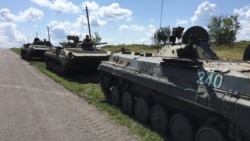
The Ukrainian military says it will not start withdrawing heavy weapons from the front line in the conflict with Russian-backed separatists because the rebels have not completely ceased fire.
Under an agreement brokered by the leaders of Germany and France, government forces and rebels were to cease fire on February 15 and begin pulling back heavy weapons no less than two days later, creating a security zone at least 70 kilometers wide.
Ukrainian military spokesman Anatoly Stelmakh said on February 23 that while hostilities have lessened in recent days after separatist forces took the strategic town of Debaltseve, rebels shelled government troops twice overnight.
Another spokesman, Vladyslav Seleznyov, said in a televised briefing that because "the positions of Ukrainian servicemen continue to be shelled, there cannot yet be any talk of pulling back weapons."
Stelmakh said Ukraine would begin the withdrawal when "the enemy stops firing on our positions."