



In today's Daily Vertical, Brian Whitmore wonders what the West can do, faced with an unreliable negotiating partner like Vladimir Putin. And if it adopts more drastic countermeasures to Moscow's meddling in Ukraine, will they have any effect?

French Foreign Minister Laurent Fabius speaking to France Info radio, in Paris, today.
"We've told the Russians clearly that if there was an attack by separatists in the direction of Mariupol, things would be drastically altered, including in terms of sanctions."
"I very clearly tell my Russian colleague, Mr. [Foreign Minister Sergei] Lavrov, it would mean that at a European level the question of sanctions would be asked again."
Our Ukrainian Service reports on the ceremony in which more than 5,000 Ukrainian troops completed basic training at a military firing range near the western city of Lviv on Tuesday. The average age of the recruits, some of whom are volunteers while others have been mobilized, is 40. They will be sent for further training before eventually being deployed to the conflict zone.

Our Ukrainian Service will be live-streaming a march in the capital, Kyiv, by the nationalist Right Sector group.
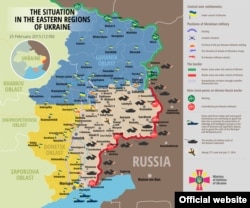
Today's map from Ukrainian military authorities:
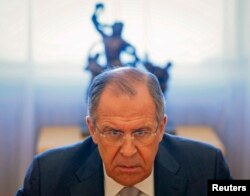
Russian Foreign Minister Sergei Lavrov speaking at a meeting with the visiting leader of the French Senate, via Reuters:
"A lot now depends on an honest, objective, unbiased approach by the observers who must record what is happening on the ground, so that we can all resist the attempts to present the Minsk agreements as having already failed. There are many people outside Ukraine and in Kyiv who want them derailed."
From RFE/RL's News Desk:
Ukraine’s central bank has imposed a temporary ban on purchases of foreign currencies by authorized banks on behalf of their customers.
The ban, which is in effect from February 25 to February 27, is the latest move by Ukraine’s National Bank aimed at supported the troubled hryvnya currency.
The central bank also increased the waiting time from three to four business days for the purchase of foreign currency through deposits in special accounts, or for making advance payments on imports worth more than $50,000.
Ukraine’s Prime Minister Arseniy Yatsenyuk criticized the move, saying it was made without consultation with the government and would not bring stability to the hryvnya.
Yatsenyuk also called on parliament to convene urgently to debate how to stabilize Ukraine’s financial system.
Ukraine’s conflict has hit the economy hard, with the hryvnya losing about 70 percent of its value on foreign exchange markets during the past year.
On February 23, with the hryvnya trading about 9 percent lower that its level the previous week, the central bank capped payments in foreign currencies at $500,000 without letters of credit from foreign banks.
From RFE/RL's News Desk:
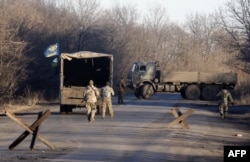
Ukraine’s military says violations by Russian-backed separatists of a newly signed cease-fire deal are continuing but have been decreasing in recent days.
A spokesman said on February 25 that separatists shelled the village of Popasna overnight and continued trying to overrun Ukrainian positions at the village of Shyrokyne, near the southeastern port city of Mariupol.
Ukraine says it will not begin to pull back its heavy weapons from front lines, as required by the Minsk cease-fire deal, until fighting stops.
Separatists said on February 24 that they were beginning to pull back heavy weapons, but their claim could not be confirmed.
Kyiv has expressed concerns that the separatists, having seized the eastern town of Debaltseve despite the cease-fire deal, were merely redeploying weaponry near Mariupol.
In Moscow on February 25, Foreign Minister Sergei Lavrov called for OSCE monitors to confirm the withdrawal of heavy weapons and said Kyiv must implement constitutional reforms under the Minsk agreement.