

Just so you know it's out there. :-)
Here's an excerpt:
Welcome to Canada’s unofficial war. It’s being fought on several fronts. In Canada, the Ukrainian lobby, led by the Ukrainian Canadian Congress, pressures Ottawa to aid the government of President Petro Poroshenko. But the community also raises funds for its own improvised stream of aid, via organizations such as Army SOS. At the individual level, people have taken up tasks ranging from providing front-line technical help to playing key roles in Ukraine’s propaganda campaign.
And some – a handful – have taken up arms. While Canadians who have gone to join the fight in Syria have had their passports revoked, at least one Ukrainian-Canadian who joined a pro-government militia and fought in the Lugansk region has returned to Canada to help raise money for Army SOS. He hopes to recruit other Canadians to the front line.
This uncharted territory is not without risks....
In today's Daily Vertical, Brian Whitmore highlights the growing anxiety -- in the region and throughout the trans-Atlantic region -- as Moscow continues to flex and the Baltics bristle.

German Chancellor Angela Merkel speaking at a news conference with Romanian President Klaus Iohannis following their meeting today in Berlin, in response to a question whether there is a risk that "Russia will do the same in Moldova as it did in Ukraine."
"We hope not. We are now in the process of ensuring the cease-fire in Ukraine that would hold over a longer period of time so we can proceed with what we had agreed at the Minsk meeting in September together with French President [Francois Hollande]."
From our newsroom:
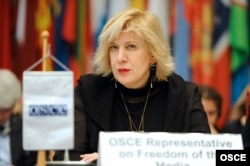
The OSCE representative on freedom of the media says recent measures limiting Russian journalists from fulfilling their professional activities in Ukraine are “excessive.”
Dunja Mijatovic said in a February 26 statement that the lack of transparency is "troubling."
Ukraine's Verkhovna Rada revoked the accreditation on February 12 of some 100 Russian media outlets at Ukrainian public institutions, including the parliament.
The list of the media outlets affected and the reasons for the move were not provided.
Mijatovic called on Ukrainian authorities to "fully disclose their reasoning for these steps" and provide a complete list of the media outlets that are banned.
Mijatovic also cited reports saying Ukrainian authorities detained and deported on February 25 journalists from two Russian television channels for disseminating anti-Ukrainian propaganda.
They were also banned from entering Ukraine for five years.
The same day, another Russian TV journalist was reportedly denied entry into Ukraine.
By RFE/RL
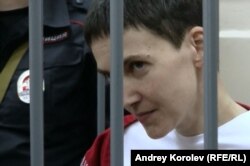
The European Union and the United States have issued fresh calls on Russia to release hunger-striking Ukrainian pilot Nadia Savchenko.
The statements came after a Moscow court upheld a ruling extending the pretrial detention period for Savchenko, who has been on a hunger strike for 76 days, until May 13.
A spokeswoman for EU foreign policy chief Federica Mogherini, Maja Kocijancic, condemned the decision in a February 26 statement and said that "Russia bears a responsibility for [Savchenko's] very fragile health."
She called for Savchenko's urgent release "on humanitarian grounds" and said it would be in line with commitments to release detainees under a peace deal for the conflict between government forces and Russian-backed rebels in eastern Ukraine.
In a statement on February 25, U.S. State Department spokeswoman Jen Psaki also cited those commitments and said the United States "deplores [Savchenko's] ill-treatment and is deeply oconcerned about her deteriorating health."
Savchenko says she was captured by rebels in June and taken to Russia, which has charged her with involvement in a mortar attack that killed two Russian journalists.
Savchenko denies the charges and says Russia has no right to hold or prosecute her.