



Carl Schreck examines the analyses that grabbed headlines this week suggesting that bearish traders hinted at Crimea annexation by Moscow.
U.S. Grad Students Find 'Suspicious' Russian Stock Trading Before Crimea Takeover
Conclusion:
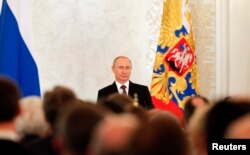
Western policymakers need therefore to contemplate the risks of eventual breakdown in Russia. That is not to say that Russia is, for us, too big to fail. Nor is it to urge us to bring about regime change. Neither option is practicable or desirable for the West to prevent or to undertake. We should, however, act in the case of Ukraine in the knowledge that what Russia is doing there is not as the Kremlin claims because of the threat to Russia from the West, but because of the developing crisis within Russia itself. Putin is not to be appeased by Western concessions, or necessarily by the West abandoning Ukraine. The respect we owe to Russia is to its people, not to its regime. Change can now come only with a new regime, whose birth may well be rough.
Vladimir Putin garners respect in the perceived "politics as sport" approach contained in a new book by "Tony Blair's former spin doctor," Alastair Campbell:
Ah, Putin: the book’s relationship with the Russian president is vexed. On the one hand, Campbell says simply that he is a bad man. On the other, he is full of admiration for his dealings with other major world leaders; specifically, at the G20 summit in Brisbane, when he “told other leaders he was the only one in the room with a strategy, and that they were all tactical, adding: ‘You think your tactics will bring me to my knees, but you will be on your knees first.’” (This gobbet is not in the public domain, as far as I know – in terms of contacts, the insiders’ confidence, he’s still got it.)
Campbell talks about how difficult it is to stick to your strategy in an age of constant media scrutiny, which is why Putin “saw media control as a strategic priority, something that would, of course, rightly be impossible in a fully fledged democracy”. So, here’s the question: what if the fact that Putin is a bad man, and the fact that he has a clear strategy from which he cannot be swerved, isn’t a coincidence? What if these are two sides of the same coin – he cannot be challenged because he brooks no challenge – and the masterplan Campbell so admires is actually impossible (never mind undesirable) in a mature, pluralistic democracy?
“The point I’m making is that it’s too simplistic to say: ‘He’s a bad man.’ The fact that he has the guts to say, ‘I’m the only one who’s got a strategy’ – now that might be over-reach. That might be because something bad’s going on in his head. That might be because he’s turning into a classic Russian totalitarian. But there is a lot of truth in it. That’s the point I’m making.”
From our newsroom:
An OSCE official has warned against "further escalation of the conflict" in eastern Ukraine despite encouraging signs of a cease-fire taking hold between government troops and pro-Russian separatists.
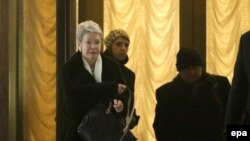
Organization for Security and Cooperation in Europe (OSCE) special representative Heidi Tagliavini told the UN Security Council on February 27 that "we seem to be at the crossroads" of war and peace in Ukraine.
She said fighting was subsiding, prisoners had been released, and the withdrawal of heavy weapons had begun.
But she added that the situation remained volatile.
Ertugrul Apakan, head of the OSCE Special Monitoring Mission to Ukraine, reported some firing around the Donetsk airport and the southeastern port city of Mariupol.
The council was holding its first meeting since it endorsed a cease-fire agreement that was reached in Minsk on February 12.
Ukraine's military said earlier on February 27 that three soldiers had been killed and seven others wounded in the past 24 hours, following two days of no fatalities.
Based on reporting by AFP and AP
Watch live: