



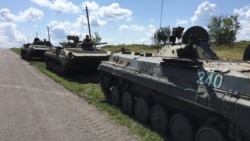
Despite the cease-fire, still fighting:
Ukrainian military spokesman Andriy Lysenko said on March 8 that one Ukrainian serviceman has been killed and three wounded in fighting in separatist eastern territories in the past 24 hours, despite a ceasefire deal.
Lysenko said that pro-Russian rebels "continue to fire on government troop positions ... (but) the intensity of provocative attacks by rebels on Ukrainian positions fell significantly overnight."
On March 7 pro-Russian rebels in eastern Ukraine said they had completed an agreed withdrawal of heavy weapons in line with recent cease-fire deals.
Lysenko said March 7 government forces are continuing to withdraw heavy weapons from the line of contact but are ready to return them to combat positions at any moment.
In cease-fire accords in September and February, the two sides agreed to form a buffer zone from 50 to 140 kilometers, depending on the range of the weapons.
That concludes our live blogging for Saturday, March 7. Follow our continuing coverage of events in Ukraine and throughout RFE/RL's broadcast region HERE.
Via TASS:
Security guarantees for OSCE monitors should be given both by militia and by Kiev, Russia's Deputy Foreign Minister Grigory Karasin told reporters on Saturday.
"The OSCE special Monitoring Mission is doing very important work, big work," he said. "What they need now is security guarantees."
"Of course, those guarantees should come both from the authorities in Kyiv, which are refraining, and from the militia," he said.
The Economist obituary of Boris Nemtsov is titled The Ruler Who Never Was:
Grassroots politics seemed the best course of action. In 2013 he got elected into a local parliament in Yaroslavl, not far from Nizhny Novgorod, where he handed out leaflets on the streets. After Russia’s annexation of Crimea, however, he found himself in a different country. Suddenly he was dealing not just with corrupt government, but also with millions of people whipped into a state of patriotic frenzy. Russia, he fretted, was turning into a fascist state, complete with Nazi-style propaganda and assault brigades.
When he spoke out now against the war in Ukraine, he was almost a lone voice. A vast banner-portrait calling him a traitor hung outside a bookshop in Moscow. Cheerfully determined, he went on distributing his leaflets, most recently for a rally that became his memorial procession.
He was not born for hatred or heroics. He had dreams, but had never intended to become a fighter against state-sponsored fascism. He was simply a good man: too good, in the end, for the country and the times he lived in.
From the U.S. ambassador to Ukraine: