



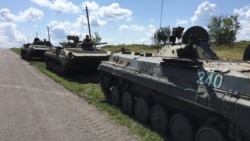
Just in case you missed it: Igor Sutyagin from the Royal United Services Institute, British defense and security think tank, has published a very detailed paper on the apparent involvement of Russian forces in Ukraine,
Here is an excerpt
Following their increasingly large-scale, direct and conventional involvement in combat against Ukrainian troops in the middle of August 2014,3 Russian troops in Ukraine numbered between 3,500 and 6,000–6,500 by the end of August 2014, according to different sources.4 That number fluctuated, reaching approximately 10,000 at the peak of direct Russian involvement in the middle of December 2014. The Russian Ministry of Defence (MoD) had to involve 117 combat and combat-support units to generate the approximately 42,000 troops rotating in the vicinity of the Russo–Ukrainian border: either stationed there, delivering artillery fire against Ukrainian territory from Russian soil, or directly participating in combat operations on Ukrainian sovereign territory. It is noteworthy that 104 of these 117 units have been involved in combat since autumn 2014 in either one of the two above mentioned forms – 3.5 times more than the number of military units involved in Crimea and in southeastern Ukraine over spring and summer 2014.
The overall figure of Russian troops operating in eastern Ukraine reached approximately 9,000 by the last week of February 2015 and has increased by at least 1,500–2,000 personnel since then.5 Russian troops stationed in Crimea should be also kept in mind – they might conservatively be estimated to number 26,000–28,000 now, including approximately 13,000 of the Russian Black Sea Fleet (other estimates of the overall number of Russian troops in Crimea range between 29,000 and 40,000).
It is also worth noting that all but two of Russia’s ten field armies – the 35th and 5th Red Banner – contributed troops for the summer-autumn phase of the Ukrainian operation (military units from Ussuriysk and Vladivostok came from the Eastern Military District, not from the 5th Red Banner field army; see Figure 1). Military units from as far as Vladivostok and the Kuril Islands have been identified participating in the Ukraine operation. Furthermore, seven out of ten Russian field armies (namely, the 2nd Guards, 6th, 20th, 49th, 41st, 36th and 29th Field Armies) have had or still have all manoeuvre units within their commands mobilised in order to generate sufficient troops for the summer/autumn and winter stages of the Ukraine operation. The 58th Field Army mobilised all but one of its manoeuvre units, which is stationed abroad without direct access to Russian territory (namely, the 102nd Military Base in Armenia; this is marked by a light-blue star in Figure 1). It is illustrative that the 102nd Military Base is the Russian beachhead in Armenia, which has been involved in a conflict with neighbouring Azerbaijan over the disputed Nagorno-Karabakh area since late 1989; the conflict has shown signs of heating up in recent months. The other Russian military base without direct access to Russian territory – the 201st in Tajikistan – was reported to be sending troops to the Russo–Ukrainian border in late January 2015.
The Russian MoD kept sending reinforcements to the east of Ukraine even after the ceasefire was signed in Minsk on 13 February. Indeed, two days later detachments of the 2nd Guards were detected in combat near Mariupol, where they arrived as a fresh reserve to replace the 138th Motor-Rifle Brigade, which had suffered serious manpower losses over a three-week period.
Read the entire article here
Here's a Putin update from our news desk:
Russian President Vladimir Putin, speaking in a pre-recorded documentary about Russia's seizure of Crimea, said former Ukrainian president Viktor Yanukovych's life was in danger as a result of the "revolution" that set out to seize power in Kyiv.
Russian news agencies quoted Putin as saying in the film, "For us it became clear and we received information that there were plans not only for his capture, but -- preferably for those who carried out the coup -- also for his physical elimination."
Putin was quoted as adding, "As one famous historical figure said: no person, no problem."
Putin's spokesman, Dmitry Peskov, said the Russian leader would watch the documentary, The Way Back Home, when it airs at 10:00 p.m. Moscow time on March 15.
Putin has not been seen in public or on live television since March 5 -- prompting a wave speculation as to his whereabouts, despite official insistence it was business as usual in the Kremlin.
(Reuters, Interfax, Tass)
RFE/RL's Ivan Putilov has been writing about the evident harrassment of independent journalists in Crimea.
KYIV -- One year after Russia's annexation of the Ukrainian Black Sea peninsula of Crimea, the pro-Russian de facto authorities continue to crack down on independent journalists there.
This week, agents of the Russian Federal Security Service (FSB) in the Crimean capital of Simferopol raided the homes of two reporters from the Center for Investigative Reporting, an independent journalism group that was forced to relocate to Kyiv after Russia annexed Crimea in March 2014.
In a statement issued on March 13, the Committee to Protect Journalists, a nongovernmental organization based in New York, described the raids as "repressive actions" and said journalists covering Crimea "have been harassed, attacked, detained, and had their equipment seized" over the last year.
Journalist Natalya Kokorina said the FSB searched the home of her parents, where Kokorina was registered, on March 13. At 8 a.m., Kokorina received a phone call telling her to come to the apartment immediately.
"In the morning, a man called saying he was from the...police," Kokorina told RFE/RL. "He said the doors of the apartment where I am registered and where my parents live had been sealed. My parents' telephones had been turned off."
She was subsequently detained and questioned for more than six hours before being released.
"Natasha is the author of many investigations about problems in Crimean society, corruption, thieves in power and the Russian occupation," wrote the founder of the Center for Investigative Reporting, Dmytro Gnap, on his Facebook page. "She and her colleagues have had to practically work underground on their articles."
Read the entire article here
Another update from our news desk:
Adam Osmayev, a Chechen commander of a Ukrainian volunteer battalion has denied any involvement in the murder of Russian opposition figure Boris Nemtsov.
Pro-Kremlin Russian newspaper Komsomolskaya Pravda had reported that "the organizers of the crime could have been Chechen militants" that it said have fought alongside government forces against Russian-backed separatists in the war in eastern Ukraine.
It cited an unnamed law enforcement source as claiming the masterminds of the murder were Osmayev and his wife, Amina Okuyeva.
Nemtsov was shot dead on February 27 on a Moscow bridge just meters away from the Kremlin.
Osmayev told Russia's Dozhd TV station on March 14 that the accusation was "complete nonsense, which isn't even worth commenting on." Osmayev said he viewed Nemtsov positively and news about his murder was "painful" to learn.
Osmayev was arrested in Ukraine in 2012, at Moscow's behest, on suspicion of plotting to kill Russian President Vladimir Putin, but was released in November 2014.
He then joined a Ukrainian volunteer battalion named after Dzhokhar Dudayev, the Chechen rebel leader who fought against Russia in the early 1990s.
(UNIAN, tvrain.ru)