



Eyeing Russia nervously, Poles enrol in volunteer militias
By Wiktor Szary and Kacper Pempel
WARSAW, March 20 (Reuters) - Spurred by the war in Ukraine, growing numbers of Poles are joining volunteer paramilitary groups to get basic military training and prepare to defend their homeland from what some see as a looming Russian invasion.
The Polish government has kept its distance from the unofficial civilian militias but, with anxieties about Moscow's intentions growing, the professional military is now looking for ways to harness the volunteer groups.
There are an estimated 120 such groups in Poland, with total membership around 10,000. Eight hundred members gathered on Friday in Warsaw at a meeting organised by the Defence Ministry, the first time they have been given official recognition.
Defence Minister Tomasz Siemoniak told them his ministry would pay the wages of 2,500 people who would form the backbone of local volunteer units to be mobilised in the event of a war.
The Polish president's chief security adviser, General Stanislaw Koziej, told Reuters the new approach had been prompted by the conflict in neighbouring Ukraine, where Russia is accused of fighting alongside pro-Moscow separatists.
"Until recently, paramilitary organisations treated defence as a pastime," he said. "Today, as we face a war across our border, they realise that this pastime could contribute to the country's security."
SELF-RELIANCE
Poland is a member of NATO, but the defence alliance rejected requests from Warsaw to establish a substantial permanent presence on Polish soil. That has shaken Poles' faith in NATO's resolve, officials in Warsaw say.
Instead, Poland is counting on a bilateral defence partnership with the United States, while building up its own defence capability, both conventional and unconventional.
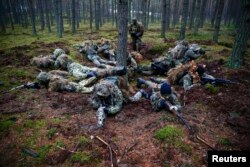
On a Saturday morning in March, 15 volunteers from the National Defence militia, an informal volunteer group, gathered in the rain and bitter cold in a forest near Minsk Mazowiecki, 40 km (25 miles) from Warsaw, to plan their weekly manoeuvres on a map sketched in the sandy soil.
Dressed in full military camouflage with fake rifles in their hands, the volunteers eagerly consulted a dog-eared photocopy of a military handbook before splitting into teams to practise ambushing an enemy.
Bernard Bartnicki, a student who led the drill, said the war in Ukraine boosted the organisation's ranks.
"Back in the day we would have two, maybe three people at our recruitment days, now it's 20, sometimes 30" he said.
General Boguslaw Pacek, a defence ministry adviser, has conducted a countrywide survey and estimated total membership at around 10,000.
Some of the 120 or so groups have as few as 30 members, Pacek says, and their skill levels vary. But because they are scattered all over the country, they could form a useful line of local defence in the event of war.
He said the army was looking into compiling training manuals for them and supplying them with surplus equipment.
PARTISAN FORCE
During World War Two, when Poland was occupied by Nazi Germany, the Polish government-in-exile commanded an underground partisan "Home Army" that ambushed German troops, staged acts of sabotage and mounted the ill-fated 1944 Warsaw Uprising.
Many defence analysts say a Russian attack on Poland is highly unlikely. Countries such as Moldova, Latvia or Estonia, with substantial Russian-speaking minorities, are much more likely targets, they say.
But suspicion of Moscow runs deep in Poland, which was ruled by Czarist Russia for over a century and under Soviet domination for over four decades after World War Two. It borders on Russia's Baltic enclave of Kaliningrad.
Moscow denies it has any plans for an offensive and says it has no direct role in the fighting in eastern Ukraine.
Robert Przybyl, a 42-year-old project manager, joined a civilian militia unit after Malaysian Airlines flight MH17 came down over eastern Ukraine in July last year, killing all 298 passengers and crew.
Kiev and its Western allies blamed Russia and the Moscow-backed separatists, who responded that Ukraine's military had shot the plane down.
Przybyl said he was shocked at what happened and started to worry Poland was again coming under attack by a foreign power.
"I want to decide what country my son lives in, and what language he speaks," he said.
His unit, also part of the National Defence militia, was carrying out exercises in a forest near Otwock, near Warsaw. New recruits took 5-km (3-mile) marches to test their stamina.
"Let's be honest, at war we would likely be cannon fodder," Przybyl said in an interview. But he said it was his duty to serve if war does break out.
"I never considered running away," he said.
Kremlin urges France, Germany to push Ukraine more on peace deal
MOSCOW, March 23 (Reuters) -- Russia accused Kiev on Monday of violating parts of the Minsk peace deal for east Ukraine and urged Germany and France, which helped negotiate it, to do more to ensure Kiev sticks to the agreements that were reached.
"The countries acting as guarantors of the Minsk agreements ... Russia, Germany, France .. should carry out their share of responsibility for ensuring the provisions are fulfilled," Kremlin spokesman Dmitry Peskov told reporters.
"To ignore that one side is not delivering on the agreements is not conducive to normalising the situation."
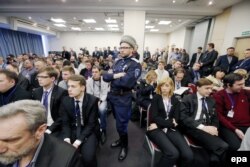
Far-right figures from Europe and the United States and nationalist supporters of Russian President Vladimir Putin criticized the West at a forum in St. Petersburg.
Participants at the Russian International Conservative Forum on March 22 condemned Western governments' stances on the conflict in Ukraine and praised what they described as Moscow's efforts to promote "traditional values."
Nick Griffin, the expelled former leader of the anti-immigrant British National Party, Udo Voigt, a senior figure in Germany's neo-Nazi fringe National Democratic Party, and members of the neo-Nazi Greek party Golden Dawn were among some 200 participants.
Griffin said that U.S. leaders "and their puppets in the European Union are doing everything they can...to drag us into a terrible war" between government forces and Russian-backed separatists in eastern Ukraine.
The gathering, which was halted by what authorities said was a bomb threat, drew criticism inside and outside Russia.
Russian opposition leader Aleksei Navalny wrote on Twitter: "The fascists have strangely and very quickly turned into Russia's friends."
Dozens of antifascist activists protested against the forum, and police detained eight of them.
Based on reporting by AFP, AP, fontanka.ru, Ekho Moskvy
By RFE/RL
Ukrainian authorities say a son of former President Viktor Yanukovych has died after a minivan he was driving plunged into Russia's Lake Baikal.
Anton Herashchenko, a lawmaker and aide to Ukrainian Interior Minister Arsen Avakov, said on Facebook on March 22 that the ousted former leader's younger son, also named Viktor, "died tragically today."
He said the minivan Yanukovych was driving plunged through ice and sank in the Siberian lake after falling over onto the driver's side.
Herashchenko said all five passengers in the minivan survived and "four of them didn't even get their feet wet."
Nestor Shufrych, a Ukrainian parliament deputy from the Opposition Bloc, gave a similar account on Facebook.
There was no confirmation from Russian authorities.
The younger Yanukovych, 33, was reportedly going by the name of Viktor Davydov.
The senior Yanukovych and most of his family have lived in Russia since was he chased from office in February 2014 after months of protests over his decision to reject a deal tightening ties with the EU and turn toward Moscow.
With reporting by Interfax, AP, BBC, Dozhd, and SiberianTimes.com
That concludes our live-blogging of the Ukraine crisis for today. Check back here on Monday morning for more of our continuing coverage.