



Ukraine to stop buying Russian gas from April 1 -energy minister
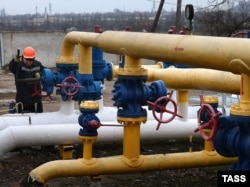
KIEV, March 23 (Reuters) - Ukraine plans to stop buying Russian gas from April 1, Ukrainian Energy Minister Volodymyr Demchyshyn said in a briefing on Monday.
"At the moment we don't need to buy Russian gas. We will simply stop buying it," Demchyshyn said.
On Saturday, he said that Ukraine was confident Russia would have to lower the price it charges Kiev for gas as increased imports from the European Union have greatly reduced Ukraine's reliance on supplies from Gazprom.
Russia and Ukraine are discussing a new pricing arrangement once the current package expires at the end of March.
Ukraine Says Rebels Moving Tanks Up, Attacks Persist
By RFE/RL
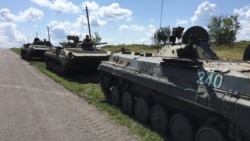
Ukrainian authorities are accusing Russian-backed separatists of moving tanks, weapons, and fighters closer to the line of contact with government forces in the east of the country.
In a statement issued on March 23, Interior Ministry adviser Zoryan Shkiryak said that 10 to 12 tanks had arrived overnight in Horlivka, a rebel-held city close to the front line.
Shkiryak said that "the enemy continues to concentrate its forces in occupied areas of Donetsk and Luhansk," a reference to two provinces held in part by the separatists.
The Ukranian military, meanwhile, said that six government soldiers were wounded in the previous 24 hours despite a cease-fire deal signed in Minsk last month.
More than 6,000 people have been killed in the conflict in eastern Ukraine since April 2014.
Fighting has lessened since the cease-fire took effect on February 15, but fighting persists and the prospects for a resolution of the conflict are clouded by disputes over other aspects of the peace deal.
With reporting by Unian
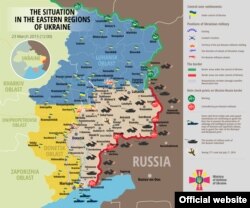
Here is today's map of the security situation in eastern Ukraine, according to the National Security and Defense Council (CLICK TO ENLARGE):
By RFE/RL's Ukrainian Service
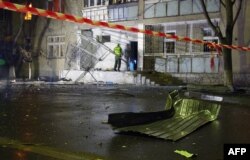
ODESA, Ukraine -- Police in Odesa say a homemade bomb exploded near an apartment block in the Ukrainian Black Sea port city late on March 22.
Authorities were treating the explosion, the latest in a series of bomb blasts in Odesa and the eastern city of Kharkiv in recent months, as a terrorist act.
Nobody was hurt.
Police said the blast damaged the office of Padaigma 12, an organization that aids handicapped people and in recent months has been helping soldiers wounded in the conflict with Russian-backed separatists in eastern Ukraine.
Other offices on the building's ground floor were also damaged.
Ukrainian authorities blame the blasts in Odesa and Kharkiv, many of which have apparently targeted organizations that have ties to soldiers fighting in the east, on Russia and the rebels who hold parts of the eastern provinces on Donetsk and Luhansk.
Both cities are under government control but are seen as prizes coveted by the Russian-backed rebels.
Russia expects Ukraine to repay $3 bln Eurobond on time - Finance Ministry
MOSCOW, March 23 (Reuters) - Russia expects Ukraine to repay a $3 billion Eurobond in full and on time, Deputy Finance Minister Sergei Storchak said on Monday.
In late 2013 Russia acquired $3 billion in Ukrainian Eurobonds that fall due this December.
Storchak also said that Moscow would not exercise a covenant of the Eurobond that stipulates that Russia has the right to ask for early repayment if Ukraine's overall debt exceeds 60 percent of nominal gross domestic product.
Storchak said Russia does not want to make Kiev's "life more difficult".
Eyeing Russia nervously, Poles enrol in volunteer militias
By Wiktor Szary and Kacper Pempel
WARSAW, March 20 (Reuters) - Spurred by the war in Ukraine, growing numbers of Poles are joining volunteer paramilitary groups to get basic military training and prepare to defend their homeland from what some see as a looming Russian invasion.
The Polish government has kept its distance from the unofficial civilian militias but, with anxieties about Moscow's intentions growing, the professional military is now looking for ways to harness the volunteer groups.
There are an estimated 120 such groups in Poland, with total membership around 10,000. Eight hundred members gathered on Friday in Warsaw at a meeting organised by the Defence Ministry, the first time they have been given official recognition.
Defence Minister Tomasz Siemoniak told them his ministry would pay the wages of 2,500 people who would form the backbone of local volunteer units to be mobilised in the event of a war.
The Polish president's chief security adviser, General Stanislaw Koziej, told Reuters the new approach had been prompted by the conflict in neighbouring Ukraine, where Russia is accused of fighting alongside pro-Moscow separatists.
"Until recently, paramilitary organisations treated defence as a pastime," he said. "Today, as we face a war across our border, they realise that this pastime could contribute to the country's security."
SELF-RELIANCE
Poland is a member of NATO, but the defence alliance rejected requests from Warsaw to establish a substantial permanent presence on Polish soil. That has shaken Poles' faith in NATO's resolve, officials in Warsaw say.
Instead, Poland is counting on a bilateral defence partnership with the United States, while building up its own defence capability, both conventional and unconventional.
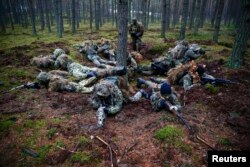
On a Saturday morning in March, 15 volunteers from the National Defence militia, an informal volunteer group, gathered in the rain and bitter cold in a forest near Minsk Mazowiecki, 40 km (25 miles) from Warsaw, to plan their weekly manoeuvres on a map sketched in the sandy soil.
Dressed in full military camouflage with fake rifles in their hands, the volunteers eagerly consulted a dog-eared photocopy of a military handbook before splitting into teams to practise ambushing an enemy.
Bernard Bartnicki, a student who led the drill, said the war in Ukraine boosted the organisation's ranks.
"Back in the day we would have two, maybe three people at our recruitment days, now it's 20, sometimes 30" he said.
General Boguslaw Pacek, a defence ministry adviser, has conducted a countrywide survey and estimated total membership at around 10,000.
Some of the 120 or so groups have as few as 30 members, Pacek says, and their skill levels vary. But because they are scattered all over the country, they could form a useful line of local defence in the event of war.
He said the army was looking into compiling training manuals for them and supplying them with surplus equipment.
PARTISAN FORCE
During World War Two, when Poland was occupied by Nazi Germany, the Polish government-in-exile commanded an underground partisan "Home Army" that ambushed German troops, staged acts of sabotage and mounted the ill-fated 1944 Warsaw Uprising.
Many defence analysts say a Russian attack on Poland is highly unlikely. Countries such as Moldova, Latvia or Estonia, with substantial Russian-speaking minorities, are much more likely targets, they say.
But suspicion of Moscow runs deep in Poland, which was ruled by Czarist Russia for over a century and under Soviet domination for over four decades after World War Two. It borders on Russia's Baltic enclave of Kaliningrad.
Moscow denies it has any plans for an offensive and says it has no direct role in the fighting in eastern Ukraine.
Robert Przybyl, a 42-year-old project manager, joined a civilian militia unit after Malaysian Airlines flight MH17 came down over eastern Ukraine in July last year, killing all 298 passengers and crew.
Kiev and its Western allies blamed Russia and the Moscow-backed separatists, who responded that Ukraine's military had shot the plane down.
Przybyl said he was shocked at what happened and started to worry Poland was again coming under attack by a foreign power.
"I want to decide what country my son lives in, and what language he speaks," he said.
His unit, also part of the National Defence militia, was carrying out exercises in a forest near Otwock, near Warsaw. New recruits took 5-km (3-mile) marches to test their stamina.
"Let's be honest, at war we would likely be cannon fodder," Przybyl said in an interview. But he said it was his duty to serve if war does break out.
"I never considered running away," he said.