

Great little "sign of the times" exchange between New York Times journalists.
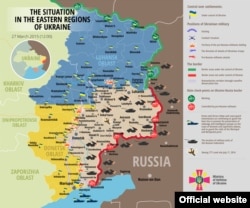
The latest situation map from Ukrainian military authorities.
Says Speck:
As the Ukraine conflict continues, the question is whether Germany will be able to maintain a leadership position by permanently moving the conflict from the field of military confrontation, where Russia has the upper hand, to the diplomatic and the economic spheres, where a German-led EU has the comparative advantage.
Politics professor Nicolai Petro argues in The Guardian that "...if the west is truly interested in the success of Ukraine, then it should recognise that it too has a vital stake in expanding liberal discourse in Ukraine, and in overcoming the nationalistic rhetoric that can only further divide the nation."
He also says:
...Ukrainian elites have a fateful choice to make. They can try to resolve the problem of national unity by adopting nationalistic symbols, rallying people around an “eternal enemy” (Russia) and making the new national identity a litmus test of loyalty. Or, they can forge unity through the incorporation of Russian speakers into a new civic patriotism in which Ukrainian identity is defined by its civic virtues rather than by culture or ethnicity. Simply put, the choice is between nationalism and liberalism.
Both are quintessential European values, but they lead to very different political systems.
Moreover, given Russia’s overwhelming cultural presence in Ukraine, building a national identity at the expense of Russian identity would prove especially difficult, like trying to build Canadian identity around anti-Americanism and a refusal to speak English.