


An excerpt:
“Are they waiting for us?” asked Olga Ischenko, the mayor of Pervomaysk, a rebel-held town on the frontlines of the conflict in eastern Ukraine. She was asking me because I had just been in Popasnaya, a government-held town five miles away. She wanted to know if its people were yearning to be liberated by the rebels. What has happened to these neighboring towns shows just how divided and bitter the region has become since fighting began almost exactly a year ago.
Before the war Pervomaysk’s population was nearly 39,000, while Popasnaya’s was 22,000; the former is a mining town, the latter mostly industrial and agricultural. Identities in this part of Ukraine are fluid and Russian is the lingua franca, but according to the 2001 census a majority of people in the Popasnaya district regarded Ukrainian as their first language, while in Pervomaysk it was Russian. The war has shattered the economies of both and most of their populations have fled, either just away from the front, to Russia, or to other parts of Ukraine. It also has left them on opposite sides.
Just outside the Pervomaysk town hall where Mayor Ischenko works is a statue of Lenin, in front of which have been stacked unexploded artillery shells and the remains of Grad and Smerch missiles fired at her town from Popasnaya. Until January 22, the mayor was Evgeny Ischenko, Olga’s husband, a Cossack militia leader whose forces are part of those of the self-proclaimed Lugansk People’s Republic. Then he was murdered, so she took over. “It was necessary to take the position,” she explains, “to prevent armed robbery and looting in town.”
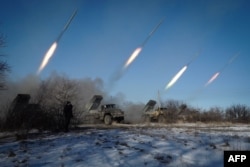
Ukraine accuses rebels of firing Grad rockets
Kiev, March 28, 2015 (AFP) -- Ukraine government forces on Saturday accused pro-Russian separatists of using Grad multiple rocket launchers overnight in the country's war-torn east in violation of a truce deal signed last month.
Military spokesman Andriy Lysenko told reporters that separatists fired the heavy weapons towards the village of Novotoshkivka from their Lugansk stronghold.
Around 40 missiles were aimed at a Ukrainian checkpoint, while another 20 hit a residential area, he claimed, adding that there had been no military or civilian casualties over the last 24 hours.
The use of Grads is prohibited under the ceasefire brokered by French President Francois Hollande, German Chancellor Angela Merkel and Russian President Vladimir Putin that came into force on February 15.
Despite the agreement, eastern Ukraine has been the scene of daily clashes. The nearly year-long conflict has claimed more than 6,000 lives.
Meanwhile, Turkish diplomat Ertugrul Apakan, who heads the OSCE monitoring team, called on both sides to stop the fighting around the village of Shyrokyne, where a civilian was killed on Thursday.
"I am profoundly disappointed that, in the face of mounting deaths and injuries among the civilian population, the calm that prevailed in Shyrokyne for two days has not endured," he said in a statement issued overnight Friday.
"I urge all sides to silence their guns immediately, and to allow the residents of Shyrokyne to return to their homes and to a peaceful existence."
The village is 10 kilometres (six miles) from the strategic port of Mariupol, the last major city in the rebel-controlled east still held by Kiev.
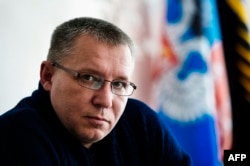
Judge looks to build 'new society' in Ukraine rebel bastion
Donetsk, Ukraine, March 28, 2015 (AFP) -- Even as he breaks down in tears, judge Alexander Klyanoshkin admits no regrets about ending a decade on the bench in his government-held hometown in eastern Ukraine to serve in the pro-Russian breakaway republic of Donetsk.
Along with his wife and children, Klyanoshkin made the 50 kilometres (30 miles) journey south to sign up as a judge in the fledgling court system being established by rebels in their war-scarred capital.
Now his dream is to help build what he hopes will be a "new society" in the self-proclaimed separatist statelet.
Klyanoshkin says he left Kiev-held territory to cross over to the legally unrecognised would-be country after becoming "disgusted" by the Ukrainian authorities, whom he views as illegitimate.
"That country (Ukraine) has no future," he says, sitting in a leather chair in his new office.
Pro-European President Petro Poroshenko, voted in last May after the ouster of Kremlin-backed leader Viktor Yanukovych, "took power by unconstitutional means", the judge insists.
"A president must be elected according to the constitution and not by revolution," he says, with the flag of the enclave the rebels have carved out through a brutal uprising on his desk.
After almost a year of fighting that has cost the lives of more than 6,000 people, the legal system in the rebel republic is still in its infancy.
The basis of it -- and everything that Klyanoshkin believes to "the bottom of his soul" -- is bound up in a new "Criminal Code", published by the separatist leaders.
- 'Respect power!' -
The little book -- with a cover depicting a Russian eagle on top of the separatist flag -- replaces the Ukrainian code that rules in the rest of the country.
The new criminal code is "more humane" than its Ukrainian counterpart, the judge says, citing its reduced reliance on custodial sentences.
A new civil code should follow, but not without a lot of debate over its contents, he adds.
"People should respect power! And if they want to fight against it, they must do so through democratic means," he argues.
"I do not see democracy in Ukraine. I was attracted by the Donetsk People's Republic because this 'state' respects the fundamental principles of law: respect for the individual, religion and cultural diversity."
According to the judge, the refusal of the international community, notably France and Germany, to recognise DPR's legitimacy "does not matter".
"It may take a year, 10 years, but the international community will recognise the People's Republic," he predicts.
"We will convince them by promoting democratic principles. And because we are creating a new society."
Klyanoshkin served in the judicial system for 10 years in his home city of Artemivsk, but claims decisions there were made "not by law but by politics".
After a decade of resentment, he says, "it is very hard to be disappointed here".
"There will certainly be challenges, but I'm ready to do anything so that the judicial powers will be respected," added the stocky judge, but stressed that it must be "without violence".
He suddenly breaks down in tears when asked if his eight-year-old daughter blames him for taking the family from their old life, away from the bombs and fear.
"No, I think she understands. But when she watches a film about the war on television, she cries," he admits, rushing to the window to hide his tears.
"During the bombing, we hid in our bedrooms," he recalls, looking down on the street.
Meanwhile, his 20-year-old son is following his father's footsteps, and just now completing his law studies.
That concludes our live-blogging of the Ukraine crisis for Friday, March 27. Check back here tomorrow for more of our continuing coverage.
Russian Orthodox Priest Suspended After Blessing Ukraine-Bound Fighters
By RFE/RL
The Russian Orthodox Church has suspended a priest for incendiary comments he made during a send-off for dozens of fighters preparing to join pro-Russian separatists in eastern Ukraine.
Local diocese authorities in the Urals city of Yekaterinburg said in a March 26 statement that the priest, Vladimir Zaitsev, broke with the church’s position on the bloody conflict in Ukraine by encouraging the fighters to battle Ukrainian forces he described as “fascist scum.”
They said his March 11 comments, which were captured on film, should not be considered a "blessing for carrying out a fratricidal war."
They said a decision on whether to reinstate Zaitsev will be made after Easter.
More than 6,000 people have been killed in the conflict since April 2014.
Western governments accuse the Kremlin of providing arms and personnel to the separatists, a charge Moscow denies.
With reporting by Reuters
In Dnipropetrovsk, Kolomoyskiy's Departure Leaves No One Indifferent
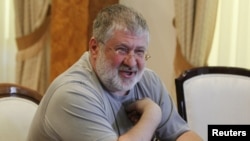
This week's surprise ouster of oligarch and Dnipropetrovsk Governor Ihor Kolomoyskiy has prompted strong emotions among locals, who -- love him or hate him -- acknowledge the key role he's played in keeping the eastern region safe.