



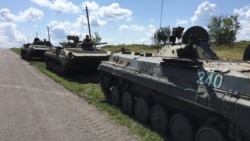
Maxim Tucker has been writing for Newsweek on how Russia's "hybrid war" in Ukraine is entering a deadly new phase:
Pushing his baby daughter in a pram in front of him, 37-year-old Dmitriy Komyakov paused as marchers ahead adjusted their positions around a huge Ukrainian flag. It was a bright day in Kharkiv, Ukraine’s second largest city. A good day for the hundreds in attendance to celebrate one year since Euromaidan demonstrators ousted president Viktor Yanukovych.
Just as the march moved off again, an explosion ripped into the crowd. Komyakov was close enough to feel the heat of the blast wave. As bloodied victims slumped to the floor, he searched for his wife and 12-year-old daughter among the panicked crowd. “I could see pieces of metal flying and people starting to fall,” he says. “First I checked the baby to see if she was injured, then myself, looked around and that’s when my wife and daughter ran to me.” Miraculously, the whole family had escaped unscathed. But four people, including two teenage boys, were killed in that blast and another nine seriously wounded.
Ukraine’s state security service, the SBU, says Russia has entered into a new phase of its campaign to destabilise Ukraine, with the 22 February attack in Kharkiv just one of a series of bombings orchestrated by Russian spy services, the FSB and the GRU. “It starts with the FSB’s security centres 16 and 18, operating out of Skolkovo, Russia,” says Vitaliy Naida, head of the SBU department responsible for intercepting online traffic. “These centres are in charge of information warfare. They send out propaganda, false information via social media. Re-captioned images from Syria, war crimes from Serbia – they’re used to radicalise and then recruit Ukrainians.”
He takes a suspected three-man terror cell from Dnipropretovsk who are currently on trial as an example and walks Newsweek through the evidence, including photographs and video of weapons with Russian serial numbers and intercepted communications. Passed instructions and weapons via dead-drops, the cell never met their handlers.
“They were recruited by the FSB. Instructions were initially given in private messages via internet and in some cases Vkontakte [a Russian social network],” Naida says. “When they were detained and arrested, in their houses we found explosives, grenades, means of communications and printed messages – where to set explosives, where they should be placed to create panic.” Naida’s unit monitors roughly 600 “anti-Ukrainian” social network groups with hundreds of thousands of members. So far it has intercepted communications between 29 prolific group administrators and individuals using accounts linked to the Russian security services.
A cursory internet search reveals separatist groups are no longer just Ukraine’s problem. This year Armenia, the Baltic countries, Moldova and Poland have suddenly acquired new “People’s Republic” pages on social media, some overtly pro-Russian, others simply stoking ethnic tensions between majority and minority populations in the same city or country – be they Russians and Latvians, or Poles and Lithuanians.
In the meantime, not a week goes by in Ukraine without some form of terror-related incident – from a hoax bomb threat shutting down Lviv airport in western Ukraine, to a series of blasts targeting pro-Ukrainian political groups in Odessa, southern Ukraine. Infrastructure such as railways and financial institutions are hit, and in cases like Kharkiv, ordinary Ukrainians too.
Read the entire article here
Here's an update ATR TV update from the Crimean Desk of RFE/RL's Ukrainian Service:
SIMFEROPOL, Ukraine -- The only television channel broadcasting in the Crimean Tatar language on the annexed Ukrainian peninsula of Crimea may be shut down.
Lenur Islyamov, the owner of the ATR channel, told reporters in Simferopol on March 31 that Russian media regulator Roskomnadzor has rejected several attempts by ATR to register under Russian law, citing various technicalities.
Islyamov said the deadline for registering his channel, which still holds a Ukrainian license to broadcast, is March 31.
Islyamov said his station has no plans to move from Crimea to another location in Ukraine in order to continue broadcasting.
Some 100 Crimean Tatars came to ATR's headquarters on March 31 to support it.
Activists, community leaders, and rights groups say Crimean Tatars have faced discrimination, pressure, and abuse for their opposition to Russia's illegal annexation of Crimea from Ukraine in March 2014.
Crimean Tatars make up some 10 percent of the population of Crimea.
Meanwhile, two combat helicopters were illegal sold by someone inside Ukraine's army, AG @GP_Ukraine says. Two. Helicopters.
— Maxim Eristavi (@MaximEristavi) March 31, 2015
Former Kyiv Police Officials Wanted Over Maidan Crackdown
Ukrainian prosecutors have added two former senior Kyiv police officials to a list of suspects wanted over a deadly crackdown on "Euromaidan" protesters in the capital in February 2014, before Viktor Yanukovych was ousted as president.
The Ukrainian Prosecutor General's office said on March 31 that former acting Kyiv police chief Valeriy Mazan and his deputy, Petro Fedchuk, are suspected of organizing the dispersal of protesters on Kyiv's Independence Square on February 18-19, 2014.
It said that 13 people were killed and 130 injured on those dates as a result of the "unlawful" use of force.
The whereabouts of Mazan and Fedchuk are unknown.
More than 100 people, including 17 security officers, were killed during a crackdown on the pro-European protests between February 18 and 21, 2014.
Nine protesters died in the weeks that preceded the clashes.