



Savchenko starts eating again "to survive until her trial":
Ukrainian military pilot Nadia Savchenko, who has been on hunger strike to protest being held in a Russian jail, has reportedly resumed eating small amounts of food.
Mikhail Fedotov and Yelizaveta Glinka, members of Russia's presidential human rights council, say Savchenko has begun eating dairy products with the aim of staying alive until her trial, which has yet to be scheduled.
The announcement came after Fedotov and Glinka visited Savchenko at Moscow's Matrosskaya Tishinka prison on April 3.
This is the second time Savchenko, 33, has interrupted her hunger strike.
Citing health concerns, she briefly resumed eating in early March after more than 80 days without solid food. She returned to her fast on March 16.
Savchenko, a member of Ukraine's volunteer Aidar Battalion, is charged in connection with a June 2014 mortar attack that killed two Russian journalists covering the conflict between government forces and Russian-backed separatists in eastern Ukraine.
She says she was kidnapped by separatists in June and illegally transferred to Russia. (TASS and Interfax)
Ukraine Detains Alleged Separatist Fighter
By RFE/RL
The Ukrainian Security Service (SBU) says it has detained an alleged mercenary suspected of having fought on the side of pro-Russian separatists in the country's east.
The SBU said on April 2 that a 26-year-old Kharkiv resident had been detained after returning to the eastern Ukrainian city from Russia's Rostov region.
Investigators believe the man received money to fight alongside separatists in the Donetsk region, which borders Kharkiv province.
They said preliminary investigations revealed he was wounded last year and treated in the Rostov region.
The suspect is facing charges of threatening Ukraine's territorial integrity and could be imprisoned for five years if convicted.
More than 6,000 people have been killed in eastern Ukraine in fighting between rebels and pro-government forces since April 2014.
Kyiv and the West accuse Russia of sending troops and arms to aid the separatists, a charge Moscow denies.
An excerpt:
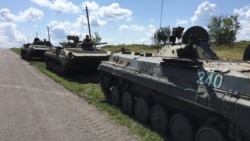
YENAKIEYEVE, Ukraine -- On a recent spring morning, an important visitor watched Russian-backed rebels conduct infantry maneuvers on the sunlit training grounds outside this town in eastern Ukraine.
"The general is very pleased," rebel battalion commander Ostap Cherny told his troops, referring to the figure in camouflage encircled by five armed guards.
The man — almost certainly a Russian military officer — became alarmed when he saw two journalists approach. His entourage shielded him from all sides, warning that photos were forbidden, and the group soon sped off in a four-car motorcade, with the "general" safely inside a black Toyota SUV with no license plates.
Nearly a year into the conflict in Ukraine, the extent of Moscow's direct involvement has become clear: They may wear camouflage, but the Russians' presence in eastern Ukraine is hardly invisible.
At the same time, there has been a recent shift in tactics that appears aimed at minimizing Russia's military presence as part of an effort to persuade the West to lift its punishing economic sanctions.
Visits by The Associated Press to training grounds like those near Yenakiyeve and interviews with dozens of rebels reveal that Russian armed forces spearheaded some of the major separatist offensives, then withdrew quickly before they could be widely noticed.
Excerpt:
Parliament may soon enter dangerous territory if it decides to criminalize the public denial of military aggression that Ukraine is facing from Russia. Should the bill, co-authored by the buffoonish Radical Party leader Oleh Lyashko, be approved, the offender will receive up to five years in prison. A repeat offender will face 10 year in prison for denying the fact. The authors argue that this law will prevent the nation from breaking up and specifically targets local officials in Ukraine’s east who refuse to use the word “aggression” in describing Russia’s actions.