



TUCKED away behind the Carpathian mountains, Ukraine’s Transcarpathian region has its share of problems. Ethnic separatism is not among the major ones. Nonetheless, this remote region's Ruthenian and ethnic-Hungarian communities have become a target for Russian propaganda aimed at dividing Ukrainian society. In mid-March Ukrainian news outlets reprinted a report that organisations of Transcarpathia's Ruthenes (a small Slavic ethnic group scattered across Ukraine, Slovakia and Poland) had held a congress “demanding recognition of their national identity and autonomy of their land”. It turned out that the congress had been made up out of whole cloth by TASS, the Russian news agency.
It was a postmodern tactic that might have been appreciated by the art world's most famous ethnic Ruthene, Andy Warhol. In Transcarpathia itself, the fake news caused a stir at the Ruthenian House in Mukacheve, a town just south of the Carpathians. Local Ruthenes say that Petro Getsko, a “Ruthenian leader” quoted by TASS who calls himself the “prime minister of Subcarpathian Rus”, has not been seen in Transcarpathia for several years. Mr Getsko, who is a wanted man in Ukraine, is believed to be in Russia.
OSCE monitors discuss visit to Donetsk's destroyed airport:
Russia's role in eastern Ukraine shifts to training separatist fighters, AP reports:
YENAKIEYEVE, Ukraine (AP) — On a recent spring morning, an important visitor watched Russian-backed rebels conduct infantry maneuvers on the sunlit training grounds outside this town in eastern Ukraine.
"The general is very pleased," rebel battalion commander Ostap Cherny told his troops, referring to the figure in camouflage encircled by five armed guards.
The man — almost certainly a Russian military officer — became alarmed when he saw two journalists approach. His entourage shielded him from all sides, warning that photos were forbidden, and the group soon sped off in a four-car motorcade, with the "general" safely inside a black Toyota SUV with no license plates.
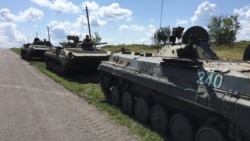
Nearly a year into the conflict in Ukraine, the extent of Moscow's direct involvement has become clear: They may wear camouflage, but the Russians' presence in eastern Ukraine is hardly invisible.
At the same time, there has been a recent shift in tactics that appears aimed at minimizing Russia's military presence as part of an effort to persuade the West to lift its punishing economic sanctions.
Visits by The Associated Press to training grounds like those near Yenakiyeve and interviews with dozens of rebels reveal that Russian armed forces spearheaded some of the major separatist offensives, then withdrew quickly before they could be widely noticed.
More recently, as a shaky cease-fire has taken hold, Russia has kept fewer troops in Ukraine but has increased its training of rebels to make sure they are capable of operating sophisticated Russian weaponry and defending the territory they control. NATO and an independent London-based Russian scholar estimate that Russia has several hundred military trainers in eastern Ukraine.
Savchenko starts eating again "to survive until her trial":
Ukrainian military pilot Nadia Savchenko, who has been on hunger strike to protest being held in a Russian jail, has reportedly resumed eating small amounts of food.
Mikhail Fedotov and Yelizaveta Glinka, members of Russia's presidential human rights council, say Savchenko has begun eating dairy products with the aim of staying alive until her trial, which has yet to be scheduled.
The announcement came after Fedotov and Glinka visited Savchenko at Moscow's Matrosskaya Tishinka prison on April 3.
This is the second time Savchenko, 33, has interrupted her hunger strike.
Citing health concerns, she briefly resumed eating in early March after more than 80 days without solid food. She returned to her fast on March 16.
Savchenko, a member of Ukraine's volunteer Aidar Battalion, is charged in connection with a June 2014 mortar attack that killed two Russian journalists covering the conflict between government forces and Russian-backed separatists in eastern Ukraine.
She says she was kidnapped by separatists in June and illegally transferred to Russia. (TASS and Interfax)