



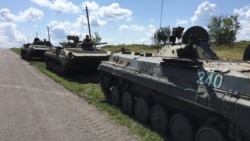
Good morning. We'll start the live blog today with this report from our news desk on some fatalities in eastern Ukraine yesterday:
Six Ukrainian soldiers were killed on April 5 in the east of the country in two separate incidents as the conflict in eastern Ukraine entered its second year.
The Interior Ministry said a military vehicle was hit as it drove across a bridge in Schastye, a government-held town about 170 kilometers northeast of the separatist-held city of Donetsk.
The ministry accused Russian-backed separatists of firing the shell, but that report could not be independently confirmed.
It said Initial reports showed "militants had fired a laser-guided antitank missile."
Ukraine's antiterrorism center has identified all four of the servicemen, adding that they came from the Kharkiv region.
The information center for the so-called Luhansk People's Republic denied reports its forces were involved.
The pro-Russian separatists claimed the Ukrainian military vehicle hit a landmine placed on the bridge by Ukrainian forces.
In a separate incident less than an hour later, a Ukrainian military vehicle hit a landmine near the town of Shyrokyne, east of the city of Mariupol, killing two servicemen and wounding one other.
The previous day, the government reported the deaths of another three soldiers when a mine exploded near Avdiyivka, a government-held town north of Donetsk.
The fatalities were the first announced by the authorities in almost a week after the death of a Ukrainian army soldier reported on March 30.
The deaths have underscored the fragility of a cease-fire in force since February, when it was brokered by leaders from Germany and France with the Ukrainian and Russian leaders in attendance.
Both sides in the conflict have accused the other of violations since the cease-fire went into effect.
More than 6,000 people have been killed since fighting broke out between pro-Russian separatists and the Ukrainian government a year ago, according to the UN.
(Reuters, AFP, UNIAN, Interfax)
Barring any major developments, we won't be live blogging today. Normal service will resume on Monday.
Read Carl Schreck's piece on the Kremlin troll's cartoon database here:
Russian Trolls' Vast Library Of Insulting Images

Leonid Reshetnikov, a retired SVR general, director of the Russian Institute for Strategic Studies (RISI), and an advisor to Vladimir Putin, says that there is no possibility that Novorossiya will be part of Ukraine ever again because “the people of the south-east do not want to be Ukrainians.”
He also rules out the likelihood that the territories of the Donetsk Peoples Republic and Luhansk Peoples Republic, with their “millions of people,” could become something like a Transdniestria, a partially recognized country within the borders of another country recognized by most.
And thus he suggests that the immediate future is more war and the longer term future is the annexation of these areas and ultimately the rest of Ukraine and much of the former Soviet space into a new Russian state that will combine “the best features” of the pre-1917 Russian Empire and the USSR.
These are just some of the views that Reshetnikov offers in the course of a wide-ranging interview he gave to Aleksandr Chuikov, a journalist for “Argumenty Nedeli” (rgumenti.ru/toptheme/n481/394395).
Lavrov urges withdrawal of more weapons from eastern Ukraine:
Russian Foreign Minister Sergei Lavrov has proposed that both sides in the conflict in Ukraine withdraw weapons of under 100 mm caliber from the line of contact as a way of boosting confidence in a February cease-fire.
Lavrov made the comment in the Slovak capital, Bratislava, where he was holding talks with officials and attending festivities to commemorate the 70th anniversary of Bratislava's liberation by the Red Army in World War II.
Lavrov said it was necessary to monitor mainly the military part of the February Minsk agreement that established a cease-fire between Ukrainian government soldiers and pro-Russian separatist fighters in the east of Ukraine.
The Mink agreement committed both sides to withdrawing larger weapons of 100 mm caliber or more and to creating a security zone of at least 50 kilometers wide within 14 days. (Reuters, Interfax, TASS)