



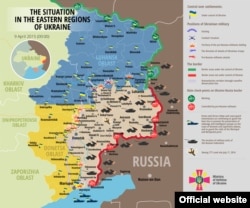
Here is a map of today's military situation in the Donbas region, issued by Ukraine's Ministry of Defense (click image to enlarge):
Meanwhile, our resident Kremlin-watcher, Brian Whitmore, also looks at Odesa in the latest Daily Vertical video blog. In today's edition, he looks at efforts in the city to revive the old Russian imperial territory of Bessarabia, which straddles what is now Moldova and part of the Odesa region:
Here's an item from RFE/RL's news desk on events in Odesa, where things are expected to get pretty tense in the coming weeks in the run-up to the first anniversary of May 2 clashes in the city between pro-Moscow and pro-Kyiv groups that culminated in the deaths of dozens of separatists in the local trade union building:
Ukrainian authorities say they have detained 27 alleged members of a "saboteur" group in the Black Sea port city of Odesa.
President Petro Poroshenko's press secretary, Svyatoslav Tseholko, said on Facebook on April 9 that Security Service (SBU) chief Valentyn Nalyvaychenko reported the suspects' detention to Poroshenko.
According to Tseholko, investigators found grenade launchers and maps of Odesa's ports in the suspects' possession. He said two of those detained are also suspected of plotting to kill a lawmaker.
Last week, the SBU said it had detained three people suspected of involvement in a series of bombings in Odesa, some of them targeting organizations with ties to soldiers fighting against Russian-backed rebels in eastern Ukraine.
Ukrainian authorities blamed those blasts on Russia and the rebels who hold parts of the eastern provinces of Donetsk and Luhansk.
Odesa lies on territory coveted by the separatists.
The BBC has issued a nice piece looking at the ramifications of Right Sector leader Dmytro Yarosh's apppointment as an adviser to the Ukrainian Army earlier this week:
Russian media were quick to condemn the move. "Neo-Nazis are strengthening their positions," proclaimed Russia's state-owned Rossiya 1 TV. "Radical armed groups will become a separate assault brigade, led by Yarosh."
Russia accuses him of incitement to terrorism and at Russia's request he is listed as wanted by Interpol. He denies the charges.
The claim that Mr Yarosh comes from neo-Nazi ranks, or represents them, is a distortion.
"He is a nationalist - though there is a discussion, among experts, on whether labels like 'ultra-nationalism', 'fascism' or 'extreme right' should be applied to him," wrote Andreas Umland, an expert on the far right in Ukraine.
Mr Umland points out that Mr Yarosh, unlike many other far-right activists, defines nationality according to citizenship. That is, not just ethnic Ukrainians are considered to be, so to speak, "true Ukrainians", but Russians, Jews, Tartars or any other group living on Ukrainian territory.
That said, Mr Yarosh's political beliefs fall firmly to the right of the political spectrum.
"In the past, he has made critical statements about Western liberalism and European integration," Mr Umland said.
Read the entire article here
Meanwhile in Moscow... (from RFE/RL's news desk):
Russian Foreign Minister Sergei Lavrov says he plans to meet with his counterparts from Ukraine, Germany, and France on April 13 to discuss the implementation of a deal meant to end the armed conflict in eastern Ukraine.
Russian news agencies reported on April 9 that the meeting will take place in Berlin.
Talks in Minsk between the leaders of Germany, France, Ukraine, and Russia produced a February 12 agreement on a cease-fire and steps aimed to resolve disputes between the Ukrainian government and Russian-backed separatists who control parts of Ukraine's Donetsk and Luhansk provinces.
Fighting between the rebels and government forces has killed more than 6,000 people since April 2014, many of them civilians.
Fighting has decreased markedly since the cease-fire took effect, but each side accuses the other of frequent violations.
Disagreements over political aspects of the Minsk accord, such as elections, have undermined the chances of ending the conflict.
(TASS, Interfax)