



More on Polish President Bronislaw Komorowski's trip to Ukraine:
On April 9, Komorowski and Poroshenko visited Bykivnya, an area on the outskirts of Kyiv where thousands of people, including Polish officers killed by Soviet authorities in March-April 1940, are buried.
Paying tribute to the victims of the Soviet regime, Komorowski said that "the commemoration of the victims of the past is one of the ways to prevent similar tragedies in future."
Poroshenko said that Bykivnya graves are "an echo of the black September of 1939 when Hitler and Stalin together ignited the bloody slaughter of the World War II, trying to share and break Europe."
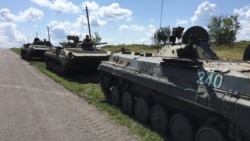
RFE/RL's Darya Kostenko and Claire Bigg have been writing about a town called "Happiness," which is on the front line of the Ukrainian conflict:
Most of the insurgent strikes were launched from Merry Hill, an elevated spot on the edge of Shchastya. Behind the hill lies Luhansk, the second-largest city controlled by the insurgents.
Almost 14,000 people lived in Shchastya before the conflict. Only about 3,000 remain, many of them pensioners.
While the fighting has stopped, destruction is everywhere. The shelling has smashed countless windows and left gaping holes on buildings across the town.
"A shell fell here and a woman was killed by a falling beam," explain Andriy, a medic helping out the Ukrainian fighters, pointing to an apartment block. "The beam lay there for some time, spattered with blood."
The hospital, too, has come under fire. A charred ambulance parked outside testifies to the violence that shook this once uneventful city. One of the hospital's floors has been turned into a sickbay for injured soldiers.
Surgeons and other specialists, however, have long fled. Shchastya's last anesthesiologist left last summer after her husband, who had joined the separatists, was killed in a firefight.
A woman smokes next to blood-stained stretchers placed to dry in the sun at the hospital in Shchastya in October 2014.
A woman smokes next to blood-stained stretchers placed to dry in the sun at the hospital in Shchastya in October 2014.
On the city's central square, young mothers strolling with their children lend the area an atmosphere of normalcy. Only the empty pedestal, on top of which the statue of Bolshevik leader Vladimir Lenin once stood before being toppled by Ukrainian fighters, evokes the conflict. Local residents have jokingly dubbed it "the monument to the invisible man."
Read the entire article here
Here's another update from our news desk:
Ukraine's parliament voted on April 9 to ban "propaganda of the totalitarian Communist and Nazi regimes," a major rebuke to the country's Soviet-era masters in Moscow and to Russia.
A total of 254 members of the 450-seat Vekhovna Rada voted in favor of the legislation in the former Soviet republic, which is deeply at odds with Russia over its annexation of Crimea and support for separatists in a conflict that has killed more than 6,000 people.
Under the legislation, the Communist government that ruled between 1917 and 1991 -- the Soviet era -- is condemned as a criminal regime that conducted policies of state terror.
Its symbols and propaganda are banned -- a measure that, if implemented thoroughly, would require the demolition of monuments to Bolshevik Revolution leader Vladimir Lenin and other Soviet-era images that remain.
The legislation was initiated by the government and will become law when it is officially published, possibly on April 10.
It applies the same treatment to the Nazi regime, which occupied and controlled much of Ukraine during World War II before being driven out by Soviet forces.
The legislation is part of a shift away Soviet imagery Kyiv says the Kremlin is using to influence neighbors and promote self-serving myths about World War II amid the conflict in eastern Ukraine.
(UNIAN, AFP)
A tweet from the BBC reporter who exposed a fake news report about a 10-year-old girl who has died in shelling in eastrn Ukraine: