



The ruble's rise continues:
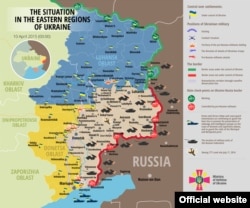
Here's today's map of the military situation in eastern Ukraine, according to the National Security and Defense Council:
Another Crimean journalist has been detained by the Russians, reports Human Rights in Ukraine:
Tatyana Guchakova, former deputy chief editor of Black Sea News has been taken away by FSB officers in Yalta after a 10-hour search of her home. Andriy Klymenko, BSN Chief Editor reports that the FSB turned up just before 8 a.m. on Thursday and left after 5 o’clock, taking the journalist with them, as well as all computer technology.
The Black Sea News offices, together with Klymenko, have been based in Kyiv since shortly after Russia’s invasion and annexation of Crimea. Guchakova has not worked for the publication since then, however remains a member of the Ukrainian National Union of Journalists.
Telekritika adds that Guchakova was a member of the international initiative Crimean Political Dialogue which existed from 2010-2014, but ended after annexation.
Why Tatyana Guchakova should have been detained is unclear unless the real target is Black Sea News and the related Maidan of Foreign Affairs, which have played an important role in highlighting rights violations in Crimea. Klymenko is the author of a major report published recently – Human Rights Abuses in Russian-occupied Crimea.
As of late Thursday evening there is nothing to suggest that the journalist has been released, with this possibly indicating an escalation in repressive measures against Crimean journalists, especially those currently or formerly linked with independent media which dare to write honestly about what is happening in Crimea.
More on Polish President Bronislaw Komorowski's trip to Ukraine:
On April 9, Komorowski and Poroshenko visited Bykivnya, an area on the outskirts of Kyiv where thousands of people, including Polish officers killed by Soviet authorities in March-April 1940, are buried.
Paying tribute to the victims of the Soviet regime, Komorowski said that "the commemoration of the victims of the past is one of the ways to prevent similar tragedies in future."
Poroshenko said that Bykivnya graves are "an echo of the black September of 1939 when Hitler and Stalin together ignited the bloody slaughter of the World War II, trying to share and break Europe."
RFE/RL's Darya Kostenko and Claire Bigg have been writing about a town called "Happiness," which is on the front line of the Ukrainian conflict:
Most of the insurgent strikes were launched from Merry Hill, an elevated spot on the edge of Shchastya. Behind the hill lies Luhansk, the second-largest city controlled by the insurgents.
Almost 14,000 people lived in Shchastya before the conflict. Only about 3,000 remain, many of them pensioners.
While the fighting has stopped, destruction is everywhere. The shelling has smashed countless windows and left gaping holes on buildings across the town.
"A shell fell here and a woman was killed by a falling beam," explain Andriy, a medic helping out the Ukrainian fighters, pointing to an apartment block. "The beam lay there for some time, spattered with blood."
The hospital, too, has come under fire. A charred ambulance parked outside testifies to the violence that shook this once uneventful city. One of the hospital's floors has been turned into a sickbay for injured soldiers.
Surgeons and other specialists, however, have long fled. Shchastya's last anesthesiologist left last summer after her husband, who had joined the separatists, was killed in a firefight.
A woman smokes next to blood-stained stretchers placed to dry in the sun at the hospital in Shchastya in October 2014.
A woman smokes next to blood-stained stretchers placed to dry in the sun at the hospital in Shchastya in October 2014.
On the city's central square, young mothers strolling with their children lend the area an atmosphere of normalcy. Only the empty pedestal, on top of which the statue of Bolshevik leader Vladimir Lenin once stood before being toppled by Ukrainian fighters, evokes the conflict. Local residents have jokingly dubbed it "the monument to the invisible man."
Read the entire article here