



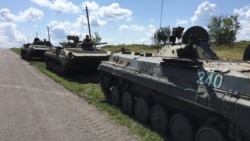
Simon Shuster has been writing compellingly for TIME on pro-Russian partisans who have been waging a bombing campaign against Ukraine:
Soon after midnight on April 1, a separatist group calling itself the Kharkov Partisans issued another one of its video warnings to the Ukrainian government. It claimed that within the next 48 hours a bomb would explode far behind the front lines of the war in eastern Ukraine. “As of now, the earth will begin to burn beneath your feet,” said the group’s spokesman, Filipp Ekozyants, in the message to Ukraine’s President Petro Poroshenko and his top security officials.
Sure enough, the bomb arrived. Though reports have been conflicting as to the damage it caused, a large explosion rang out in the southwestern part of Kharkov, Ukraine’s second largest city, within 24 hours of the Partisans’ threat. Police denied that any bombing had occurred that night, though that seems to be part of a cover up. “The explosion did take place,” says Andriy Sanin, the head of the local branch of Right Sector, a nationalist paramilitary group that works in league with Ukraine’s armed forces. “It appears to have been an act of intimidation,” he says, declining to give further details. In a follow-up video on April 3, the Partisans claimed that the attack had targeted a military convoy, killing a dozen Ukrainian servicemen.
But whatever the details of that bombing, it would hardly have been the first attack attributed to this guerrilla group. In interviews with TIME over the past two months, the group’s spokesman, a former wedding singer now based in western Russia, has claimed responsibility for a spate of bombings, mostly targeting military and industrial installations in the region of Kharkov, which lies right on the border with Russia. “Our goal is to liberate the people of Kharkov,” Ekozyants says in the first of several interviews. “And we will fight until the current authorities are weak enough to allow this.”
Numbering more than a dozen in the past few months alone, the bombings in Kharkov and other cities have marked a grim turn in Ukraine’s year-old conflict. The Russian-backed separatists in Ukraine’s eastern regions have managed to seize control of two major cities and large chunks of the border with Russia. But they are clearly not satisfied with the extent of their possessions. Even amid the ceasefire that Russian President Vladimir Putin negotiated and signed with President Poroshenko in February, the bombing of Ukraine’s cities has only intensified. The war now seems to be shifting from the use of tanks and artillery to the methods of terrorism and guerrilla warfare.
The goal of these attacks, says Ekozyants, is to paralyze the Ukrainian authorities and inspire locals to join a separatist revolt against them. But there seems to be some debate within his organization about the admissible means of achieving this. About two hours before Ekozyants issued his warning on April 1, he told TIME that the November bombing of a crowded bar in Kharkov was the work of a radical cell of the Partisans. Eight people were wounded in that bombing, two of them critically.
From their bases in Russia and the rebel-held cities in eastern Ukraine, the more moderate leaders of the Partisans then issued a ban on attacking civilians, in part to avoid a popular backlash against their methods, says Ekozyants. “After what happened at [the bar], our coordinating council issued a directive to all our cells, saying any more actions in places where there are peaceful people will be punished by lethal means.”
Read the entire article here
Reuters' Alessandra Prentice has issued a dispatch from the western Ukrainian city of Lviv that is well worth a gander. Here's an excerpt:
When Ukrainians toppled a pro-Russian president last year, nowhere was the euphoria greater than in Lviv, a short drive from the EU border, where people have dreamt for generations of escaping Moscow's orbit to join the West.
More than a year of war and economic collapse later, nowhere else has the disillusionment been felt more harshly.
"Everyone thought Ukraine would suddenly turn into Poland," said mechanic Taras Yakubovsky, sitting by a cast-iron woodburner in his small garage, where work has dried up because customers can no longer afford car repairs. "But we've become more like Europe's Somalia."
Part of the Austrian empire until World War I, this city of baroque churches and cobbled streets looks more like Mitteleuropa than the ex-Soviet Union, which it joined only after Red Army tanks rolled in and seized it from Poland in 1939.
Its residents, known for their fierce nationalist streak and pro-European outlook, traveled by busload to Kiev last year, forming the core of the "Maidan" movement on the capital's central square that toppled President Viktor Yanukovich after he rejected a free trade pact with the EU.
When that revolt was followed by war with pro-Russian separatists in the distant east, Lviv residents were among the most enthusiastic volunteers. The furthest major city in Ukrainefrom the war zone, it has suffered some of the highest per capita losses in a conflict that has killed more than 6,000 people.
But after a tough winter and with no sign of economic pain ending any time soon, support for the war is eroding, even here. According to a poll by research company GfK, over half of residents of western regions believe the government must avoid further bloodshed at any cost.
"We understand it's difficult times, but they're tossing away money on the war, and someone in Kiev will definitely be making some money off it too," Yakubovsky said.
Read the entire article here