



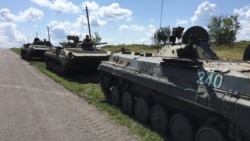
Six Ukrainian soldiers killed in latest attacks:
Six soldiers have been killed and 12 injured as fighting has flared in eastern Ukraine in the past 24 hours, despite a cease-fire.
Ukrainian military spokesman Andriy Lysenko said on April 14 that the casualties were the result of "serious provocations" by Russian-supported separatists.
Lysenko said the situation in eastern Ukraine was "unstable" with attacks "by the enemy continuing in almost all directions."
He added that the most intense shelling occurred in the villages of Shyrokyne and Pavlopil, near the southern seaport of Mariupol, and in areas near the rebel-held regional capitals of Donetsk and Luhansk.
The six deaths are the highest toll in eastern Ukraine in 10 days.
The announcement came hours after the Ukrainian, German, French, and Russian foreign ministers met in Berlin and expressed "grave concern" over cease-fire violations.
Fighting in the conflict that has killed more than 6,000 people in a year has eased considerably since a cease-fire deal was signed in Minsk in February. (AFP, Reuters)
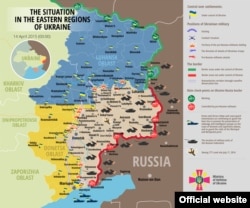
Here is today's map of the military situation in eastern Ukraine, according to the National Security and Defense Council:
Ukrainians are divided in how they view their country’s history. This is confirmed by surveys, but has just been ignored by Ukraine’s parliament which decided it knows how the country’s history should be viewed. If President Petro Poroshenko does not veto laws just passed, it will become illegal to express other views on certain aspects of Ukraine’s recent history.
Criticism of the law ‘On the Legal Status and Honouring of Fighters for Ukraine’s Independence in the Twentieth Century’, which the Verkhovna Rada adopted on April 9, has been met with demands that critics prove their credentials. If they are not historians, the line goes, they should not venture an opinion. Only historians with ‘substantive historical works’ published can comment on a law that gives full legal status to members of the Ukrainian Insurgent Army [UPA] or Organization of Ukrainian Nationalists [OUN] and prohibits disrespect or denial of their role in fighting for Ukraine’s independence. There are many reasons for questioning the validity of this argument, but for the moment we will confine ourselves to one. The majority of parliamentarians are not historians, nor do they need to be. They are elected to represent the people and here there is a major problem.
Judging by the results of a recent survey, the historical views set in legislative stone through the above law and at least one other on ‘decommunization’ do not correspond to those held by the voters. What is worse, there is a clear geographic divide with some Ukrainians’ position really not taken into consideration at all.
Over the Easter weekend, the Ukrainian Security Service arrested 11 people in Kharkiv and seized a cache of weapons:
Ministers agree to extend weapons withdrawal:
Foreign ministers from Germany, France, Russia, and Ukraine have agreed to push ahead with the withdrawal of weapons from the frontlines in eastern Ukraine.
Frank-Walter Steinmeier, Laurent Fabius, Sergei Lavrov, and Pavlo Klimkin met for about five hours in Berlin late on April 13 for talks to assess the implementation of a cease-fire.
Speaking to reporters after the talks early on April 14, Steinmeier said the ministers agreed to continue with the withdrawal of heavy weapons and to include weapons below 100 mm caliber, mortars, armored vehicles, and tanks in the withdrawal.
He said they also agreed to establish four working groups to address security issues, the process for holding local elections in rebel-held areas, the exchange of prisoners of war, and improvement of the economic situation in Ukraine's east.
The conflict between Russia-backed separatists and government troops in eastern Ukraine has claimed more than 6,000 lives since April 2014.
The cease-fire agreement brokered by the German and French leaders in the Belarusian capital of Minsk in February has reduced violence, but violations are reported regularly.
Under the truce, fighting was supposed to stop and heavy weapons bigger than 100 mm caliber were to be pulled back from the front lines.
The German, French, Russian, and Ukrainian foreign ministers were also all willing to support the OSCE, which is monitoring the implementation of the cease-fire deal, with money and personnel over the coming weeks.
Steinmeier admitted the talks had been "very long, very intensive, and at times very contentious" given the tense situation on the ground.
But he said all participants agreed there was no alternative to the Minsk agreement.
"We need to ensure that the cease-fire is adhered to far more strongly as fully as possible," Steinmeier said.
He also insisted that the Minsk accord went beyond the cease-fire agreement and must pave the way toward elections in the rebel-held territories.
"Everyone knows that we have a long path ahead of us," Steinmeier said. "But we're going to do everything we can to continue this process."
"If this process stalls, then the Minsk agreement risks possibly coming off the rails,” he added. “All sides want to prevent this."
In a joint statement, the four ministers expressed "grave concern at the recent outbreak of fights over the last weekend."
This included the use of heavy weapons around the village of Shyrokyne, on the outskirts of the port city of Mariupol, and at Donetsk airport.
The Ukrainian military said one of its servicemen was killed and six others wounded on April 13.
"The rebels have not stopped firing at Ukrainian positions,” army spokesman Oleksandr Motuzyanyk said. “Over the past day, the enemy has used weapons banned under the Minsk agreements."
Meanwhile, separatist officials accused government troops of firing tank and artillery rounds repeatedly at rebel positions.
The situation in Ukraine will be discussed at a meeting of G7 foreign ministers in the northern German city of Luebeck on April 14-15.
German Defense Minister Ursula von der Leyen is to spend April 14-15 discussing the Ukraine crisis in the Estonian capital, Tallinn, with the Baltic countries. (w/ Reuters, AP, TASS)
This concludes our live-blogging of the Ukraine crisis for Monday, April 13. Check back here tomorrow morning for more of our continuing coverage.