


By RFE/RL
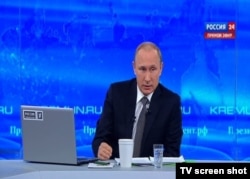
Russian President Vladimir Putin said on April 16 that Western sanctions are aimed at restraining Russia, asserting that Moscow's role in the crisis and conflict in Ukraine are only a pretext for the punitive measures imposed by the European Union, United States, and other nations.
Putin made the remarks in annual question-and-answer session shown live on state television.
He said the purpose of the sanctions is Russia's "containment" and predicted they would not be lifted soon.
The United States and EU say the sanctions are aimed to change the behavior of Russia, which Kyiv and Western nations say illegally annexed the Crimean Peninsula from Ukraine in March 2014 and has sent troops and weapons to eastern Ukraine to support separatists in a war that has killed more than 6,000 people since April 2014.
Putin claimed that Russia is abiding by the terms of a cease-fire deal and that the sanctions have nothing to do with the situation in Ukraine.
Putin said Russia should use the sanctions as a basis to for "new achievements" in the economy.
RFE/RL is live-blogging Russian President Vladimir Putin's annual marathon question-and-answer session with the Russian public. There is sure to be much talk of Ukraine. Check out our Putin live blog here.
Demonstrators Protest At Ukraine's Constitutional Court Over Lustration Law
By RFE/RL's Ukrainian Service
KYIV -- Dozens of protesters demonstrated outside of Ukraine's Constitutional Court in Kyiv on April 16 to express support for a law aimed at sacking civil servants linked to corruption during the rule of ousted President Viktor Yanukovych's government.
Dozens of opponents of the lustration law also gathered near the court building on April 16 to protest what they called "illegal firing of officials."
The Constitutional Court is scheduled to start hearings on the lustration law later on April 16.
The lustration law was adopted by Ukrainian lawmakers in September.
About 1 million civil servants are subject to screening under the law.
Some officials in Ukraine already have been fired in accordance with law.
Ukrainian Prime Minister Arseniy Yatsenyuk said on April 15 that lawmakers must take part in the Constitutional Court's hearings because there is a "conflict of interests" in the situation.
That is because some members of the court also are subject to review themselves under the lustration law.
Ukraine's Supreme Court and 47 lawmakers referred the legislation to the Constructional Court, urging it to rule on whether the lustration law violates Ukraine' constitution.
Ukrainian Journalist From Donetsk Reportedly Killed
By RFE/RL's Ukrainian Service
KYIV -- A Ukrainian journalist from the eastern region of Donetsk has reportedly been killed.
The news site Obkom said late on April 15 that Serhiy Sukhobok was "killed during the night between April 12 and 13." No more details were provided.
It is not clear if Sukhobok was killed in his native Donetsk region, where a conflict between government forces and Russian-backed rebels has killed more than 6,000 people since April 2014.
A journalist since 1998, Sukhobok co-founded the popular sites Obkom and ProUA and was deputy chief editor of Obkom from 2001 to 2009. He remained a contributor.
In recent years, Sukhobok also wrote for several news organizations in Ukraine as an observer and analyst.
With reporting by obkom.net.ua
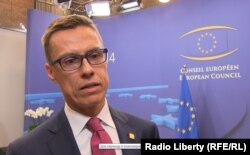
Election strains Finland's diplomatic balancing act with Russia
By Jussi Rosendahl and Alistair Scrutton
HELSINKI, April 16 (Reuters) -- From closer NATO ties to rumours of Kremlin-backed land deals on its border, Finland's diplomatic balancing act with Russia has come under the spotlight before Sunday's parliamentary election as politicians debate how far to challenge the Kremlin.
The vote sees centrist opposition front-runner Juha Sipila, who favours military non-alignment along with two other major parties, battling centre-right incumbent Prime Minister Alexander Stubb, who advocates joining NATO.
The debate was mirrored regionally after an unprecedented hawkish joint statement last week by Nordic countries -- Sweden, Norway, Finland, Denmark and Iceland -- that directly cited the Russian "challenge" as grounds to increase defence cooperation.
For the Nordics it reflected a year of Russian air force sorties, spy accusations and military border exercises. Moscow retorted immediately, saying moves by Finland and Sweden towards closer ties with NATO were of "special concern".
"It's unheard of to explicitly link Nordic defence cooperation to the Russian threat," said Anna Wieslander, deputy director of the Swedish Institute of International Affairs. "It clearly says 'us against Russia'."
That would be a sea change for Finland, which shares an 833 mile (1,340 km) border with Russia, with which it fought two bitter wars between 1939 and 1944, losing substantial territory.
The resulting "Finlandisation" became a Cold War byword for self-imposed neutrality and a willingness to accommodate Soviet interests driven by fear of its neighbour.
Helsinki has moved closer to the West since it joined the European Union in 1995 and the euro zone in 1999, but -- like Sweden -- it is still not in NATO. With about 8 percent of its exports dependent on Russian trade, Helsinki also tries to toe a pragmatic line with its former ruler.
That status quo has become strained with Russian air sorties and naval activity in the Baltic sea, as well as by the economic impact of sanctions, stirring debate about how far Finland should follow the Western response to Russia's role in destabilising Ukraine.
Polls show a majority of Finns are against joining NATO, but those numbers may be thinning -- roughly a quarter of Finland's 5.5 million people agree with Stubb's pro-NATO posture. More Swedes are also coming round to joining the alliance.
Any hint of Sweden and Finland joining NATO rankles Russia - so much so that Prime Minister Dmitry Medvedev said in 2013 their entry into the alliance would force Moscow to "respond".
"Finland has moved on - mostly - from the political generation in whom the instinct not to offend Russia was so deeply ingrained that this was automatic," Keir Giles, a Russia expert at the Chatham House think-tank, said in an email. "But the legacy lives on in some areas."
"What has polarised the debate right now is a new willingness to call a spade a spade at an official level."