



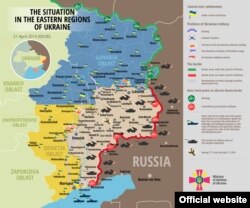
Here is today's map of the military situation in eastern Ukraine, according to the National Security and Defense Council:
“Suddenly, we are the enemy,” Irina whispers to me from the bottom bunk as our Moscow-bound train pulls into Russian border control at around 3am. A year after war broke out in the Donbass, the Kiev-Moscow train is one of the few remaining passenger rail lines linking Russia and Ukraine.
“We never had any problems before,” says Irina, a sturdy Ukrainian woman in my carriage. Born in a village in southeast Ukraine, she studied in Moscow in the 1970s before settling in the Ukrainian capital. Now in her mid-fifties, she is employed in the Kiev office of a Moscow-based pharmaceutical firm. Irina has spent 30 years traveling between the two cities.
“I work for a Russian company,” she mutters hesitantly to the female border guard examining her documents. After a lengthy pause, the guard hands back her papers. “We can all get on after all,” the Russian replies. “There’s so little good news these days.”
Irina has happy memories of Moscow — the city of her student days where she met her husband. For years she would attend university reunions in the Russian capital, where old friends would catch up over semi-sweet wine high up in the Moscow suburbs. But that was before the Maidan. “It’s all different now,” she sighs.
Ukrainians and Russians have been torn apart by a war few understand. Kiev and Moscow, once cities with shared histories, are now unrecognizable to one another. On the 13-hour journey between the two capitals, passengers try to make sense of the conflict.
Russia's ruble hits 2-week low against dollar:
Russia’s ruble currency fell to a two-week low against the U.S. dollar on April 21.
The dollar extended its gains against the ruble, rising to 54 rubles in early trading on the Moscow Exchange, its highest level since April 8.
The ruble has partially recovered this year after falling to 80 per dollar in mid-December in its worst collapse since the Russian currency crisis of 1998.
The Russian economy and the ruble were hit hard in 2014 by a sharp decline in the price of oil, one of the country's chief exports, and sanctions imposed by the West over Moscow's interference in Ukraine.
The ruble’s most recent fall follows a drop in oil prices and an April 20 decision by Russia's central bank to increase the rates at which it provides foreign exchange at auctions. (Interfax, Bloomberg)