



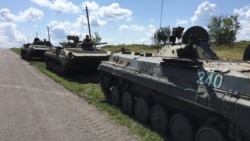
The U.S. envoy to Kyiv has been talking to RFE/RL. Our news desk has the details:
KYIV -- The U.S. Ambassador to Ukraine, Geoffrey Pyatt, says Russia has to change its approach to the situation in Ukraine's east to make peace in the region possible.
Talking to RFE/RL in Kyiv on May 6, Pyatt said that Russia is supplying pro-Russian separatists in Ukraine's Donetsk and Luhansk regions with weapons, including "many of their tanks and missiles and antiaircraft systems."
Pyatt called the military conflict between Ukrainian armed forces and what the U.S. State Department considers combined Russian-separatist forces "a manufactured war."
"The people of Donbas," he said of the eastern Ukrainian region that is at the center of the fighting, "have been a target of an aggressive campaign of propaganda and misinformation."
"Russia's information war is very effective," Pyatt said, addressing reports by Russian state-run media that the U.S. and Kyiv are hindering the implementation of peace agreements. "The United States is not providing weapons to Ukraine. Of course, we support the peace process and the cease-fire."
Pyatt stressed that the United States supports Ukraine's sovereignty and territorial integrity and the peace plan by Ukrainian President Petro Poroshenko. "We all want peace," Pyatt said. "Russia has to change its approach to make it happen."
He added, however, that there are indications that "Russia and the separatists are preparing to reignite the fighting."
"We know that Russia has maintained a very active training program for the so-called army of Novorossia ," the U.S. ambassador said, adding "And we know that Russia has moved its advanced surface-to-air missile systems very close to the contact line inside the Ukrainian territory."
Pyatt also recalled a recent statement by Aleksandr Zakharchenko, the leader of the separatists in Donetsk region, who told some media outlets that his main goal was to take control over the entire region.
"If that is his [Zakharchenko's] goal, he did not read the agreement or he does not remember the agreement that he signed in February in Minsk," Pyatt said to RFE/RL.
The leaders of Ukraine, Russia, Germany, and France signed a deal known as Minsk II in February which set out measures to stop the fighting in eastern Ukraine. The agreement included a cease-fire in the Donetsk region and sets out plans for Ukraine to grant limited self-governance to rebel-held territory there.
EU military forces? All squawk, no bite: Juncker
Brussels, May 7, 2015 (AFP) -- European Commission head Jean-Claude Juncker called again Thursday for the bloc to build an army, saying a flock of hens posed more of a threat than its current military capabilities.
"A bunch of chickens looks like a combat formation compared to the foreign and security policy of the European Union," Juncker told a Brussels forum in typically lively language.
"I always call for a European army as a long-term project. It is not something you can build from scratch tomorrow morning," he said.
Juncker has consistently backed the idea that the EU's 28 member nations -- all no strangers to a bloody, war-torn past -- should accept a military arm, a need highlighted by the Ukraine crisis.
"A common army among the Europeans would convey to Russia that we are serious about defending the values of the European Union," he told Germany's Welt am Sonntag in March.
A joint EU force would also rationalise defence spending and drive further EU integration.
For many European Union states, however, defence is a no-go area, with Britain especially hostile to sacrificing what it sees as a core sovereign perogative to Brussels.
Britain also insists that NATO, the US-led military alliance set up to hold the Cold War line against the Soviet Union, should remain the focus of European defence efforts.
Juncker told the forum that considering the current fragmented state of EU military readiness, it was perfectly "right that central and eastern European countries put their trust primarily in NATO."
"The 28 armies are just not up to it," he added.
EU leaders are due to review the bloc's security policy at a June summit to take on board the threat posed by a more assertive Russia and turmoil across North Africa and the Middle East.
Analysts say it is unlikely to lead to radical changes in the current very limited joint military operations undertaken by the EU, such as the Atalanta anti-piracy mission off the Horn of Africa.

EU says no further delay on Ukraine trade deal
Brussels, May 7, 2015 (AFP) -- The EU said Thursday it would not bow to Russian demands to delay further the planned January 2016 implementation of a free trade deal with Ukraine which is bitterly opposed by Moscow.
"The date is the first of January next year," EU Trade Commissioner Cecilia Malmstroem said.
"It is not for Russia to decide," Malmstroem said, adding that the 28-nation European Union has been very clear on the issue.
The free trade accord is part of the broader 2014 EU Association Agreement at the heart of the Ukraine crisis and was originally due to come into effect in January this year.
In September however, the EU postponed implementation for a year to support peace efforts as a first Ukraine ceasefire accord was negotiated.
In return, Russia promised to hold off on the retaliation it had threatened if the EU and Ukraine went ahead with the trade pact without resolving its concerns.
Russia claims that what is known as the EU-Ukraine Deep and Comprehensive Free Trade Agreement will damage its own important economic ties and interests in its Soviet-era satellite.
Several rounds of talks between EU, Ukraine and Russian officials have been held but no progress has been reported although Malmstroem said there would be another meeting at ministerial level this month.
"We are willing to talk on practical difficulties with the Russians, we will do so, there will be a ministerial meeting later this month to find practical solutions," she said.
Russia's ambassador to the EU Vladimir Chizhov said earlier this week that Moscow's request for another DCFTA delay was "not met with great enthusiasm" although its concerns "have been taken on board."
An EU diplomat said that at talks last month Russia had asked for a delay to 2017 and had threatened retaliation against Ukrainian goods if it was not agreed.
Moscow had been told that was out of the question but at the same time, "we do not want to break the contact with the Russians," the diplomat said.
The EU is also involved in separate, equally difficult talks with Kiev and Moscow on ensuring Russian gas supplies to Ukraine, and onward to Europe, are secured for the coming winter.
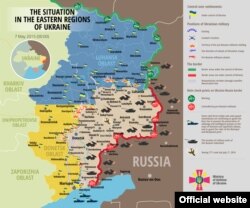
Here is today's map of the security situation in eastern Ukraine, according to the National Security and Defense Council (CLICK TO ENLARGE):
Separatists poised for offensive in Ukraine: US
Washington, May 6, 2015 (AFP) -- Pro-Russian separatists appear to be making preparations for a fresh offensive in eastern Ukraine, US Defense Secretary Ashton Carter told lawmakers on Wednesday.
The Pentagon chief also said that sanctions imposed by European countries and a decline in oil prices were the most effective way to exert pressure on Russia over its role in the conflict.
"It does appear that clearly, Russian-backed separatists in eastern Ukraine are preparing for another round of military action that would be inconsistent with the Minsk agreement," Carter told the Senate Appropriations defense subcommittee.
A shaky truce agreed in Minsk in February has dampened the violence overall but clashes continue to erupt in pivotal flashpoints.
Ukrainian government forces and analysts have warned that pro-Moscow rebels are readying for a push to extend their control to the key seaport of Mariupol, the largest remaining Ukrainian-controlled city in the conflict zone.
NATO's top commander, General Philip Breedlove, said last week actions by Russia and the separatists were "consistent" with "preparations for another offensive."
The United States has provided radios, radar, armored vehicles and other non-lethal supplies to Kiev but so far stopped short of providing weapons to the government army.
But Carter said that "if there is anything that influences Russian behavior, it's the combination of economic sanctions and the fall in oil prices.
"That is punishing Russia now."
He added that "it is the weight of European sanctions that matters, mostly because they do most of the trade done with Russia."
Carter spoke as Ukraine's warring sides met in Minsk to shore up the ceasefire deal.
Ukraine's representative, former president Leonid Kuchma, said after the meeting that it had been a "serious step towards the political resolution" of the conflict but said the shooting had to stop completely.