


Russia Issues 89-Name EU Blacklist, Bars Politicians
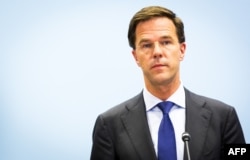
The Hague, May 29, 2015 (AFP) -- Moscow has issued a blacklist of European Union politicians barred from Russia in response to EU sanctions over Crimea and Ukraine, Dutch Prime Minister Mark Rutte said on Friday.
"Russia yesterday handed over a list of people to diverse EU embassies who may not enter Russia any longer," Rutte said at a weekly press conference, adding that two Dutch MPs and a Dutch MEP were on the list.
The list contains 89 names, according to a letter from Belgian Foreign Minister Didier Reynders tweeted by Belgian MEP Mark Demesmaeker.
The letter, which was confirmed as authentic by the foreign ministry to AFP, said that Moscow had asked for the list not to be made public.
Moscow issued the list on Thursday in response to the EU's own sanctions and travel bans over Russia's annexation of Crimea last year and its alleged involvement in the eastern Ukraine conflict, Rutte said.
A spokeswoman for the EU diplomatic service in Brussels told AFP that Russia had barred several European politicians from entry in recent months, but had so far refused to provide a list of those targeted.
"We take note that the Russian authorities have decided to share the list. We don't have any other information on legal basis, criteria and process," the spokeswoman said in an email statement.
Guy Verhofstadt, head of the Liberal group in the European Parliament and a former Belgian PM, is also on the list, his spokesman Jeroen Reijnen told AFP.
"Verhofstadt is banned from entry to Russia. He is on a blacklist with around 80 people," Reijnen said, saying the ban came after Verhofstadt called for an independent international probe into the murder of Russian opposition leader Boris Nemtsov.
Rutte said the Dutch government rejected the move and would let "Moscow know so in no uncertain terms".
Russia's list "was not based on international law, was not transparent and could not be challenged" in a court of law, Rutte added.
Berlin on Monday hit out at Moscow after it denied access to German MP Karl-Georg Wellmann, who has strong links to Ukraine, saying the move was "unacceptable".
Wellmann, a member of Chancellor Angela Merkel's conservative CDU-CSU, heads up the Bundestag's friends of Ukraine group.
German media reports said he was turned back when he arrived at Moscow airport on Sunday, despite having been invited to take part in political discussions.
The Russian authorities put him back on a plane for Berlin and slapped an entry ban on him until 2019, the reports said.
Russian President Vladimir Putin strongly denies backing the insurgency in eastern Ukraine that erupted after a pro-Kremlin president was ousted in February 2014. The fighting has killed more than 6,300 people so far.
The Kremlin hopes a current shaky ceasefire will prompt the European Union to lift some of the more punishing sanctions against Russia in the next few months.
Hollande, Merkel Call For ‘Rapid’ Implementation Of Minsk Deal
By RFE/RL
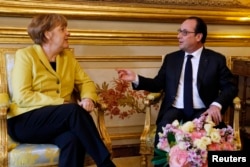
French President Francois Hollande and German Chancellor Angela Merkel have called on Russian President Vladimir Putin to “rapidly” implement measures agreed under the Minsk cease-fire agreement.
Eastern Ukraine continues to be embroiled in sporadic fighting between government forces and Russian-backed separatists despite the truce agreement signed in February.
The French presidency said Hollande and Merkel spoke on the phone with Putin on May 29 and told him they want to see “concrete results” from four working groups that were set up this month to deal with political, security, economic, and humanitarian issues.
It added that diplomats and officials from the four countries are to meet in Paris on June 10 to review progress in the Minsk process.
Meanwhile, the Kremlin said Putin expressed concern in the call over "increasingly frequent shelling by Ukrainian forces of civilian objects that have led to civilian casualties."
With reporting by Reuters
Just in from AFP:
Germany's Steinmeier warns situation in east Ukraine turning 'fragile'
Kiev, May 29, 2015 (AFP) -- Germany's foreign minister warned on Friday that the situation in Ukraine's separatist east was turning more "fragile" and that negotiators must focus their efforts on averting a further deterioration.
"The situation in east Ukraine is once again becoming fragile," Frank-Walter Steinmeier told reporters after holding talks with Ukrainian Prime Minister Arseniy Yatsenyuk, stressing the need to consider "all options" to avoid a "deterioration" in the conflict zone.
Ukraine Inches Toward Crucial Debt Restructuring Deal
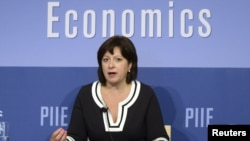
Kiev, May 29, 2015 (AFP) -- Ukraine's finance minister said on Friday that Kiev and its private creditors were about to launch direct debt restructuring negotiations that could save the war-torn country from a devastating default.
Natalie Jaresko's comments came as the ex-Soviet state's pro-Western leadership races to meet a late June deadline by which it must find a way to save $15 billion (13.7 billion euros) over four years.
A watertight debt restructuring plan would allow the International Monetary Fund to hand over the next slice of a $17.5-billion loan at the core of a $40-billion global aid package.
IMF executives are yet to name a specific date on which they will discuss Ukraine during their late June meeting.
"We should reach the stage of direct negotiations very soon," Ukrainian news agencies quoted Jaresko as saying.
"That way, we will be able to reach an agreement in an absolutely constructive and conscientious manner."
Ukrainian President Petro Poroshenko on Thursday signed a bill passed by parliament last week giving Kiev "the right, if necessary, to stop payments to foreign debt holders."
The measure is largely symbolic and meant to underscore lawmakers' support for a payment moratorium that could theoretically turn Kiev into a financial outcast that looses access to the international lending market.
Such a freeze would almost certainly prompt Russia -- due a $3-billion loan repayment at the end of the year -- to ask the International Court of Justice in The Hague to declare Ukraine in default.
Moscow has refused to discuss any loan restructuring offer and argued that it technically already has the right to ask for the money back.
Five large US private creditors who hold $8.9 billion of the debt have thus far also stuck to their guns.
They have particularly rejected the US Treasury Department and Jaresko's debt "haircut" proposal that slashes the bonds' original value and forces them to assume a loss.
Bloomberg reported on Friday that the creditors -- led by Franklin Templeton and including such bond market giants as PIMCO and Blackrock -- on May 9 submitted a counter-proposal they said would save Ukraine $15.8-billion over four years.
It reportedly preserves the bonds' original value but extends their maturities by 10 years. Bloomberg said the proposal would also lower the interest payment and allow the original loan amount to be payed back in small instalments instead of a lump sum.
- 'Protracted dispute' -
The Ukrainian government has not publicly responded to the reported offer and Jaresko on Friday called the negotiations "very difficult".
But the deal and the IMF funds that come with it are essential for the Ukrainian government's survival in the short term.
Ukraine's year-on-year inflation rate reached a staggering 60.9 percent in April and industrial output -- already weakened last year by the raging war with pro-Russian militants -- declined by another 23.4 percent.
The threat of inflation climbing even further because of Ukraine's dire currency shortage forced the central bank on Thursday to hold its key lending rate at 30 percent -- a rate that effectively chokes off economic growth.
Analysts say that Kiev is far from guaranteed meeting the requirements necessary to unlock the next IMF loan payment.
Capital Economics emerging market economist William Jackson said the five US investors' approach inched the sides forward but did not guarantee a final deal.
The US group is "reportedly in close contact with other private creditors holding $10 billion of debt, but it's not clear that these creditors have agreed to the proposal," Jackson said in a research note.
"And finally, this proposal doesn't tackle the thorny issue of the $3-billion Russian eurobond," he stressed.
"As yet, it's not clear what will happen with this, but it seems set to cause a protracted dispute."