

Today's Financial Times takes a fascinating, in-depth look at how tortuous diplomatic dealings between the West and Russia have become:
After more than 40 telephone calls and countless hours of meetings over the past six months, Angela Merkel braced herself for one last push. It was past 10pm and the German chancellor was sitting in a Hilton hotel conference room in Brisbane, Australia. Her interlocutor was the implacable Vladimir Putin.
For nearly two hours, the Russian president reeled off a litany of resentments. The west had proclaimed victory in the cold war. It had cheated Moscow by expanding the EU and Nato right to Russia’s borders. It had ignored international rules to pursue reckless policies in Iraq, Afghanistan and Libya.
The chancellor steered the conversation back to eastern Ukraine, where Russian-backed separatists were engaged in a bloody struggle against the western-backed government in Kiev, according to a person familiar with the meeting. Since the crisis began, Ms Merkel had worked hard to extract some sense from Mr Putin of what he wanted — something she could use to construct an agreement. When he finally offered a solution, she was shocked. Mr Putin declared Kiev should deal with the rebels the way he had dealt with Russia’s breakaway Chechnya region: by buying them off with autonomy and money. A reasonable idea, perhaps, to an ex-KGB colonel. But for an East German pastor’s daughter, with a deeply-ingrained sense of fairness, this was unacceptable.
Vladimir Putin is the master destabiliser. A black belt in judo, he is an expert at keeping opponents off-balance. He alternates between the friendly gesture and the menacing glance. Throughout the crisis in Ukraine, the most serious threat to security in Europe since the end of the cold war, Mr Putin has succeeded in wrongfooting western leaders. They know he wants to restore Russia’s influence and keep Ukraine within his orbit, but are at a loss to divine how he intends to achieve his aims.
Ms Merkel had asked her closest advisers to stay outside during the Brisbane meeting, on November 15 last year. “She wanted to be alone . . . to test whether she could get Putin to be more open about what he really wants,” says someone briefed on the conversation. “But he wouldn’t say what his strategy is, because he doesn’t know.”
When the hotel meeting broke up at about 2am, Chancellor Merkel and President Putin were in dark moods. Hours later, the Russian leader would fly home, missing the second day of the G20 summit and fuming about snubs from other world leaders. Ms Merkel, according to two people briefed on the outcome, left convinced there would be no quick end to the crisis.
She fretted, too, that Mr Putin’s ambitions to reassert Russian influence stretched beyond Ukraine. The next day in Sydney, she cast aside her usual caution. “Who would have thought it possible that 25 years after the fall of the Berlin Wall . . . something like this could happen in the middle of Europe?” she said in a speech. Mr Putin’s escapades in Ukraine called “the whole of the European peaceful order into question”. She also added a new warning — that Russia might come to threaten not just Ukraine, but Georgia or the Balkans.
For Moscow, too, something snapped. Weeks later, a Kremlin official dismissed the notion, often cited in diplomatic circles, that there had ever been a “special relationship” between the two leaders. “Putin and Merkel could never stand each other,” he told the Financial Times. “Of course, they are professionals, so they tried to make the best of it for a long time. But that seems to have changed now.”
Read the entire article here
Another update from RFE/RL's news desk:
Russian citizens will need passports to enter Ukraine as of March 1, a change that reflects severe tensions between the neighbors amid an armed conflict in eastern Ukraine.
On February 3, Ukrainian Prime Minister Arseniy Yatsenyuk signed a decree supporting a government resolution on the issue adopted on January 30.
Since the 1991 collapse of the Soviet Union, Russian citizens have been able to enter Ukraine using domestic identification documents known as internal passports.
Yatsenyuk told the government that Ukraine must "adopt European rules for crossing the state border, including for citizens of the Russian Federation."
Russia seized control of Ukraine's Crimea region in March, and Kyiv says Moscow has sent thousands of troops across the border to fight alongside separatists in a conflict that has killed more than 5,350 people in eastern Ukraine since April.
(UNIAN, kmu.gov.ua)
From RFE/RL's News Desk:
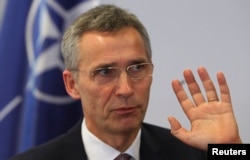
NATO says Secretary-General Jens Stoltenberg will soon meet with Russian Foreign Minister Sergei Lavrov for the first time since Stoltenberg became chief of the Western alliance on October 1.
NATO spokeswoman Oana Lungescu said on February 3 that Stoltenberg and Lavrov will hold bilateral talks during a three-day annual security conference in Munich that begins on February 6.
Russia's annexation of Crimea and the conflict in Ukraine have brought tensions between Russia and NATO to their highest point since the Cold War.
The fighting has escalated in recent weeks and the United Nations said on February 3 that at least 5,358 people have been killed in the conflict since it erupted in April.
Stoltenberg will also hold bilateral meetings with Ukrainian President Petro Poroshenko and others attending the conference.