



Conclusion:
Western policymakers need therefore to contemplate the risks of eventual breakdown in Russia. That is not to say that Russia is, for us, too big to fail. Nor is it to urge us to bring about regime change. Neither option is practicable or desirable for the West to prevent or to undertake. We should, however, act in the case of Ukraine in the knowledge that what Russia is doing there is not as the Kremlin claims because of the threat to Russia from the West, but because of the developing crisis within Russia itself. Putin is not to be appeased by Western concessions, or necessarily by the West abandoning Ukraine. The respect we owe to Russia is to its people, not to its regime. Change can now come only with a new regime, whose birth may well be rough.
Carl Schreck examines the analyses that grabbed headlines this week suggesting that bearish traders hinted at Crimea annexation by Moscow.
U.S. Grad Students Find 'Suspicious' Russian Stock Trading Before Crimea Takeover
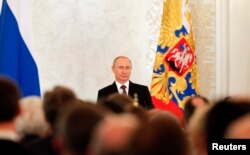
Fresh comments via Reuters:
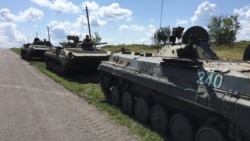
OSCE special envoy to Ukraine, Heidi Tagliavini: "We indeed seemed to be standing at the brink of a full-out war in Ukraine just a few days ago. Today, we are actively engaged in de-escalation which hopefully may become an irreversible process. A sustainable cease-fire and the continued process of de-escalation including the withdrawal of heavy military equipment are in our opinion the indispensable pre-requisites to any further progress in the way toward a peaceful settlement."
Ertugrul Apakan, head of the OSCE Special Monitoring Mission to Ukraine: "For the past days combat operations have been significantly reduced across the conflict zone. Although some firing has occurred around Donetsk airport as well as close to the town of Mariupol. Over the past two days, we have also seen significant indications that both sides are now taking steps to comply with their responsibilities under the Minsk package. As to the withdrawal of heavy weapons, yesterday our monitors began observing the movement of heavy weapons away from the line of contact on several instances."
Ukrainian UN Ambassador Yuriy Sergeyev: "There is no exact vision that their side is preparing to withdraw the heavy weaponry. So that's why we're seriously concerned if they're going to seriously take their obligations under the Minsk agreements. That's why we don't trust their words, we even don't trust deeds. We trust the final stage and implementation of all Minsk agreements and package."
Sergeyev: "We're observing a dangerous regrouping of the forces on the other side, and we have proofs and a lot of suspicions that the next target is Mariupol. Mariupol is a new goal, a new target for Russia and separatists. They're coming back to what they started with. They're not even hiding this next step, not hiding that the reason is to build the corridor. So this is what has seriously worried us."

From our newsroom:
A senior Russian Foreign Ministry official has accused the United States of taking a "destructive" stance in bilateral relations.
Deputy Foreign Minister Sergei Ryabkov said in Moscow on February 27 that U.S. Secretary of State John Kerry had breached "diplomatic ethics" when he said earlier this week that Russian officials had "lied to his face" in denying Moscow's support for separatists in eastern Ukraine.
Ryabkov added that Washington "lacks the moral right" to make such a judgment.
Ukraine, NATO, the United States, and several western countries have accused Russia of using troops and weapons to support the rebels.
Ryabkov reiterated the Kremlin's denial of such backing.
He also warned that Russia could retaliate against potential new U.S. sanctions against Moscow -- which Kerry told lawmakers this week Washington has ready to go -- with "quite painful countermeasures."
But he said Russia might not publicize the measures it would take against the United States.
Based on reporting by AP and TASS
From our newsroom:
Russia says it has formally complained to Lithuania that the Baltic country's supply of weapons to Ukraine violated its international arms trade commitments.
The Russian Embassy in Vilnius said on February 27 that the complaint was sent in a letter from the Russian Foreign Ministry to the Lithuanian Embassy in Moscow.
It said such supplies "represent a direct violation of Lithuania's legal commitments in the area of export of armaments."
Lithuanian Foreign Minister Linas Linkevicius denied his country had violated any agreements.
Lithuania has supplied weapons to Ukraine "in small quantities and openly," Linkevicius told Reuters.
He added that: "and yet we are reprimanded by the country that continually supplies arms to the conflict in Ukraine, in nonsymbolic quantities, and denies doing so."
Russia has been accused by NATO, Ukraine, the United States and numerous Western countries of supplying the pro-Russian separatists in eastern Ukraine with weapons and even troops, charges that Moscow denies.
Based on reporting by Reuters and Interfax