



From our newsroom:
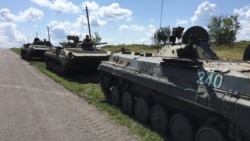
France says U.S. President Barack Obama and European leaders have agreed that a "strong reaction" would be necessary if a cease-fire between Ukraine and pro-Russian separatists is violated.
French President Francois Hollande's office said that in a March 3 video conference, the leaders underscored their support for a truce negotiated in Minsk.
"They have agreed that a strong reaction from the international community would be necessary in case of a major breach of the process put in place in Minsk," it said in a statement.
The leaders of Britain, Germany, and Italy also participated in the conference, as did European Council President Donald Tusk of Poland.
Kyiv and Western governments accuse Russia of backing separatists in eastern Ukraine with troops and arms despite the February 12 peace deal, a charge Moscow denies.
Based on reporting by Reuters and AFP
Our newsroom re-upping potentially significant news on Savchenko, who has been on hunger strike for 82 days now:
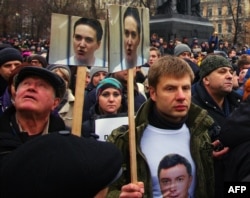
A lawyer for Nadia Savchenko says the jailed Ukrainian pilot has promised to end her hunger strike when her health becomes "completely terrible," suggesting she would halt the protest before she dies.
Attorney Mark Feigin made the remark on Twitter on March 3.
"I got her to say that when it becomes completely terrible, she will take heed and stop. She said this," Feigin wrote.
He said Savchenko promised "to remember that Ukrainians and Russians are urging her not to die."
Savchenko is in pretrial detention in Russia, where she has been charged with involvement in a mortar attack that killed two Russian journalists covering the conflict betwee government forces and Russian-backed rebels in eastern Ukraine.
She denies guilt and says she was kidnapped and brought to Russia illegally.
She has been on a hunger strike since December 13, and her sister said on March 1 that she was "in a very bad state."
Our Russian-language program Current Time TV has this video report (in Russian) from St. Petersberg, where "Russian monarchists" are volunteering and recruiting volunteers to fight for pro-Russian forces in eastern Ukraine.
Latest update from our newsroom on the mine blast, which separatists say was not caused by artillery:
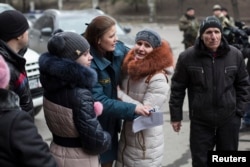
The speaker of Ukraine's parliament says at least 32 people have been killed in a coal mine blast in the separatist-held eastern city of Donetsk.
Verkhovna Rada Chairman Volodymyr Hroysman told lawmakers "a tragedy occurred this morning at the Zasyadko mine. There are dead -- at the moment, 32 people."
"Let us honor the memory of these laborers," he said.
Russian-backed separatist authorities in Donetsk said earlier that 73 people were feared trapped in the huge mine after a methane blast.
An emergency official in the self-proclaimed government, Yuliana Bedilo (eds: a woman), said 14 people were injured.
She said the blast was not caused by an artillery strike.
Donetsk has frequently been hit by artillery during the conflict between the Russian-backed rebels and government forces, which has killed more than 6,000 people since April.
Fighting has subsided following a February 12 cease-fire deal.
Carl Bildt on "Dealing With Russia":
We must understand that, in contrast to our obviously misjudged reactions after the August 2008 war between Georgia and Russia, the Ukraine crisis is more than an unfortunate episode that will soon pass.
And later:
Since the start of 2014, though, we have been faced with a new situation, and it’s one in which our principles and our vision are being fundamentally challenged. They say the 20th century started in 1914, and future historians may well say that the 21st century started in 2014. In the early hours of Wednesday February 27 an armed group seized control of the Crimean parliament building in Simferopol, and in a few ensuing hours the old leadership of the autonomous region was thrown out while a new one with a very different programme was installed.
It took some time until we in Europe realised what we now know for a fact: these were special forces of the Russian Federation, but operating without national insignia. The invasion, occupation and annexation of Crimea that followed wasn’t just a smash-and-grab operation of limited importance and relevance. It was a fundamental violation of the core principles of security of Europe that had been agreed following the end of the Cold War. Since then, Russia has been trying to advance a number of different arguments to justify what it did. None of these can be accepted, however, without grave consequences for all of our futures.
From our newsroom:
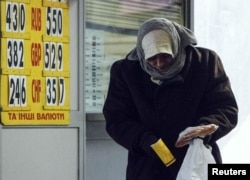
Ukraine's central bank has sharply raised the country's interest rate in an effort to stabilize the national currency and halt inflation.
National Bank chief Valeriya Hontareva said in Kyiv the benchmark interest rate would be increased from 19.5 percent to 30 percent as of March 4.
The move is aimed at stabilizing the value of the hryvnya, which has lost 80 percent of its value against the dollar since January 1.
Prices in January were 28.5 percent higher than in January 2014.
The Ukrainian economy -- forecast to contract by 5.5 percent in 2015 -- has suffered in the past year as government forces fight pro-Russian separatists in eastern Ukraine and trade with Russia has almost ceased.
The interest rate increase comes ahead of a decision by the IMF, expected on March 11, to release a $17.5 billion loan that Kyiv needs to avoid a default on its debts.
Based on reporting by AP and AFP