



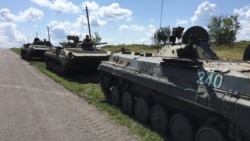
An excerpt:
The last time Marina Karpa spoke to her husband was when he called her on his mobile from a battlefield in east Ukraine on July 29 last year.
A member of the country’s special forces, Captain Taras Ivanovich, 26, had been sent on a secret mission deep into territory controlled by Russian-backed separatists to rescue the pilot of a Ukrainian SU-25 jet fighter shot down near the town of Snizhne.
His unit of 19 elite soldiers was ambushed and came under heavy enemy fire.
“I’ve been shot in the stomach. I’m bleeding . . . I think I’m going to die. I love you so much,” Taras muttered into his mobile phone, a gun-battle raging in the background. Then the line went dead.
On the lighter side...
An excerpt:
By Karoun Demirjian
DESNA, Ukraine -- In a military training class north of Kiev late last month, volunteer instructor Viktor Mosgovoi led 30 would-be officers through hours of jumps, breathing exercises and group massages -- Ukraine’s first mandatory psychological training for recruits.
“How do you feel? You feel uplifted!” Mosgovoi drilled the group of men in heavy boots and fatigues. Most of them followed along with blank looks or smirks on their faces. A few erupted into giggles. “Sing a song about what you see,” Mosgovoi suggested as a way to beat the battlefield blues. “And don’t drink.”
In nearly a quarter-century of independence, Ukraine’s military has seen so little combat that the country’s defense minister estimated the nation had only 6,000 battle-ready troops a year ago. Over the past 10 months, the Ukrainian army has drafted almost 70,000 soldiers in a war against pro-Russian separatists in the eastern part of the country. And most of the fighting has been carried out by recruits and volunteers with no prior combat experience.