



An excerpt:
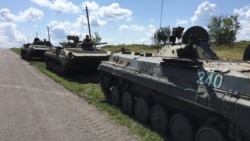
“Why are you lying?” a Donetsk woman asked me two weeks ago. She was wondering what I was doing in Donetsk, the Russian separatist stronghold. I told her that I work as a journalist, but to her a journalist from Europe was equivalent to a liar. Sadly, this woman stands not alone.
Russia's war against Ukraine is above all a propaganda war.
Propaganda spreads fear and false information.
For this reason, working as a Western journalist in separatist-held territories is dangerous and unpredictable. You simply never know what to expect.
If you ask critical questions, it might take seconds for a separatist fighter to accuse you of being a Kyiv spy. Although Western journalists have never been a direct lethal target in the conflict, it remains a challenge to provide good, unbiased and critical coverage of the war.
Most fighters in the separatist-held territories claim they fight against "fascism" and "neo-Nazis," associating Ukraine with Stepan Bandera.
Like in any country, there is an extreme-right group in Ukraine, but it is only a small portion and doesn’t reflect Ukraine at all.
By RFE/RL
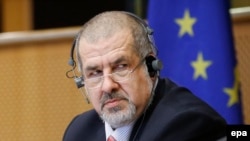
BRUSSELS -- A senior leader of the Crimean Tatar community says he is urging members of the Muslim minority to remain on the Black Sea peninsula despite worsening conditions following Russia's takeover a year ago.
But in remarks at the European Parliament on March 24, Refat Chubarov grimly evoked the deportation of the Crimean Tatars under Soviet dictator Josef Stalin.
"After April 2014, we do not exclude any action on the part of Russia, including the deportation of whole nations," said Chubarov, leader of the Crimean Tatar Mejlis, or assembly.
In 1944, Stalin ordered the mass deportation of about 180,000 Crimean Tatars to Central Asia, and many died during the journey or after their arrival.
Many deported Crimean Tatars or their children returned to Crimea during the late 1980s and the 1990s, but rights groups say they have faced discrimination and abuses since Russia seized control last spring.
Most Crimean Tatars opposed Russia's annexation of Crimea from Ukraine.
Chubarov said he could see a trend of emigration from Crimea.
He said the last session of the Mejlis was held via Skype because eight members are living in mainland Ukraine.
One Dead After Military Helicopter Crashes Near Kyiv
One person was reported killed and two others injured when a Ukrainian military helicopter crashed in the Kyiv region on March 24.
The Kyiv regional prosecutor's office said a lieutenant was killed and two other officers, a major and a captain, were injured when the MI-24 helicopter crashed near the village of Vinnytski Stavy in the Vasylkiv district.
The helicopter belonged to a military unit in Ukraine's western Lviv region.
It is unclear what the crew's mission was in Kyiv.
The military helicopter's crash occurred amid a standoff between President Petro Poroshenko and the governor of the eastern Dnipropetrovsk region, Ihor Kolomoyskiy, over a leadership change at the Ukrnafta oil company.
Poroshenko said on March 23 that Ukrainian governors will not have their own private armies after media reports said armed men who occupied the Ukrnafta building in Kyiv were linked to Kolomoyskiy.
Based on reporting by UNIAN and Interfax
From AP:
Ukraine's top football official isn't ruling out a boycott by his country of the 2018 World Cup in Russia — but believes such action won't be needed.
Federation president Hrigory Surkis tells The Associated Press "it's probably the easiest thing to say I favor boycotts ... But if we follow and comply with the Minsk agreements, then there will be no necessity to bring this matter to the agenda."
Ukraine President Petro Poroshenko said last week a boycott "needs to be discussed." He urged European allies not to take part in the sport's marquee event in four years as he accuses Russia of sending troops to fight alongside rebels in Ukraine's east.
Surkis, who has been re-elected to UEFA's executive committee, says "let's wait, let's not be pessimistic."