



Foreign ministers meet in Berlin to discuss Ukraine conflict
Kiev/Berlin (dpa) - The foreign ministers of Russia, Ukraine, France and Germany were meeting Monday in Berlin to review the progress made in implementing the Ukraine peace deal reached some two months ago.
A "degree of calm" had been achieved in eastern Ukraine but it was "too early to give the all clear," German Foreign Minister Frank-Walter Steinmeier said before the talks got underway.
The ministers are to discuss improving humanitarian supply lines into contested areas, restarting prisoner exchanges and preparing for the local elections that were agreed to under the deal signed in Belarus.
The meeting follows fresh violence between the pro-Russian rebels and government troops.
Four separatists were injured in fighting with government forces around Donetsk airport and the region east of the port city of Mariupol, separatist spokesman Eduard Basurin said according to news reports.
The Ukrainian Security Council said that one soldier was killed and six were injured during the past 24 hours.
Speaking in Kiev, Council spokesman Oleksandr Motuzyanyk accused the separatists of violating the ceasefire by attacking government positions with heavy artillery.
The separatists carried out more than 20 attacks with large caliber weapons and tanks, Motuzyanyk said according to an official transcript.
Basurin accused the Ukrainian military of violating the ceasefire with "provocative attacks."
The Organization for Security and Co-operation in Europe (OSCE), which monitors the ceasefire, expressed dismay at the violence.
The organization's chief monitor in Ukraine, Ertugrul Apakan, called upon all sides to exercise restraint.
This concludes our live-blogging of the Ukraine crisis for Monday, April 13. Check back here tomorrow morning for more of our continuing coverage.
Ministers agree to extend weapons withdrawal:
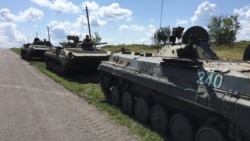
Foreign ministers from Germany, France, Russia, and Ukraine have agreed to push ahead with the withdrawal of weapons from the frontlines in eastern Ukraine.
Frank-Walter Steinmeier, Laurent Fabius, Sergei Lavrov, and Pavlo Klimkin met for about five hours in Berlin late on April 13 for talks to assess the implementation of a cease-fire.
Speaking to reporters after the talks early on April 14, Steinmeier said the ministers agreed to continue with the withdrawal of heavy weapons and to include weapons below 100 mm caliber, mortars, armored vehicles, and tanks in the withdrawal.
He said they also agreed to establish four working groups to address security issues, the process for holding local elections in rebel-held areas, the exchange of prisoners of war, and improvement of the economic situation in Ukraine's east.
The conflict between Russia-backed separatists and government troops in eastern Ukraine has claimed more than 6,000 lives since April 2014.
The cease-fire agreement brokered by the German and French leaders in the Belarusian capital of Minsk in February has reduced violence, but violations are reported regularly.
Under the truce, fighting was supposed to stop and heavy weapons bigger than 100 mm caliber were to be pulled back from the front lines.
The German, French, Russian, and Ukrainian foreign ministers were also all willing to support the OSCE, which is monitoring the implementation of the cease-fire deal, with money and personnel over the coming weeks.
Steinmeier admitted the talks had been "very long, very intensive, and at times very contentious" given the tense situation on the ground.
But he said all participants agreed there was no alternative to the Minsk agreement.
"We need to ensure that the cease-fire is adhered to far more strongly as fully as possible," Steinmeier said.
He also insisted that the Minsk accord went beyond the cease-fire agreement and must pave the way toward elections in the rebel-held territories.
"Everyone knows that we have a long path ahead of us," Steinmeier said. "But we're going to do everything we can to continue this process."
"If this process stalls, then the Minsk agreement risks possibly coming off the rails,” he added. “All sides want to prevent this."
In a joint statement, the four ministers expressed "grave concern at the recent outbreak of fights over the last weekend."
This included the use of heavy weapons around the village of Shyrokyne, on the outskirts of the port city of Mariupol, and at Donetsk airport.
The Ukrainian military said one of its servicemen was killed and six others wounded on April 13.
"The rebels have not stopped firing at Ukrainian positions,” army spokesman Oleksandr Motuzyanyk said. “Over the past day, the enemy has used weapons banned under the Minsk agreements."
Meanwhile, separatist officials accused government troops of firing tank and artillery rounds repeatedly at rebel positions.
The situation in Ukraine will be discussed at a meeting of G7 foreign ministers in the northern German city of Luebeck on April 14-15.
German Defense Minister Ursula von der Leyen is to spend April 14-15 discussing the Ukraine crisis in the Estonian capital, Tallinn, with the Baltic countries. (w/ Reuters, AP, TASS)
Over the Easter weekend, the Ukrainian Security Service arrested 11 people in Kharkiv and seized a cache of weapons: