



Good morning. This from overnight:
The United States will supply Ukraine with nearly $18 million in fresh aid.
The White House said Vice President Joe Biden discussed the financial assistance with Ukrainian Petro Poroshenko during a phone call on April 20.
According to the White House, the $17.7 million will go to providing shelter, food vouchers, potable water and health and sanitation in regions affected by fighting between government forces and pro-Russia fighters.
Biden and Poroshenko also welcomed efforts by the Organization for Security and Cooperation Europe to seek a permanent cease-fire in areas still rocked by fighting.
Both called on Russia to abide by earlier agreements and stop moving troops along the Russia-Ukraine border.
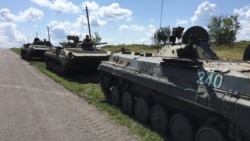
The two spoke as U.S. and Ukraine troops kicked off joint training exercises intended to help bolster Ukraine's defenses.
Savchenko is still in jail and now her mother has launched a global campaign.
The mother of a Ukrainian pilot jailed in Russia says she's launching a global campaign to free her daughter.
Nadia Savchenko has been in Russian custody since June 2014 and is awaiting trial for aiding in the killing of two Russian journalists during the conflict in eastern Ukraine.
She denies the charges, and spent 83 days on a hunger strike to protest her detention.
Her mother, Maria Savchenko, told AP on April 20 that her daughter is a political prisoner.
Maria Savchenko said Russian prosecutors have provided "no evidence" that her daughter provided guidance for a mortar attack that killed two Russian state TV journalists at a checkpoint in eastern Ukraine, as Moscow claims.
Savchenko launched her global campaign in Germany, where she pleaded for help from lawmakers.
New York is her second stop and she will meet on April 21 with UN Assistant Secretary-General for Human Rights Ivan Simonovic.
Bomb Blast In Government-Held Kharkiv
By RFE/RL's Ukrainian Service
KHARKIV, Ukraine -- Authorities say a bomb exploded in the center of the eastern Ukrainian city of Kharkiv on April 21.
It was the latest in a series of bombings in a major government-held city that is seen as a prize coveted by Russian-backed separatists.
An Opel SUV that was used by Ukrainian forces in military operations against separatists in the neighboring Donetsk province exploded at around 4 a.m.
The blast shattered windows in nearby buildings, but no casualties were reported.
There was no immediate claim of responsibility.
A series of bomb blasts have hit Kharkiv and the southern port city of Odesa in recent months, several of them targeting organizations with ties to soldiers who have battled separatists in a conflict that has killed more than 6,100 people since April 2014.
Ukrainian authorities blame the explosions on Russia and the rebels.
With reporting by UNIAN
Belarusian National Jailed In Russia For Pro-Ukrainian Stance
By RFE/RL's Belarus Service
HOMEL, Belarus -- A 22-year-old Belarusian IT engineer has been sent to jail for pro-Ukrainian activities on the Internet.
A Belarusian civil right activist, Paval Yukhnevich, told RFE/RL on April 20 that Kiryl Silivonchyk from the southeastern city of Homel was arrested in December in the Russian city of Nizhny Novgorod, where he worked for a software company.
Silivonchyk and several of his Russian colleagues were charged with inciting "terrorism" online.
Yukhnevich quoted Silivonchyk's relatives as saying that on April 9, the Moscow District Military court sentenced Silivonchyk to two years in a minimum security penal colony.
Investigators said that Silivonchyk had posted several statements condemning Russia's annexation of Crimea last year and allegedly calling for the killing of Russians.
One of the pictures Silivonchyk allegedly placed on his account on the Russian social network VKontakte showed a Ukrainian soldier "desecrating" the Russian flag.
Russia's ruble hits 2-week low against dollar:
Russia’s ruble currency fell to a two-week low against the U.S. dollar on April 21.
The dollar extended its gains against the ruble, rising to 54 rubles in early trading on the Moscow Exchange, its highest level since April 8.
The ruble has partially recovered this year after falling to 80 per dollar in mid-December in its worst collapse since the Russian currency crisis of 1998.
The Russian economy and the ruble were hit hard in 2014 by a sharp decline in the price of oil, one of the country's chief exports, and sanctions imposed by the West over Moscow's interference in Ukraine.
The ruble’s most recent fall follows a drop in oil prices and an April 20 decision by Russia's central bank to increase the rates at which it provides foreign exchange at auctions. (Interfax, Bloomberg)
“Suddenly, we are the enemy,” Irina whispers to me from the bottom bunk as our Moscow-bound train pulls into Russian border control at around 3am. A year after war broke out in the Donbass, the Kiev-Moscow train is one of the few remaining passenger rail lines linking Russia and Ukraine.
“We never had any problems before,” says Irina, a sturdy Ukrainian woman in my carriage. Born in a village in southeast Ukraine, she studied in Moscow in the 1970s before settling in the Ukrainian capital. Now in her mid-fifties, she is employed in the Kiev office of a Moscow-based pharmaceutical firm. Irina has spent 30 years traveling between the two cities.
“I work for a Russian company,” she mutters hesitantly to the female border guard examining her documents. After a lengthy pause, the guard hands back her papers. “We can all get on after all,” the Russian replies. “There’s so little good news these days.”
Irina has happy memories of Moscow — the city of her student days where she met her husband. For years she would attend university reunions in the Russian capital, where old friends would catch up over semi-sweet wine high up in the Moscow suburbs. But that was before the Maidan. “It’s all different now,” she sighs.
Ukrainians and Russians have been torn apart by a war few understand. Kiev and Moscow, once cities with shared histories, are now unrecognizable to one another. On the 13-hour journey between the two capitals, passengers try to make sense of the conflict.