



Poroshenko Warns Of War Threat As Truce Violations Continue
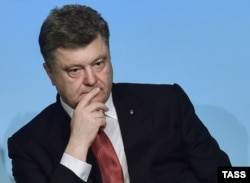
Ukrainian President Petro Poroshenko says the threat of war is "hanging over" the country as cease-fire violations continue in eastern Ukraine.
Poroshenko, speaking at an international conference on Ukraine in Kyiv on April 28, said the country needs aid and "solidarity" to prevent war from "erupting" and to resolve the situation in the Donbas region where Russian-backed separatists control territory.
More than 6,100 people have been killed in the past year as government forces battled the rebels.
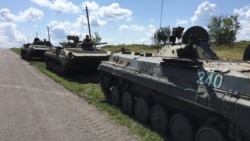
Poroshenko's comments came as military officials said the separatists had resumed using rocket launchers that are banned under a February cease-fire agreement signed in Minsk.
Meanwhile, U.S. Vice President Joe Biden said in a video address at the Kyiv conference that economic sanctions against Russia should remain in effect until the complete fulfillment of the Minsk agreement.
Russia has denied having troops in Ukraine.
Ukrainian Prime Minister Arseniy Yatsenyuk on April 28 told delegates at the international conference that Ukraine has received far less financial aid than Greece, even though Athens has no war or "Russian tanks" on its territory.
Based on reporting by Interfax and AP
Finland's Navy Fires Warning Charges Near Suspected Submarine
Finland says its navy fired small underwater depth charges on April 28 as a warning against a suspected submarine in waters near Helsinki.
The grenade-size charges were fired amid growing military tensions with neighboring Russia, fueled by Russian border incursions and air force flights into Finnish airspace, since the conflict in eastern Ukraine began a year ago.
Finnish Defense Minister Carl Haglund did not say whether Russia was involved in April 28 incident in the Gulf of Finland.
But Haglund said: "It is always serious if our territorial waters have been violated."
Reports of a submarine spotted near Stockholm last year led to Sweden's biggest mobilization since the Cold War.
Regional tensions were reflected earlier in April after a joint statement by the Nordic countries -- Sweden, Norway, Finland, Denmark, and Iceland -- that directly cited the Russian "challenge" as grounds to increase defense cooperation.
Based on reporting by Reuters and AFP
LATEST: Russia's penitentiary service says Ukrainian military pilot Nadia Savchenko has been transferred from a Moscow jail to a civilian hospital. (TASS, RIA Novosti, Interfax)
Savchenko moved to civilian hospital:
Ukrainian military pilot Nadia Savchenko has been transferred from a jail hospital to a civilian clinic in Moscow.
Russian Federal Penitentiary Service spokeswoman Kristina Belousova said on April 28 that Savchenko was moved to a clinic in the capital because of her deteriorating health, but did not say whether her move to a civilian hospital was permanent.
Savchenko had previously maintained a hunger strike for more than 80 days over the winter.
Savchenko's lawyer, Mark Feigin, said on April 27 that the military pilot had resumed the hunger strike over the weekend, and was in bad health.
Belousova on April 28 said that Savchenko stopped her hunger strike.
Savchenko has been in pretrial detention in Russia since July, when she says she was illegally brought into the country after being abducted by pro-Russian separatists in Ukraine.
She is charged with complicity in the killing of two Russian journalists who died in the conflict in eastern Ukraine, as well as illegal border crossing. (TASS, RIA Novosti)
In New TV Spots, Ukraine Accuses Russia Of 'Misappropriating' Victory Day

With Russia pushing hard to monopolize the remembrance of the victory over Nazi Germany in 1945, activists in Ukraine have decided to push back.
The Information Resistance group, with assistance from the Ukrainian military and the National Military History Museum, has produced two emotionally charged public-service advertisements that emphasize Ukraine's tremendous sacrifices and contributions to victory in 1945.
The Kremlin considers the current government of Ukraine to be fascists that revere controversial World War II-era Ukrainian nationalist leader Stepan Bandera, who Moscow views as a Nazi collaborator.
"The dialogues [in the advertisements] show better than any political rhetoric the true feelings of the 'modern Banderites,' as Russian propaganda calls us, regarding the memory of our grandfathers who fought and stopped fascism," Ukrainian lawmaker and Information Resistance activist Dmytro Tymchuk told Euromaidan Press.