




Ukraine Librarian Detained In Moscow Falls Ill, Claims Was Framed
By RFE/RL
The detained head of the Russian Library of Ukrainian Literature has fallen ill in custody and claims Russian authorities framed her by planting extremist books in her collection.
"She said they had planted a large batch of books during the searches," Russian rights activist Zoya Svetova told the AFP news agency on October 30 after speaking with Natalya Sharina, the 58-year-old library director detained by Russian authorities.
After the library was raided October 29, Russia's Investigative Committee said authorities had found books by Ukrainian ultranationalist author Dmytro Korchynsky, whose works are banned in Russia. It charged Sharina with inciting ethnic hatred and violating human dignity by distributing such books.
While Sharina was not present at the library when it was raided by armed, masked police, who carted off about 200 books, her deputy, Vitaly Krikunenko, said the library did not keep Korchynsky's books and called the accusations against her "absolute nonsense."
Sharina denied the charges in the Taganka district court in Moscow on October 30.
"I didn't do anything illegal," she said. "The library staff examined the new arrivals carefully and as soon as one or another titles was added to the list of extremist literature, we immediately excluded them from general public access."
Library employees say any extremist books purportedly found by investigators were planted to create a pretext for the raid.
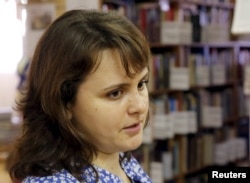
Tatyana Muntyan, an employee, said she had personally seen investigators plant banned books in the library the day before the raid.
"They brought books with them which were included on the list of extremist literature," Muntyan told Reuters. "I saw it. The books they brought did not have our stamp inside them. They planted these books."
The investigative committee did not respond to the charges.
Meanwhile, Sharina fell into a health crisis while under detention, suffering several bouts of extreme high blood pressure which required treatment by medical personnel, her lawyers said.
Russian news agencies said the court decided October 30 to put Sharina under house arrest and charge her with incitement of ethnic hatred. That crime can result in up to four years in prison.
With reporting by AFP, Reuters, TASS, and Interfax
This ends our live blogging for October 30. Be sure to check back tomorrow for our continuing coverage.
NATO chief: Russia's Syria deployment aimed to take eyes off Ukraine
By Mike Eckel
WASHINGTON -- NATO's top commander says Russia's military deployment to Syria was aimed at showcasing Moscow's resurgent armed forces, but also to distract Western attention from the simmering conflict in Ukraine.
The comments by U.S. Air Force General Philip Breedlove on October 30 came the same day that Russia staged a major test of its strategic and tactical missile forces, firing multiple ballistic and cruise missiles at testing ranges throughout the country.
Breedlove told reporters at the Pentagon that Moscow continued to defy the so-called Minsk agreements that resulted in a cease-fire in eastern Ukraine. He said Russia was supplying command-and-control units, artillery spotting and support, and other materiel to the separatists.
"Folks have taken their eye off of Ukraine because of what's happened in Syria," Breedlove said. "It's technique they've employed in the past.
"This is part of a larger construct by Russia and we need to be thinking holistically about our response," he said. "We need to remember that these are connected."
The conflict between Ukrainian forces and Russia-backed separatists who hold parts of the Donetsk and Luhansk regions, known as the Donbas, has killed more than 7,900 people since April 2014.
The Russian missile tests, which appeared to be the largest it has conducted in at least a year, included the launch of a Kalibr cruise missile from a Russian ship in the Caspian Sea, as well as intercontinental ballistic missiles from a nuclear submarine in the Barents Sea in the north and one in the Sea of Okhotsk, off Russia's eastern coast, the Defense Ministry said.
The exercises also included the firing of a land-based Topol missile from Plesetsk in northwestern Russia, Tu-160s strategic bombers launching cruise missiles in the northern Komi region and the Pacific peninsula of Kamchatka, and an Iskander cruise missile fired at Kapustin Yar in southern Russia.
The tests, and Breedlove's comments, come as rhetoric between Moscow and the West continues to ratchet up, with U.S. and NATO aircraft flying in sometimes close proximity to one another in Syrian airspace.
They also come as NATO stages its largest training exercises in more than a decade, with 36,000 troops from 30 countries participating in the drills off of Spain and Portugal. NATO officials said the Trident Juncture drills had been planned for months, but also highlighted the alliance's concerns with Russia's often bellicose actions in Eastern Europe and elsewhere.
The Russian military campaign in Syria, which began on September 30 after weeks of a stealth build-up of troops and equipment, is its largest outside the former Soviet Union in decades.
With advanced military weaponry such as Su-30M fighter jets and the Kalibr cruise missiles being used in the air campaign, many analysts believe the Syria operation is aimed at sending a message that Russian military capabilities have returned in full.
Earlier this week, two strategic Tu-160 bombers flew within 2 kilometers, and at a height of 150 meters, to the U.S. aircraft carrier Ronald Reagan in the Pacific Ocean off East Asia, prompting officials to scramble F/A-18 fighter jets to escort the bombers.
Asked why he thought the Kremlin had deployed to Syria, where the regime of President Bashar al-Assad is a close ally, Breedlove said, "Mr. Putin wants to be seen as equal on the world stage, as a world power."
"Mr. Putin needs eastern Mediterranean ports and airfields. Mr. Putin sees the Assad regime as a guarantor of those ports. Mr. Putin wants the world's eyes off of Ukraine, to put the focus on Syria, then normalize Donbas. I think he wants to take the world's eyes off of Ukraine," he said. (w/ AP, TASS, Interfax)
Poroshenko's wealth grows despite war, economic woes, AFP reports:
The value of Ukrainian President Petro Poroshenko's assets soared despite economic crisis and conflict while those of other tycoons shrank in an annual wealth list published Friday.
The 50-year-old Western-backed president's business empire ranges from chocolates to media holdings that still remain under his control.
Friday's independent Novoye Vremya weekly showed the Ukrainian leader -- often criticised for failing to curb the political powers of fellow tycoons -- ranked as the country's sixth-richest man.
His assets reportedly rose by 20 percent to $979 million (889 million euros) -- barely supporting his claim of no longer being a billionaire.
Poroshenko retains control of a top TV channel and has failed to follow through on his promise to sell off his Roshen chocolate empire due to a lack of foreign interest and a dearth of rich-enough investors in Ukraine itself.
The president's official spokesman did not pick up his phone when contacted repeatedly by AFP.
"Poroshenko's (wealth) rose thanks to the rise in value of his candy business that -- even in the midst of the deepest of crises -- is developing quickly, building new capacities and conquering new markets," the weekly said.
The wealth list is topped by the nationally renowned metals magnate Rinat Akhmetov
Tthe 49-year-old is a controversial figure accused by some Ukrainian media of impeding Poroshenko's efforts to halt the 18-month war in the pro-Russian east.
Novoye Vremya said Akhmetov's fortunes had plunged by 56 percent to $4.5 billion due in a part to the sharp recent fall in global commodity prices.
Poroshenko's sworn political foe and banking giant Igor Kolomoyskiy came in third with a fortune estimated at $1.9 billion.
The 52-year-old grey-bearded and fiercely outspoken figure finds himself in the peculiar position of being at odds with both Kiev and Moscow.
Russia's state media accuse him of funding Ukrainian neo-Nazi combat units that commit grave crimes in the separatist east.
Poroshenko's fight against Kolomoyskiy began with efforts to strip him of his indirect control of a state-owned oil company and culminated in the businessman losing his seat as governor of the industrially important Dnipropetrovsk region in March.
Kolomoyskiy's wealth reportedly slipped by 17 percent due to the EU-neighbouring country's financial woes.
All the other names in the top 10 also suffered losses since the weekly conducted its study last year.
Ukraine's economy is on track to lose about 12 percent of its gross domestic product this year and only return to marginal growth should the eastern campaign end in 2016.