




WASHINGTON -- The US House of Representatives has passed legislation requiring the administration to produce a detailed assessment of Russian and Chinese intelligence activities in Georgia, marking the latest sign of growing concern in Washington over the direction of the South Caucasus country under the ruling Georgian Dream party.
The bill, H.R. 7668, known as the Countering China's Control of the Caucasus Act, was fast-tracked through the House on June 8 and approved under suspension of the rules with bipartisan support.
The legislation mandates reports on Russian and Chinese intelligence assets and influence networks operating in Georgia, areas of cooperation between Moscow and Beijing inside the country, and a broader US strategy toward future relations with Tbilisi.
The vote comes amid mounting criticism from US lawmakers who have accused the ruling Georgian Dream party -- in power since 2012 -- of democratic backsliding, passing repressive laws targeting civil society and opposition voices, and tilting toward Russia and China -- despite broad public support among Georgians for Euro-Atlantic integration.
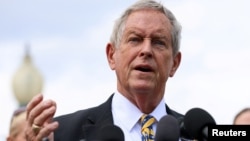
Representative Joe Wilson, a Republican from South Carolina and the bill's sponsor, told RFE/RL after the vote that the legislation was intended to support the Georgian people rather than the country's current leadership.

“The anti-American Georgian Dream party does not represent the Georgian people," Wilson said. "The Georgian people want to have a strong relationship with the United States. The only way to do that is free political prisoners, have free and fair elections, and root out the malign influence of China, Russia, and Iran.”
Growing Alarm In Congress
During floor debate, lawmakers from both parties described the bill as part of a broader effort to respond to what they see as democratic deterioration and expanding foreign influence in Georgia.
Representative Brian Mast, the Republican chairman of the House Foreign Affairs Committee, argued that recent developments had raised "serious questions" about the state of democracy in the country.
"To this day, Russia occupies 20 percent of Georgia's sovereign territory following its 2008 invasion," Mast said, noting longstanding concerns about Moscow's influence.
He also pointed to Beijing's growing footprint in Georgia, including the selection of a Chinese consortium over a US company for the development of the strategically significant Anaklia deep-water port project.
“Competition is good," Mast said, "but when it comes to critical infrastructure like this, our partners should take into consideration the risk posed by the PRC (People's Republic of China).”
According to Mast, the legislation is designed to determine the extent of Russian and Chinese intelligence activities in Georgia while assessing whether the country remains committed to closer ties with the United States.

Democratic Representative Ami Bera of California echoed those concerns, describing the legislation as a response to what he characterized as democratic backsliding under Georgian Dream.
"In recent years, the current Georgian Dream government, as well as foreign malign influence from Russia and China in Georgia, have threatened Georgia's hard-fought democratic gains, corrupted some of its state institutions, and caused a rift in US-Georgia relations and between the Georgian government and its people," Bera said.
Bera linked the bill to the broader congressional push embodied in the MEGOBARI Act, legislation previously passed by the House that seeks to strengthen support for democratic institutions and civil society in Georgia.
"The goal is to let the Georgian people know that we stand by them in their quest for democracy, respect for their rights, and deeper integration in the Euro-Atlantic community," he said.
Georgia, China Upgrade Ties
The House action comes as China and Georgia jointly announced on June 9 that they had elevated their bilateral relations to a "comprehensive strategic partnership."
The decision was announced by Chinese President Xi Jinping and Georgian President Mikheil Kavelashvili on the 34th anniversary of the establishment of China-Georgia diplomatic relations.
“Today is a very important day,” Georgian Dream Prime Minister Irakli Kobakhidze said at a briefing on June 9. “This is a very important agreement that was signed today.”
The prime minister said the upgraded ties would further deepen Georgian-Chinese relations, noting that the two countries had already established visa-free travel, direct flights, and “concrete, tangible results” in trade and economic cooperation.


The sharpest criticism during the debate came from Wilson, one of Congress's most vocal advocates for Georgia's opposition movement and Euro-Atlantic integration.
Wilson argued that Georgia's strategic importance has increased as Washington seeks to strengthen economic and transportation links across the South Caucasus and Central Asia.
But Wilson accused the ruling party of moving the country away from that path.
"The illegitimate Georgian Dream regime is in the process of selling out the country to the Chinese Communist Party and, indeed, war criminal Putin and Iran against the wishes of the Georgian people and the interests of the United States," he said.
The South Carolina lawmaker also said that the new legislation passed by the US House would help determine whether Georgia should continue to receive substantial American assistance while relations remain strained.
Supporting The Georgian People
Despite the criticism directed at the Georgian government, supporters of the bill repeatedly emphasized that the legislation was intended to support Georgian citizens rather than punish the country.
Democratic Representative Bera stressed that the measure "does not seek to malign the Georgian government" but instead demonstrates that the United States remains committed to the Georgian people's "Euro-Atlantic aspirations."
Mast similarly framed the legislation as an effort to provide policymakers with a clearer understanding of foreign influence operations and the future trajectory of bilateral relations.
“It's time for the United States and Georgia to move forward," he said. "But doing so requires clarity on what's happening in their country behind the scenes and a responsible strategy for future engagement.”
In response to the new US legislation, Georgian Prime Minister Kobakhidze called Wilson, the bill's sponsor, an "absolutely frivolous man."
"We continue to communicate with the executive branch, President Trump's administration, [and] the State Department," Kobakhidze said. "We are having specific conversations and we hope that these conversations will bring results."
The bill now moves to the Senate; it requires Senate approval and the president’s signature to become law.

