




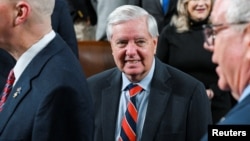
The US House of Representatives moved to advance a sweeping Russia and Iran sanctions package on August 10, just days after the Senate approved it by an overwhelming 86-11 vote, opening the next phase of a congressional push to squeeze Moscow’s war economy and give President Donald Trump additional leverage to force Russia toward negotiations with Ukraine.
The move came unusually quickly -- while the House is in its August recess -- with Republican Representatives Michael McCaul of Texas, Brian Fitzpatrick of Pennsylvania, Democratic congressman Steny Hoyer of Maryland, and a broad bipartisan group introducing the House companion to the Lindsey O. Graham Sanctioning Russia and Iran Act of 2026.
The House legislation is identical to the measure passed by the Senate last week.
The bill, named after the late Senator Lindsey Graham, would target Russian banks, energy revenues, oligarchs, the Kremlin-linked “shadow fleet,” sanctions-evasion networks, and foreign governments and companies helping sustain Moscow’s war against Ukraine. It would also extend longstanding sanctions against Iran through 2031.
The rapid House move gives supporters a chance to capitalize on the Senate vote’s overwhelming bipartisan margin, but it also sets up a potentially difficult debate over the bill’s tariff provisions and the extent of presidential authority over countries that continue buying Russian energy.
Congress In Recess
McCaul, a former chairman of the House Foreign Affairs Committee, said he had promised Graham before his death that he would introduce the legislation in the House.
“Senator Graham was a national security giant, a statesman of unmatched conviction, and a personal friend and mentor,” McCaul said, adding that Graham had worked on the legislation for more than a year and had secured White House support.
McCaul said Ukrainian President Volodymyr Zelenskyy told him during a visit to Ukraine last month that he was ready for a cease-fire and negotiations, while Russian President Vladimir Putin continued to refuse to come to the negotiating table.

The Texas Republican said the sanctions would help increase the pressure on Putin and advance what he described as Graham’s vision of an enduring peace.
Hoyer, one of the House's most senior Democrats, said the measure was long overdue.
The Maryland Democrat said the bill would attack multiple sources of Russian war financing, including oil and gas, the shadow fleet, and financial institutions.
“We must send the strongest possible message of American support as Ukraine defends democracy against despotism,” Hoyer said in a statement.
But Hoyer also highlighted a significant limitation: the sanctions package does not include several provisions contained in the Ukraine Support Act, including $8 billion in military and reconstruction assistance and sanctions relating to the kidnapping of Ukrainian children into Russia.
That omission could become part of a broader House debate over whether sanctions alone are sufficient to shape the war’s outcome.
The legislation is backed by lawmakers from across the political spectrum.
The original cosponsors include Republicans Joe Wilson of South Carolina, House Baltic Caucus co-Chair Don Bacon of Nebraska, Armed Services Committee Chairman Mike Rogers of Alabama, Mike Turner of Ohio, Ann Wagner of Missouri, Andy Barr of Kentucky, and Nathaniel Moran of Texas, as well as Democrats Congressional Ukraine Caucus co-founder and co-Chair Marcy Kaptur of Ohio, Jake Auchincloss of Massachusetts, Jill Tokuda of Hawaii, Gabe Vasquez of New Mexico, Josh Gottheimer of New Jersey, Ed Case of Hawaii, Eugene Vindman of Virginia, and Chrissy Houlahan of Pennsylvania.
Fitzpatrick said the legislation attacks what he described as the three foundations of Putin’s war machine: “oil, money, and the willingness of others to look the other way.” According to him, the bill would isolate Russian banks, shut down financing networks and force governments and companies supporting Moscow to choose whether to continue doing business with Russia.
“The most fitting tribute Congress can offer Lindsey is to finish the work he began,” Fitzpatrick said.
New Tariffs
The bill's most powerful -- and potentially most contentious -- provision would give Trump significant new authority to impose tariffs on countries that continue to purchase Russian oil and gas or help Moscow evade sanctions.
The legislation authorizes duties of up to 500 percent on goods imported from Russia and targeted duties of up to 100 percent on goods from countries that rank among the largest purchasers of Russian crude oil or natural gas or the leading facilitators of Russian oil sanctions evasion.
Hoyer said negotiations could continue over the precise scope of presidential tariff authority. In his statement, he pointed specifically to a proposal limiting that authority to eight nations whose imports are helping finance Russia's war. That provision could prove decisive once lawmakers return to Washington.
Senior House aides familiar with the discussions told RFE/RL that the immediate challenge is preserving the bipartisan coalition that produced the Senate's 86-11 vote without reopening the entire package. The political calculation is straightforward: supporters want to use the Senate vote as momentum for quick House action, while avoiding changes that could force another lengthy round of negotiations.
The aides' assessment is that the sanctions themselves command broad support. The more difficult question is how far Congress should go in delegating tariff power to the president and how aggressively the measure should be applied to major Russian-energy buyers.
That distinction could become the House fight.
Supporters argue that the tariff threat is precisely what makes the legislation potentially effective. Countries that continue buying Russian energy would have to weigh access to the US market against their commercial relationship with Moscow.
Critics, however, could argue that broad tariff authority risks creating economic consequences beyond Russia and gives the White House substantial discretion over trade policy.

For supporters of Ukraine, the trade-off is worth it.
Yuriy Boyechko, CEO of Hope For Ukraine, a New Jersey-based nonprofit delivering medical and humanitarian supplies to civilians and frontline areas, told RFE/RL that the House introduction provides the economic pressure needed to strike at the foundations of Russia's war effort.
“The introduction of the House companion bill by Representatives Brian Fitzpatrick, Michael McCaul, Steny Hoyer, and a broad bipartisan coalition offers the precise economic sledgehammer needed to break the Russian economy,” Boyechko said.
He said the combination of the House's rapid action and the Senate's 86-11 vote could give Washington a mechanism for targeting what he described as the remaining foreign revenue streams supporting the Kremlin.
“By threatening 100 percent tariffs on buyers of Russian energy, dismantling the illicit shadow tanker fleet, and isolating Russian financial institutions, the legislation targets the remaining foreign revenue streams sustaining the Kremlin's budget,” Boyechko said.
He argued that cutting those revenues could ultimately force Moscow to negotiate.
“Squeezing these vital energy revenues and financial lifelines threatens total economic exhaustion for Russia, removing its capacity to finance prolonged aggression and forcing Moscow to negotiate on Ukraine's terms,” he said.
Bill Targets Russia's Financial And Energy Lifelines
The legislation goes considerably beyond individual sanctions on Russian officials.
It would target senior Russian officials, oligarchs, companies supporting Russia's defense-industrial base, and foreign actors materially assisting Moscow's military operations or efforts to undermine Ukraine's sovereignty, territorial integrity, democratic institutions, and critical infrastructure.
It would also impose sanctions on major Russian financial institutions and certain foreign financial institutions conducting significant transactions with sanctioned Russian banks.
Another major target is Russia's shadow fleet -- vessels, owners, operators, insurers, ports, and other intermediaries involved in moving Russian oil and sanctioned goods while helping Moscow evade Western restrictions.
The bill would prohibit new US investment in Russia, restrict investment in Russia's energy sector, prohibit purchases of Russian sovereign debt and target financial-messaging services used to circumvent sanctions.
The energy provisions are central to the strategy.
Supporters argue that Russian oil and gas revenues remain critical to the Kremlin's ability to finance its military campaign, despite years of Western sanctions.
Beyond Russia
The bill also reaches beyond Russia.
It would extend the Iran Sanctions Act of 1996 through 2031, preserving sanctions authorities targeting Iran's energy and weapons sectors.
Rogers said the Iran provisions were necessary because of Tehran's threats to freedom of navigation in the Strait of Hormuz and its role in supporting Russia.
Moran said the legislation would also target dangerous Chinese entities supporting Russia's defense-industrial base.
That provision could give the legislation an additional geopolitical dimension as Washington confronts both Moscow and Beijing over their expanding strategic relationship.
One of the bill's most consequential provisions concerns when Russia-related sanctions could be lifted.
The legislation would permit the president to terminate the sanctions only after certifying to Congress that Russia had signed a peace agreement accepted by Ukraine's free and independent government and had ceased military hostilities and activities aimed at overthrowing, dismantling, or subverting the Ukrainian government.
That condition is designed to ensure that sanctions retain leverage rather than becoming simply a temporary punishment.
Fitzpatrick said the objective was a peace “determined by Ukraine, not imposed by Moscow.”
Houlahan similarly described sanctions as a diplomatic tool while cautioning that they cannot replace a broader strategy or the president's responsibility to seek congressional authorization for war.
The House move also carries a personal dimension.
Graham, who worked on the package for more than a year, became one of Congress's most prominent advocates of tougher economic pressure on Russia. His sister, Senator Darline Graham of South Carolina, said the legislation was deeply important to him and expressed hope that the House would match the Senate's bipartisan support.
For congressional Republicans and Democrats backing the bill, that legacy now intersects with a much larger strategic question: whether economic pressure can alter Putin's calculations at a moment when the Trump administration says it wants an end to the war.
The Senate has already answered one part of that question with an overwhelming vote. Now the House must determine whether it can preserve that bipartisan consensus and turn the Graham sanctions package into law.

