




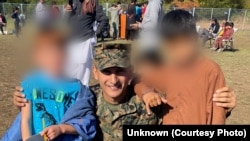
Mohammad Masood Jamshidi was a security guard at the US consulate in Herat when it was attacked by Taliban bombers. He hoped to get asylum in the United States but now fears deportation to the Democratic Republic of Congo (DRC).
His brother, former US Marine Sean Jamshidi, recently arrived in Qatar, where Masood is being held at a camp along with some 1,100 other Afghans. To Sean's surprise, he was denied access and has spent the past few days desperately trying to reach someone who will let him in.
The As-Sayliyah camp, a former US Army base, is due to close on September 30, and its residents still don't know what will happen next.
"They're traumatized from this situation, and I want to come and see them and to bring them a little bit of cash," Sean told RFE/RL on September 23, referring to his brother's family.
"We don't know where they could be relocated to. They keep talking about a third country that's not the United States, maybe in Africa, like the DRC… When I came here, they told me they declined access for me to be able to come on the camp," Sean said.
During a previous trip, in February, he was granted access.
Fighting For Freedom
Many of the Afghans at the camp worked for US forces during the US-led international military presence in Afghanistan between 2001-2021. The others are primarily their family members.
Evacuated from the country after the withdrawal of US and international forces in 2021, they had expected to be welcomed in the United States.
But all immigration requests relating to Afghanistan were halted by a presidential executive order in November 2025 after an Afghan national shot two members of the National Guard, one of whom died a day after the shooting near the White House in Washington, D.C.
An official at the US State Department told RFE/RL that the United States has "kept its promise to Afghans who risked their lives to support the US government during our attempts to help Afghans build a better country for themselves," adding that roughly 400,000 Afghans have been resettled since 2001.
"The State Department continues to work toward a positive resolution that provides safety for these remaining people to start a new life outside of Afghanistan while upholding the safety and security of the American people," the official maintained.
However, the official said that "it is long past time to move past this decades-long conflict, and look ahead to the future."
According to AfghanEvac, a charity that has helped resettled Afghans who aided the US effort in Afghanistan, 292 resident of the camp have officially been denied access to the United States. It adds that more than 400 camp residents are children.
Sean was born in Afghanistan and came to the United States, aged 4, in 2000. He signed up to join the Marine Corps when he turned 18.
"I saw the Marines in Afghanistan, I said, 'You know what? I want to be a Marine, stand up for what's right and fight for freedoms, the freedoms that we have in America,'" he said.
Across a 10-year stint, Sean served as a commander of security at the US embassy in the DRC and was also involved in caring for evacuated Afghans who reached the United States in 2021.
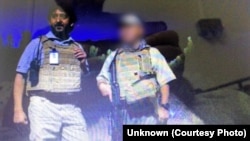
He said his brother, 49-year-old Masood, worked as a security officer for a private contractor at the US consulate in Herat, western Afghanistan, protecting government and diplomatic personnel.
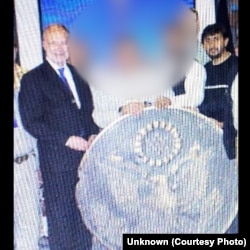
A photo from 2013 shows Masood with the US ambassador at the time, James Cunningham. Also visible is the US seal damaged in a truck bomb attack on the consulate that killed eight Afghan guards in September that year.
"The fear and loss would have deterred most individuals from returning, but Mr. Jamshidy (sic) demonstrated his courage and commitment by returning a couple of weeks later," his supervisor wrote in a letter recommending him for a US entry visa in December that year.
Masood has been at As-Sayliyah for two years now, along with his wife, three children, son-in-law, and 3-year-old grandchild.
"He risked his life. So it's definitely sad that they're talking about a third country when an individual like him literally risked his life for our policies, for our cultural values, for our freedom," Sean said.
'Welcome To The United States'
The fate of the people at the camp has been raised at Congressional hearings.
In June, Democratic Senator Chris Coons from Delaware said they included "400 children and 150 family members of currently serving active-duty US service members."
Responding, Secretary of State Marco Rubio cited the executive order but said Washington had talked with "multiple countries" about giving the Afghans refuge. He said he wanted them to find "the right places to go."
The State Department official who commented to RFE/RL called As-Saylilah "a legacy of the Biden Administration’s attempt to move as many Afghans to America as possible without properly vetting them."
Physical conditions at the camp are not said to be an issue. But people there have told RFE/RL's Radio Azadi of the frustration of being in limbo for so long and the emotional strain caused by the uncertainty ahead of the September 30 deadline for closure.
"Everyone here in the camp is anxious. We are all wondering what will happen to us and what our future will be," one camp inmate, a man who declined to be named, told RFE/RL.
"We cannot trust these people. Will they take us to America, or will they send us to another country -- perhaps somewhere in Africa?" he continued.
The man said his family had been scattered by the chaos of war and international politics since the Taliban recaptured Kabul in 2021. Two of his children were in the United States, he said, while a daughter was in Iran and two other children in Afghanistan.
"They call us constantly and ask what is happening. They are living in hiding in a house in Kabul. That alone is a source of enormous worry. And then there is our situation here. We sold everything we had -- our home, our belongings and everything else…because we believed we were going to America," the man said.
A man who chose to be identified only by his first name, 42-year-old Faraidoon, said the camp authorities held regular meetings with inmates but "at every meeting, they say there is no information."
Faraidoon has been in the camp for "about two years" with his wife and three children.
"When we arrived, there was even a sign inside the camp saying, 'Welcome to the United States of America.' Now they have simply isolated us, and we do not understand what is happening," he said.

"Yesterday, we had a meeting with the head of the camp and other officials. We asked many questions, but nothing is clear. They told us they have not yet received any order saying that the camp will close on that date. Nor has anyone told us anything about a third country," a 65-year-old inmate said on September 23.
Accounts such as these are typical for people in As-Sayliyah.
The State Department official told RFE/RL that US authorities are in "regular and direct communication with residents on resettlement efforts," saying that they "continue to work to identify options for voluntary resettlement of all Camp As-Sayliyah residents."
"Other countries have no obligation to these people, and they have no ties to other countries except for Afghanistan, where it is unsafe for them to go because of their relationship with the United States government. So, these folks are really caught between a rock and a hard place," Shawn VanDiver, a former US soldier who as head of AfghanEvac is campaigning for the Afghans to be brought to the United States, told RFE/RL.
Sean Jamshidi, the former Marine, says the toll on his family has been enormous.
"We lost our dad in America while my brother was on camp….[My brother] wasn't able to be there for the funeral," he said, adding that their mother has suffered two strokes in the past two years.
"It's been very tough for our family that we're not able to see each other," he continued. "I hope they're sent somewhere where they're safe, not just sent to another third country that has its own issues. And I'm going to continue fighting for it."



