


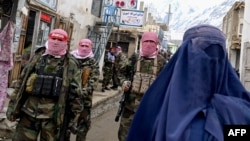
The United Nations said it was “gravely concerned” by the arrests of at least 30 women in Afghanistan’s western city of Herat over the past week for allegedly violating a new dress code imposed by the Taliban government.
Members of the Taliban’s notorious morality police arrested or detained dozens of women for violating a new directive issued in early June, according to the UN.
The directive prohibited women from appearing in public without what they described as a “proper hijab,” or Islamic head scarf. Women who failed to comply with the Islamic dress code, including those showing their faces or wearing makeup -- would face punitive measures, according to the order.
The latest restrictions led to protests in Herat on June 9 that were violently dispersed by Taliban security forces.
At least two people were killed and more than 20 wounded in the protest, the UN said. The Taliban denied any weapons were used during the demonstration. Several women were also arrested or detained, eyewitnesses said.
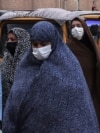

“While many women have since been released, the arrests have heightened fear and apprehension among women and girls across Afghanistan,” UN Women, the United Nations agency for gender equality and the empowerment of women, said in a statement on June 11.
The agency cited UN Human Rights Council-appointed rights experts, who expressed grave concern over the “excessive use of force” against protesters in Herat.
Among the women detained before the June 9 protest was a hospital worker employed by Doctors Without Borders (MSF).
The Swiss charity said the employee, who worked in an MSF-supported pediatric ward at Herat Regional Hospital, was detained for two days and released on June 8 after signing a written commitment to obey the new dress code.
MSF “is outraged by the arrest and detention of one of its employees as part of the enforcement of dress code requirements in the city,” the group said in a statement on June 12.
“This incident is not isolated. Women in Afghanistan already face very severe restrictions on movement and access to public life.”
The Taliban has denied making any mass arrests over the dress code.
Crackdown On Women
Protests are rare under the Taliban, which has ruled Afghanistan with an iron fist since regaining power in 2021.
The militant Islamist group has waged a violent crackdown on dissent, arresting, beating, and torturing activists and journalists, according to human rights groups.

Women have borne the brunt of the Taliban’s attempts to impose their extreme version of Islam on the war-torn country of some 40 million people.
The hard-line group has largely erased women from public life and imposed severe restrictions on their appearances, freedom of movement, and right to work and study.
In November, the Taliban barred female patients, visitors, and medical staff who do not wear the all-encompassing burqa from entering public hospitals in Herat. It is unclear if the measure has been extended nationwide.
In August 2024, the Taliban enacted a morality law that imposed severe restrictions on women. Under the law, women are required to fully cover their faces and bodies when in public and are banned from wearing "transparent, tight, or short" clothing.
The enforcement of the extremist group’s laws, however, has been sporadic and uneven across the country, and often left to the discretion of local Taliban leaders.
Many Afghan women wear a hijab, or Islamic head scarf, which covers the head and neck. In addition, some women wear a face mask to conceal their nose and mouth.
Other women don the burqa or an Islamic abaya robe and niqab that covers the hair, body, and most of the face. The latter is common in Arab countries in the Persian Gulf.
Afghan women, especially those in urban areas, consider the burqa and niqab to be alien to Afghan culture.
Before the Taliban’s return to power, many women wore loose head scarves that only concealed their hair.

