



News
Bulgaria Blames Suicide Bomber For Burgas Attack; Iran Denies Role
The attack took place outside the airport in the Black Sea resort city of Burgas after a planeload of Israeli tourists from Tel Aviv had boarded a double-decker bus.
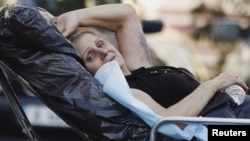
The Bulgarian Interior Ministry says five Israelis were killed in the blast and dozens more injured. The number of Israeli fatalities had been revised down from six.
The Bulgarian bus driver was also killed, along with the bomber, who was reported to be holding what appeared to be a falsified driver's license from the U.S. state of Michigan.
Israeli leaders have accused Iran and it's Lebanese ally Hizballah of responsibility.
Iran's embassy in Bulgaria dismissed the allegations as "unfounded."
A commentary posted on the website of Iran's state television channel called the Israeli claim "ridiculous."
The Burgas blast is the deadliest attack on Israeli citizens abroad since 2004, when 12 Israelis were killed in a bomb attack in Egypt's Sinai Peninsula.
The blast also came on the 18th anniversary of the 1994 bombing of a Jewish community center in Argentina that killed 85 people. Iranian officials and Hizbollah have been implicated in some official investigations of the attack -- allegations denied by Tehran.
International Investigation
Speaking on July 19, Bulgarian Prime Minister Boiko Borisov said work was under way to indentify the suspected Burgas bomber, whose body is reported to have suffered extensive damage.
"We have strong evidence to believe that [attack] was the work of a suicide bomber," Borisov told reporters. "We've been working closely with our FBI and CIA colleagues and no information was found about the [alleged perpetrator] in their databases. So, we can say with certainty that one of the victims had false [ID] documents."
Bulgaria's Interior Ministry has released a short clip of security camera video showing the man suspected of carrying out the bombing.
WATCH: A security video shows the man Bulgarian authorities say is the bombing suspect
Meanwhile, Israeli Prime Minister Benjamin Netanyahu has claimed the attack was carried out by Lebanon's Hizballah in conjunction with Iran.
Speaking at a news conference in Jerusalem on July 19, he described the Lebanese militia as "the long arm of Iran."
He said: "Yesterday's attack in Bulgaria was perpetrated by Hizballah, Iran's leading terrorist proxy."
Netanyahu added that the attack was part of a global campaign of terror carried out by Iran and Hizballah, which had reached a dozen countries on five continents.
He pledged that Israel would continue to fight against terror and would "exact a heavy price from those who support it."
Outrage And Injuries
NATO Secretary-General Anders Fogh Rasmussen condemned the bombing, saying in a statement that terrorism "can never be tolerated or justified."
The Russian Foreign Ministry said those responsible for the blast "must be identified and carry just punishment."
Israeli and Bulgarian officials, meanwhile, were coordinating relief efforts for Israelis injured in the blast and identifying the dead.
An Israeli military plane was preparing to fly back 30 wounded Israelis who had been temporarily hospitalized in Burgas.
A Bulgarian government plane will return some 100 Israelis who were not injured in the attack but want to cut their vacations short.
Based on reporting by AP, Reuters, AFP, and dpa
More News
UN Security Council Extends EU Peacekeeping Mandate In Bosnia, Debates High Representative's Report
The UN Security Council has adopted a resolution extending the mandate of the European Union's peacekeeping and security mission in Bosnia-Herzegovina for another year.
The resolution was adopted unanimously on November 2 at a Security Council session in New York during which the 15-member council also discussed a report by the international community's high representative to Bosnia, Christian Schmidt.
Known as EUFOR Althea, the peacekeeping mission -- made up of about 1,100 soldiers from 20 countries -- must be renewed by the Security Council every year. It was first deployed to Bosnia in 2004.
The report, which covers the period from April 16 to October 15 of this year, warns that there have been "unprecedented attacks on the Dayton peace agreement and the constitutional order of Bosnia.“
The high representative also highlighted wrong interpretations of the Dayton agreement in the entity of Republika Srpska, which "serve secessionist goals, including claims which negate the continuity of BiH and wrongly present its composition.“
It also emphasizes that "there is only one country on the territory of Bosnia and Herzegovina, and that is Bosnia and Herzegovina."
The Office of the High Representative (OHR) was established by the Dayton agreement, which ended the 1992-95 Bosnian War, and Schmidt functions as the international community's overseer of civil and other aspects of the accord.
The agreement also established the division of the country between two entities, Republika Srpska and the Bosniak-Croat federation, which are tied together by a weak central government.
The pro-Russian leader of Republika Srpska, Milorad Dodik, has spoken in favor of the secession of the majority Serb entity, and his actions have resulted in charges related to his efforts to ignore Schmidt’s decisions and decisions made by Bosnia's Constitutional Court. A hearing in the case has been set for November 22.
Dodik, who has been under U.S. sanctions since 2017 and under U.K. sanctions since last year for undermining the Dayton agreement, has refused to enter a plea and has called the proceedings "a circus."
The presiding member of the Bosnian tripartite presidency, Zeljko Komsic, told the Security Council that the country "hasn't completed its democratic transition" 28 years after the war, and that it's "still stuck in ethnic policies.“
U.S. Deputy Ambassador Robert Wood told the Security Council that the United States is "concerned" by recent events, including rhetoric and actions by officials undermining the Dayton agreement, the constitutional structure of the country, and rule of law. Wood added that Schmidt has the full support of the United States.
Russian Ambassador to the UN Vasily Nebenzya said "political crisis in the country is a permanent reality" and that "OHR is obsolete and should be closed as soon as possible."
Russia and China -- which took over the presidency of the UN Security Council -- do not recognize Schmidt as the high representative, claiming that he wasn't properly confirmed. Other countries that do recognize Schmidt have said that this was not required.
Because of the Russian and Chinese opposition, top politicians in Republika Srpska also dispute Schmidt's status.
Georgian Government Is Suppressing Free Expression, PEN Says.
The U.S.-based PEN writers' association warned in a report published on November 2 that the government in Georgia is clamping down on freedom of speech and cultural expression in ways that could have implications for Georgia's bid to join the European Union.
The report by PEN America highlighted a “concerning pattern of targeting individuals” in the cultural sphere who have criticized the government or expressed views at odds with the government’s line. It also highlighted the government’s interference in the system of selecting and appointing leaders of the country’s major cultural institutions.
According to the New York-based nonprofit, these practices are part of the ruling Georgian Dream party’s “concerted effort to suppress free expression and curb cultural independence in the country.”
“Their goal seems to be the redirection of overwhelming public support away from EU membership and toward stronger ties with Russia,” PEN America’s advocacy and Eurasia director, Polina Sadovskaya, said in a statement.
“These actions have drawn limited international attention, which is concerning, given that restraints on writers, artists, and cultural workers are regularly one of the first signs of democratic backsliding as autocrats seek to control public opinion,” she added.
The report details several initiatives spearheaded by Tea Tsulukiani, Georgia’s minister of culture, which according to PEN America are “aimed at overseeing and controlling Georgia’s vibrant cultural landscape.”
Among them are alleged attempts to silence artists who are critical of the government.
One case detailed in the report is a criminal investigation launched against the artist Sandro Sulaberidze, who removed his self-portrait from a gallery wall and had painted in its place the phrase “Art is alive and independent!”
Another case mentioned in the report is that of Gaga Chkheidze, who was dismissed from his position as director of the Georgian National Film Center shortly after posting critical remarks about the government on Facebook.
The report also detailed a case of alleged government interference in the personnel policy of cultural institutions, including the National Museum of Georgia and the National Agency for Cultural Heritage Protection. As part of their “restructuring,” staff members were required to undergo interviews during which they were asked about their political allegiance.
Subsequently, scores of employees, including many highly qualified researchers and directors, were let go and replaced by government-appointed officials with little to no experience in managing museums or cultural institutions, the report said.
PEN America also described government interference in awarding literary awards, with the Culture Ministry requiring the inclusion of a ministry representative on literary awards juries and requiring the ministry’s approval of the other jury members.
The PEN America’s report comes as Georgia is expecting a decision on its EU membership bid.
Georgia applied for EU membership shortly after Russia's 2022 invasion of Ukraine, along with Ukraine and Moldova. While the two latter countries were awarded candidate status in June 2022, Georgia was instead given an EU “perspective” and a list of reforms it should implement.
In addition to tackling political polarization and other issues, the European Commission has recommended that Georgia address concerns about freedom of expression.
By the end of the year, the EU will decide -- based on its perception of the progress Georgia has made on those reforms -- whether to award it candidate status.
Pakistan Sets February 8 As Date For Delayed Elections
Pakistan will hold national elections in early February 2024, the Office of the President and the Election Commission said on November 2. "It was unanimously decided that the election will be held on Thursday, February 8," the Pakistani Election Commission (ECP) said in a statement after its members met with caretaker President Arif Alvi, whose office confirmed the date. A caretaker government has been running Pakistan since parliament was dissolved on August 9. Polls were to have taken place within 90 days of that date, but the ECP said it needed time to redraw voting districts following the latest census. To read the full story on RFE/RL's Radio Mashaal, click here.
- By RFE/RL
U.S. Expands Effort To Choke Russia's Supplies Of Military Technology With New Sanctions
The U.S. Treasury Department imposed sanctions on November 2 on 130 entities and people from Turkey, China, and the United Arab Emirates (U.A.E.) that it says are providing Russia with technology and equipment from third countries needed to fight its war against Ukraine.
The sanctions also take aim at Russia’s domestic industrial base, which the department’s Office of Foreign Assets Control (OFAC) said in a news release is “seeking to reinvent itself as the maintainer of Russia’s war machine.”
The Treasury Department said the sanction designations continue its efforts to “disrupt the networks and channels through which Russia attempts to sustain its beleaguered military.”
In addition, the State Department imposed diplomatic sanctions on more than 90 entities and individuals that it said have engaged in sanctions evasion and "those complicit in furthering Russia’s ability to wage its war against Ukraine."
U.S. Secretary of State Antony Blinken said the State Department's actions target Russia’s future energy capabilities, "which will limit Moscow’s ability to funnel future revenues toward its destructive aims."
Among the 130 designated for sanctions by the OFAC are Turkish national Berk Turken and two companies he owns, which the OFAC said have been involved in enabling Russian intelligence services to procure technology for sanctioned Russian entities. Turken's network arranged payments and shipping details designed to “overcome sanctions barriers” and move goods from Turkey to Russia, OFAC said.
One of Turken’s two companies, Turken Digital, worked with the company TBS, based in Moscow, and Andrei Timoshin to arrange payment and shipping details, OFAC said. TBS is a technology company that provides testing systems for the microelectronic industry. OFAC said Russia’s intelligence services have used TBS to enable payments and ship equipment on behalf of Russian customers.
A series of U.A.E.-based firms alleged to have shipped aviation equipment, machines for data reception, and other equipment were also sanctioned. In addition, the U.A.E.-based ARX Financial Engineering was sanctioned for allegedly being involved in finding ways for Russian rubles to be sent from the sanctioned Russian VTB Bank and converted to U.S. dollars.
Treasury Secretary Janet Yellen said Russia “is dependent on willing third-country individuals and entities to resupply its military and perpetuate its heinous war against Ukraine and we will not hesitate in holding them accountable.”
“Our global sanctions coalition has choked off Russia’s access to key inputs for its military industrial complex and has undermined the Kremlin’s ability to wage its unprovoked war," she said in the Treasury Department's statement.
The sanctions freeze any U.S.-based assets owned or controlled by the individuals and entities. They also block financial transactions with those designated and prohibit the contribution of funds, goods, and services to them.
The latest sanctions build on other rounds of sanctions, visa bans, and financial penalties imposed on Russian businesses and individuals, banks, and oligarchs since its full-scale invasion of Ukraine.
Along with imposing sanctions, the United States and its European allies have frozen Russian Central Bank funds, restricted Russian banks’ access to the main system for global financial transactions, and imposed a $60-per-barrel price cap on Russian oil and diesel.
With reporting by AP
- By Reuters
Hungary Says Eight Hungarian Citizens Left Gaza To Egypt
Eight Hungarian citizens with two Palestinian family members have left Gaza through the Rafah border crossing to Egypt on November 2, Hungary's foreign minister said on his Facebook page. Peter Szijjarto said there had been 15 Hungarian citizens in Gaza, and all of them could have left Gaza, but only two families took on the journey and now "they are in complete safety on Egyptian territory."
Iran Continues Clampdown On Teachers' Union Activists As Court Upholds Educator's Sentence
An Iranian court has upheld the six-month prison sentence of one teachers' union activist, while another faced his third court appearance in two months as authorities continue their crackdown on organized labor.
The Coordinating Council of Teachers Syndicates (CCTS) reported on its Telegram channel that Atkeh Rajabi's sentence was confirmed by the Khorasan Razavi Provincial Appeals Court, with two months of jail time and four months suspended for five years.
Rajabi had been previously dismissed from her job as a teacher because she did not wear a hijab, or Islamic head scarf, when appearing in a protest video, as well as due to her participation in nationwide strikes in support of imprisoned teachers.
Rajabi, who used to teach in the northeastern Iranian city of Ahmadabad, said in the video that she could not cooperate with an institution “that allows repressive forces to take away the security and peace of our children.”
Separately, the CCTS said that Mohsen Omrani had made his third court appearance on October 31 in a trial revolving around charges of "propaganda against the system."
Omrani, who was apprehended by security forces at his residence in May amid a surge in detentions of educators' rights and labor activists, had previously been sentenced to two years of imprisonment and asset confiscation, with an additional three months and 35 lashes in a separate case.
The council condemned what it called "the systematic case fabrications" against union activists and its members.
Unrest -- including several protests by teachers -- has rattled Iran in response to declining living standards, wage arrears, and a lack of welfare support. Labor law in Iran does not recognize the right of workers to form independent unions.
The death of 22-year-old Mahsa Amini while in police custody in September 2022 for allegedly wearing a head scarf improperly breathed new life into the protests, which officials across the country have tried to quell with harsh -- and sometimes deadly -- measures.
Written by Ardeshir Tayebi based on an original story in Persian by RFE/RL's Radio Farda
Thousands Of Afghans, Facing Expulsion From Pakistan, Continue To Cross Border
Thousands of Afghans continue to flood back into the country from Pakistan as they seek to avoid deportation following a deadline from Islamabad for undocumented migrants to leave, a move the United Nations warned could lead to "severe" human rights violations.
As of November 2, officials said more than 165,000 Afghans have fled Pakistan in the month since the government ordered some 1.7 million migrants -- more than 1 million of whom are Afghan nationals who fled following the August 2021 seizure of power in Kabul by Taliban militants -- to leave or face arrest and deportation.
The majority have rushed to the border in recent days as the November 1 deadline approached and police began to open dozens of centers to detain arrested Afghans before expelling them. On the other side of the border, Taliban officials have also opened temporary transit camps to assist those returning.
More than 100 people were detained in one police operation in the city of Karachi on November 2, while police rounded up 425 Afghans in Quetta, the city closest to the Chaman border crossing.
WATCH: Afghan refugees in Pakistan, many having traveled for days, crossed into Afghanistan as a November 1 deadline to leave the country took effect. Islamabad has vowed to deport an estimated 1.7 million undocumented Afghans living in Pakistan if they don't leave voluntarily.
Islamabad has said the deportations are to protect its "welfare and security" in Pakistan after a sharp rise in attacks, which the government blames on militants operating from Afghanistan.
Afghanistan's Taliban-run administration has dismissed Pakistan’s accusations against Afghan migrants and has asked all countries hosting Afghan refugees to give them more time to prepare for repatriation.
The Afghan Embassy in Islamabad has said the move will further damage relations between the neighboring countries.
Pakistan has brushed off calls to reconsider its decision from the UN, rights groups, and Western governments, who have urged it to incorporate into its plan a way to identify and protect Afghans facing the risk of persecution at home from the ruling militants.
At the country's busiest border crossing at Torkham in Khyber Pakhtunkhwa Province, officials worked into the early hours of November 1 to clear a line of 28,000 people that stretched for 7 kilometers, AFP reported.
Just over 129,000 have fled from Khyber Pakhtunkhwa, the provincial Interior Ministry said, while a total of 38,100 have crossed through Chaman in Balochistan Province, border officials there told AFP.
Authorities on the Afghan side of the border have set up a center several kilometers from a border crossing, as well as camps for families with nowhere to go.
WATCH: In Karachi, Afghan men and boys on November 1 were put on buses and taken to a temporary detention center.
Pakistan is home to more than 4 million Afghan migrants and refugees, about 1.7 million of them undocumented, Islamabad says, although many have lived in Pakistan for their entire lives.
About 600,000 Afghans have crossed into neighboring Pakistan since the Taliban seized power and imposed its harsh interpretation of Islamic law, joining a large number there since the Soviet invasion of Afghanistan in 1979.
Some Afghans who have been ordered to leave have never been to Afghanistan and wonder how they can start a new life there.
Pakistan's move to remove undocumented foreigners is seen as part of an anti-immigrant crackdown that has been criticized by human rights groups.
The Pakistan People's Party, National Democratic Movement, and other politicians and human rights activists appealed for a stop to the forced deportation of undocumented foreigners in the Supreme Court on November 1.
On October 31, the chair of the nongovernmental Human Rights Commission of Pakistan, Hina Jilani, wrote to the UN refugee agency (UNHCR) warning that Islamabad's move to expel Afghans could "trigger a humanitarian crisis."
Human Rights Watch slammed Islamabad's deadline, saying it has resulted in significant threats against and abuse of Afghans living in the country.
Since returning to power, the hard-line Islamist Taliban has banned women and teenage girls from education in Afghanistan. It has also banned them from employment in most sectors and discouraged them from leaving their homes.
With reporting by AFP and Reuters
- By AFP
Kuleba Says Ukraine 'Optimistic' About Opening EU Accession Talks This Year
Ukrainian Foreign Minister Dmytro Kuleba said on November 2 that Kyiv was confident about its quest to open EU membership talks this year, touting reforms it made even in the face of the Russian invasion. Speaking in Berlin, Kuleba told reporters that Ukraine was on track to fulfill its obligations to open accession negotiations. "We are optimistic. We did a lot of reforms and we passed legislation necessary to meet, to implement the recommendations," he said. Ukraine applied for EU membership just days after Russia's invasion in February 2022 and received candidacy status several months later.
- By Current Time
Russian Man, Woman Granted Asylum-Seeker Status In Kazakhstan
Anti-war activists Aikhal Ammosov and Natalya Narskaya, two Russian passport holders who are in an Almaty pretrial detention center, have received asylum-seeker status in Kazakhstan, their lawyer said on November 2. Adam Murat is representing the two in their battle to avoid extradition to Russia, where they face charges over their opposition to the Kremlin's war against Ukraine. Murat said the status does not give his clients actual asylum, but it does suspend the decision to extradite them. To read the original story by Current Time, click here.
Putin Signs Law Revoking Russian Ratification Of Nuclear Test Ban Treaty
The withdrawal of Russia's ratification of the global treaty banning nuclear weapons tests is a step in the wrong direction and will serve to set back confidence in the international arms control regime, U.S. Secretary of State Antony Blinken said on November 2. "We are deeply concerned by Russia's planned action to withdraw its ratification of the Comprehensive Nuclear-Test-Ban Treaty (CTBT)," Blinken said in a statement. "Unfortunately, it represents a significant step in the wrong direction, taking us further from, not closer to, entry into force," Blinken said. To read the full story by RFE/RL's Russian Service, click here.
Russian Attacks In Ukraine's East Unabated As Analysts Predict Renewed Offensive
Russia launched dozens of air strikes overnight in Ukraine amid signs it is regrouping near the eastern city of Avdiyivka with the aim of renewing attacks on the embattled area.
Live Briefing: Russia's Invasion Of Ukraine
RFE/RL's Live Briefing gives you all of the latest developments on Russia's full-scale invasion, Kyiv's counteroffensive, Western military aid, global reaction, and the plight of civilians. For all of RFE/RL's coverage of the war in Ukraine, click here.
The General Staff of the Armed Forces of Ukraine said on November 2 that Russia used missile, air, and artillery attacks to target Ukrainian troop positions as well as "populated areas."
There were 38 combat clashes at the front during the day, the General Staff said later on November 2 in its evening summary, adding that the operational situation in the east and south of Ukraine remains difficult.
"In total, the enemy carried out four missile and 44 air strikes [and] 59 attacks from rocket salvo systems on the positions of our troops and populated areas," the General Staff’s evening message said.
According to the General Staff, the Ukrainian military has also repelled attacks by Russian forces in areas around Kupyansk, Bakhmut, Maryinka, and Shakhtarsk.
It was not possible for RFE/RL to verify the claims, but Russian forces have consistently shelled and launched air strikes at the areas.
It was also not possible to verify a claim by the Russian Defense Ministry that its force shot down nine Ukrainian drones near the Zaporizhzhya nuclear station.
The Defense Ministry said air defenses had shot down the nine drones on November 2 near the Russian-held city of Enerhodar, where many of the plant's employees live, in an attempt to disrupt the rotation of International Atomic Energy Agency (IAEA) staff.
Serhiy Lysak, the head of the Dnipropetrovsk military administration, said Russian troops again attacked the southern region of Nikopol, directing three kamikaze drones at the district's center. Lysak said heavy artillery struck the village of Pokrovsk, damaging a utility company, eight private houses, and other buildings, and infrastructure. No injuries were reported.
Pokrovsk lies 54 kilometers northwest of Avdiyivka near the Donetsk region’s border with the Dnipro region.
The U.S.-based Institute for the Study of War (ISW) says Moscow is "likely" preparing for another wave of highly "attritional" infantry-led ground assaults on Ukrainian positions in the Avdiyivka area.
The ISW said in a report that satellite imagery showed Russia had lost dozens of vehicles in assaults earlier this month in attacks on the region, showing that it had failed to learn from previous "failed offensives" in Ukraine.
"The current situation near Avdiyivka is a microcosm of the Russian General Staff’s wider failure to internalize and disseminate lessons learned by Russian forces during previous failed offensive efforts in Ukraine to other force groupings throughout the theater," the ISW said.
On October 28, British military intelligence stated that Russia suffered massive losses during its offensive on Avdiyivka in 2023.
The ISW comments come after General Valeriy Zaluzhniy, commander in chief of the Ukrainian military, wrote in an article published on November 1 that the war was entering a new phase involving positional warfare and attritional fighting.
"Just like in the First World War, we have reached the level of technology that puts us into a stalemate," Zaluzhniy said in comments published by The Economist.
The general concludes that it would take a massive technological leap to break the deadlock and said there likely will be no such breakthrough.
"The simple fact is that we see everything the enemy is doing, and they see everything we are doing," he said. "In order for us to break this deadlock, we need something new."
Kremlin spokesman Dmitry Peskov rejected the notion that the conflict had reached a stalemate.
"Russia is steadily carrying out the special military operation. All the goals that were set should be fulfilled," Peskov told reporters, using the Kremlin's term for its full-scale military invasion.
With reporting by AFP
Iran Is Carrying Out Executions 'At An Alarming Rate,' UN Says
Iran is carrying out executions “at an alarming rate,” putting to death at least 419 people in the first seven months of the year, United Nations Secretary-General Antonio Guterres said in a new report, which shows a 30 percent increase in capital punishment over the same period in 2022.
The rate of executions in Iran has been rising sharply, particularly in the wake of widespread protests after the death of 22-year-old Mahsa Amini in Tehran in 2022 while in the custody of the notorious Iranian morality police for an alleged hijab infraction.
The authorities have responded to the unrest with a crackdown that has left hundreds dead and thousands injured.
Guterres said in a report to the UN General Assembly that seven men were executed in relation to or for participating in protests sparked by Amini’s death.
In all seven cases, information received “consistently indicated that the judicial proceedings did not fulfill the requirements for due process and a fair trial under international human rights law,” he said.
The data was first published in October in a report by Javaid Rehman, the UN special rapporteur on human rights in Iran.
It said that there was evidence of “confessions extracted through torture and of the death penalty having been implemented after court proceedings that substantially violated the right to fair trial.”
The UN secretary-general also cited information received by the UN rights agency that between September 17, 2022, and February 8, 2023, an estimated 20,000 individuals were arrested for participating in the protests.
“It is particularly concerning that most of the individuals arrested may have been children, given that the reported average age of those arrested was estimated to be 15 years, according to the deputy commander of the Islamic Revolutionary Guards Corps,” Guterres said.
Guterres cited reported instances of disproportionate and excessive use of force against protesters, and beatings and sexual violence after they were put in detention, as well as psychological abuse.
“Access to adequate and timely legal representation was frequently denied, with reports of coerced confessions, which may have been obtained as a result of torture,” he also said.
Guterres expressed deep concern “at the lack of transparent and independent investigations into reported human rights violations, in particular in the context of the latest nationwide protests.”
He said the continued targeting of lawyers is also impeding accountability for past and ongoing violations.
The secretary-general also said that 239 people -- more than half of those executed in the first seven months of 2023 -- were reportedly put to death for drug-related offenses.
The October report by the UN special rapporteur on Iran said that the number of those executed from ethnic minority communities, in particular the Baluch minority, remained “disproportionately high,” especially for drug-related or security-related offenses.
Amnesty International has said the regime in Tehran executes more people than any other country in the world other than China, and decried a situation that has turned the country’s prisons into “killing fields.”
The U.S.-based Center for Human Rights in Iran has said politically motivated executions in Iran are increasing "dramatically" as authorities use capital punishment as a “tactic of intimidation and retribution.”
With reporting by AP
- By Reuters
Moldovan President Accuses Russia Of 'Buying' Voters In Local Elections
Moldovan President Maia Sandu has accused Russia of "buying" voters in the November 5 local elections by funneling money to pro-Moscow political parties. Sandu said Moscow had channeled 90 million Moldovan lei (about $4.9 million) in two months to finance "criminal groups," including a banned party led by fugitive businessman Ilan Shor. "Russia previously bought those people who were running Moldova," Sandu said on November 1 in an interview with Jurnal TV, referring to corruption scandals before she was elected in 2020. "It no longer has that possibility. Now it is buying Moldovan citizens."
- By AFP
Russian Oligarch Kuzmichyov Charged In France With Tax Fraud
Russian billionaire Aleksei Kuzmichyov, one of the founders of the financial firm Alfa Group, has been charged with tax fraud in France, French authorities said on November 1. Kuzmichyov, who is close to Russian President Vladimir Putin, was "placed under judicial supervision" and banned from leaving the country, according to the French National Financial Prosecutor's Office (PNF). He also faces charges of concealing work with an organized crime group and suspicion of money laundering. Kuzmichyov was obliged to pay a bond of 8 million euros ($8.5 million). His lawyer refused to comment, according to AFP.
- By RFE/RL
U.S. Diplomat Confident Funding For Ukraine, Israel Will Pass Divided Congress
PRAGUE -- A top U.S. diplomat says the Biden administration's plans to provide assistance to both Israel and Ukraine will pass in a divided Congress despite opposition from Republicans who say the aid packages should be considered separately.
U.S. Undersecretary of State Liz Allen told RFE/RL in an interview on November 1 that it's critically important that the United States stands with Ukraine -- alongside its allies and NATO -- at the same time it sends aid to Israel, which would be used in part to fund humanitarian aid to Palestinians in Gaza.
Speaking at RFE/RL in Prague, Allen noted that Secretary of State Antony Blinken and Defense Secretary Lloyd Austin testified the day before at a U.S. Senate committee to make “the very affirmative case for why we do need more funding for Ukraine alongside funding needs to resource Israel to defend itself.”
Their testimony was part of the Biden administration’s efforts to convince Congress to pass a nearly $106 billion supplemental funding request that includes aid for both Israel and Ukraine.
WATCH: U.S. Undersecretary of State Liz Allen told RFE/RL that the Biden administration's plans for a joint bill for funding Israel, Ukraine, Taiwan, and security on the Mexican border will go ahead despite opposition in Congress. Allen was speaking to RFE/RL's Ray Furlong in Prague on November 1.
The new speaker of the House, Representative Mike Johnson (Republican-Louisiana), has said the aid must be considered separately in order to pass in the House of Representatives.
Asked whether the Biden administration can win the political fight over the funding, Allen said, “We can. We will continue to make the case.”
Johnson reportedly spoke about the aid packages with fellow Republicans in the Senate on November 1, telling them that Ukraine needs the U.S. aid, but there is no way President Joe Biden's request for aid for both countries in one bill could pass the House.
In a closed-door meeting, Johnson said that a fresh Ukraine aid package linked to U.S. border security would come up quickly in the House after lawmakers wrap up action on $14.5 billion in aid to Israel.
Senate Democrats remain skeptical of the approach, saying that separating the aid packages would face stiff opposition in the upper chamber, where they hold power. Majority Leader Chuck Schumer (Democrat-New York) said that the House's decoupling of the funding was “a joke.”
The House bill currently under consideration would require that the $14.5 billion for Israel be offset with spending cuts elsewhere -- namely, the Internal Revenue Service, which received bulked up funding last year to go after tax cheats. The Congressional Budget Office said on November 1 that the House's bill would end up costing the federal government $12.5 billion because of the reduction in tax revenues.
Allen noted that the White House and the Office of Management and Budget also have rejected separating the two aid packages and their assessments made clear that this “is not a solution to the very real geopolitical realities in the world right now.”
Allen’s current tour of Europe included a stop in Varna, Bulgaria, on October 31 for talks with the Bulgarian military about security, the NATO alliance in the region, and the importance of bolstering the security presence in the Black Sea "not just to forestall further Russian aggression, but also to push back against its coercive actions in the region."
She said the region must remember that there are "global consequences" to Russia's aggression, including a global food security crisis caused by Russia’s invasion, which has reduced the flow of Ukrainian grains and other foodstuff on the Black Sea to many other parts of the world.
"So part of what we will do is continue to make sure that people understand the implications, and that we are working toward a whole of society approach to mitigate Russia's actions in Ukraine," she said.
With reporting by AP
Family Of Dead Iranian Teen Says It's Being Pressured To Change Memorial Date
Iranian security officials are reportedly exerting significant pressure on the family of Armita Garavand to change the date of a memorial ceremony for the teen, who died over the weekend due to injuries suffered in an alleged confrontation with Tehran's morality police.
A source from the Garavand family told RFERL’s Radio Farda on October 31 that while the family intends to commemorate their daughter on November 2 -- a Thursday, as is customary in Iranian Islamic culture -- they are being pushed to move the ceremony because security authorities fear large crowds will gather if there is more time to plan.
The family, the source said, is "deeply distressed" and firmly opposes any change to the date.
The situation highlights the intense scrutiny and pressure grieving families who have lost loved ones during a crackdown by law enforcement over the past year face when trying to come to grips with their loss.
Rights groups and journalists say 17-year-old Garavand and two of her friends were confronted on October 1 by officers for not wearing the mandatory hijab as they tried to enter a Tehran subway station.
One of the friends has said the officers physically assaulted Garavand, who later fell unconscious after entering a train carriage. Officials have said Garavand suffered a sudden drop in blood pressure, fainted, and fell to the floor, hitting her head.
A source at Fajr Hospital, who spoke to Radio Farda on condition of anonymity while Garavand was still alive, said shortly after the incident that the student suffered internal bleeding in the brain. She succumbed to her injuries on October 28.
Garavand's case, and suggestions of a cover-up by the authorities, has drawn parallels with the events leading up to the death of Mahsa Amini.
Protests sparked by Amini's death in September 2022 led to renewed pressure against students, specifically female students who refused to comply with the hijab law. The 22-year-old was in police custody for an alleged head-scarf violation when she died days after being detained.
Written by Ardeshir Tayebi based on an original story in Persian by RFE/RL's Radio Farda
Prominent Iranian Actress Says She's Been Summoned To Appear Before Court Over Hijab
Renowned Iranian actress Hengameh Ghaziani, known for her public opposition to the mandatory hijab, says she has been summoned to appear in court for her stance against the mandatory hijab law, compounding fears for her freedom after she was arrested last year for participating in a women's rights protest.
In a series of Instagram stories, Ghaziani said she will appear in court on November 4.
Ghaziani urged that, in the event of her arrest, no one should attempt to post bail on her behalf as all such matters have been entrusted to Iran’s House of Cinema.
The 53-year-old film and theater actress also recounted her arrest last year, saying eight people "stormed her residence" before she was arrested by security forces last November along with fellow actress Katayoun Riahi after they removed their head scarves in public in an act of defiance against the regime.
"Their [security agents'] actions still haunt my memories," she said.
Ghaziani and Riahi were detained after being summoned by prosecutors in a probe into their "provocative" activities, the state-run IRNA news agency said at the time.
The lack of women's rights in Iran has come under intense scrutiny since the September 2022 death of Mahsa Amini.
Iranians, angered by the 22-year-old's death while in police custody for an alleged head-scarf violation, have poured onto the streets across the country to protest the treatment of women and a general lack of rights, with women and schoolgirls making unprecedented shows of support in the biggest threat to the Islamic government since the 1979 revolution.
Several film industry luminaries and other prominent public figures have also been summoned by the police or arrested after they made public appearances without wearing the mandatory hijab to show support for the protesters.
In response, the authorities have launched a brutal crackdown on dissent, detaining thousands and handing down stiff sentences, including the death penalty, to protesters.
While the protests appear to be waning, resistance to the hijab, or mandatory head scarf, remains high as it is seen now as a symbol of the state's repression of women and the deadly crackdown on society.
Written by Ardeshir Tayebi based on an original story in Persian by RFE/RL's Radio Farda
- By AP
North Korea Shipped More Than 1 Million Artillery Shells To Russia, Seoul Believes
South Korea's top spy agency believes North Korea has sent more than 1 million artillery shells to Russia since August for use in the war on Ukraine, according to lawmaker Yoo Sang-bum, who attended a closed-door intelligence briefing on November 1. Yoo said the South Korean National Intelligence Service believes the shells -- roughly two months' worth of supplies for the Russians -- were sent by ship and other transport means. North Korea and Russia have been actively engaged in diplomacy, triggering concerns about North Korea supplying Russia with munitions in exchange for advanced Russian technologies.
Rights Group Memorial Recognizes Jailed Navalny Lawyers As Political Prisoners
Rights group Memorial says it has recognized three of Kremlin critic Aleksei Navalny's lawyers -- Vadim Kobzev, Igor Sergunin, and Aleksei Lipster -- as political prisoners as they are being prosecuted "in connection with their legitimate professional activities aimed at representing the interests of their client." The three were taken into custody last month for allegedly participating in an extremist community because of their association with Navalny and his foundation to root out corruption. "In Russia, a vicious practice has developed.... Absolutely legal actions become criminal only because those accused of them are declared 'participants of an extremist community,'" Memorial said. To read the original story by RFE/RL's Russian Service, click here.
- By Reuters
Russia Investigates Editor At Online News Outlet For 'Justifying Terrorism'
Moscow's Investigative Committee has opened a criminal investigation into an editor at a news outlet that has regularly angered the authorities. The Investigative Committee, which handles serious crimes, said in a statement that it had opened a probe of journalist Anna Loiko on suspicion of "publicly justifying terrorism." Loiko works with the online news outlet SOTA, which publishes mostly on Telegram. Investigators said in a statement that an article written by Loiko in 2021 about the Islamist group Hizb ut-Tahrir, which is banned in Russia, justified the ideology of an organization Moscow regards as "terrorists."
- By AP
Israeli Envoy To Russia Says Tel Aviv Passengers Hid From Weekend Airport Riot In Terminal
Israel’s ambassador to Moscow says some passengers had to hide in the terminal during a weekend riot at an airport in Makhachkala in Daghestan in southern Russia before being flown by helicopter to safety. Ambassador Alexander Ben Zvi said more than 30 people on the flight that arrived from Tel Aviv were Israeli citizens, and none was hurt. When they got off the plane and through passport control, "they apparently ran into some kind of unrest," he said. "In the end, most of them ended up in a VIP room, and they hid there” until they could be flown by helicopter to a closed facility, he added.
Bulgaria Says Russian Journalist Is Being Expelled For 'Security Reasons'
Bulgaria has expelled Russian journalist Aleksandr Gatsak, a correspondent for the Russian-government's Rossiiskaya Gazeta, for "security reasons." The move was announced after the State Agency for National Security (DANS) said on November 1 that Gatsak's residency rights had been revoked in September. "The actions of the agency aim to protect national security, not restrict freedom of speech and expression," DANS said in a statement.
Gatsak did not respond to a request for comment from RFE/RL's Bulgarian Service. To read the original story by RFE/RL's Bulgarian Service, click here.
- By Reuters
Russia Can't Claim Immunity In $60 Billion Fight With Former Yukos Investors, London Court Rules
Russia cannot claim state immunity to avoid the enforcement of a $60 billion arbitration award over the expropriation of defunct oil group Yukos, London's High Court has ruled. The decision removes one obstacle for three former Yukos shareholders -- Hulley Enterprises, Yukos Universal, and Veteran Petroleum -- in their fight to enforce the 2014 award. The companies were awarded just over $50 billion in 2014 by an arbitration tribunal in The Hague, which found that Russia carried out a "devious and calculated expropriation" of Yukos after its former owner, Mikhail Khodorkovsky, was jailed.
Belarusian Singer Who Supported Protesters Has Been Detained, Says Rights Group
The Vyasna human rights center says popular singer Larisa Hrybaleva, who is reported to be on a secret government list of 80 entertainers who are not permitted to perform in Belarus, has been detained and her house has been searched. Vyasna said in a post on Telegram that the police actions took place on either November 1 or a day earlier. Further details of the case are not known. To read the original story by RFE/RL's Belarus Service, click here.
- By RFE/RL
In Smuggled Message, Imprisoned Nobel Laureate Calls Iranian Regime Change An 'Unstoppable Process'
In a message smuggled out of her cell in Tehran's notorious Evin prison, imprisoned Nobel laureate Narges Mohammadi has urged Iranians to continue with the "unstoppable process" of dismantling Iran's "religious authoritarian regime."
Mohammadi, who was awarded the Nobel Peace Prize last month for her battle for women's rights in Iran, wrote in a message read out by her 17-year-old daughter, Kiana Rahmani, that Iranians "demand democracy, freedom, human rights, and equality, and the Islamic Republic is the main obstacle in the way of realizing these national demands."
"We... are struggling to transition away from this religious authoritarian regime through solidarity and drawing on the power of a nonviolent and unstoppable process in order to revive the honor and pride of Iran and human dignity and prestige for its people," her daughter said, reading the message out in French.
"Victory is not easy, but it is certain."
In a separate message posted on her Instagram account on November 1, Mohammadi demanded an immediate cease-fire in Israel’s war against Hamas.
“The reality is that 'war' and 'tyranny' are two sides of the same coin, both destructive to humanity and taking lives,” she said. “The attacks on innocent people, the killing of children, women, and noncombatants, their hostage-taking, the bombing of hospitals and schools, and the missile strikes on residential areas have left the world in astonishment, horror, and even despair.”
She said that though her feet are in chains “behind the cold and dark walls of Evin Prison,” she demands an end to the war, respect for human rights, and the possibility of peaceful coexistence among the people of the Middle East.
“I am confident that with the power of global public opinion and the international unity of human rights defenders and peacemakers, this path, though difficult, will be realized. With the hope for global peace, equality, and freedom,” she said.
Renowned globally as a staunch advocate for the "Women, Life, Freedom" movement, Mohammadi was awarded the Nobel Peace Prize on October 6. For years she has consistently voiced dissent against the obligatory hijab rule imposed on Iranian women, as well as restrictions on women's freedoms and rights in the country by its Islamic rulers.
Mohammadi, whose family fled to France, has been arrested 13 times, convicted five times, and sentenced to a total of 31 years in prison and 154 lashes for her work on campaigns for freedom of expression and women's rights.
In the message read by her daughter, Mohammadi condemned "a regime that has institutionalized deprivation and poverty in society for 45 years" and said Iran's leadership was built "on lies, deception, cunning, and intimidation."
In a comment on unrest triggered by the death of Mahsa Amini in September 2022 while in police custody for a head scarf violation, and more recently the death last month of 17-year-old Armita Garavand after reportedly having an altercation with morality police in a Tehran subway car over the hijab, Mohammadi said the law "is a means of control and repression imposed on the society and on which the continuation and survival of this authoritarian religious regime depends."
Thousands of protesters have been detained and hundreds killed by security forces in the government's crackdown on unrest over Amini's death.
Editors' Picks
Top Trending
Airport Assault: Turkmen Students Returning From Russia Immediately Forced Into The Army
2Earning The Ropes: The Armenian School Growing And Selling Its Own Food
3Leaks, Loose Bolts Plague Romania's New 'Golden Gate' Bridge
4Anti-Jewish Mob Storms Daghestani Airport As Flight From Israel Arrives
5'Cultural Expropriation': Russia Steps Up Seizures Of Artifacts In Occupied Ukraine
6Russia Suffers Heavy Losses Near Avdiyivka, U.K. Says, As Kyiv-Backed Peace Talks Begin In Malta
7'Not Doomed' But Uncertain: What Does The New U.S. House Speaker Mean For Aid To Ukraine?
8Iranian Teen Who Died After Alleged Incident With Morality Police Buried Amid Tight Security, Detentions
9Ukraine's Counteroffensive Isn't Going As Well As Many Had Hoped. The Prognosis Isn't Great Either.
10Moscow Will Confiscate EU Assets If Brussels 'Steals' Frozen Russian Funds, Putin Ally Threatens
Subscribe